Weather of the San Francisco Bay Region
Where weather plays every role
Description
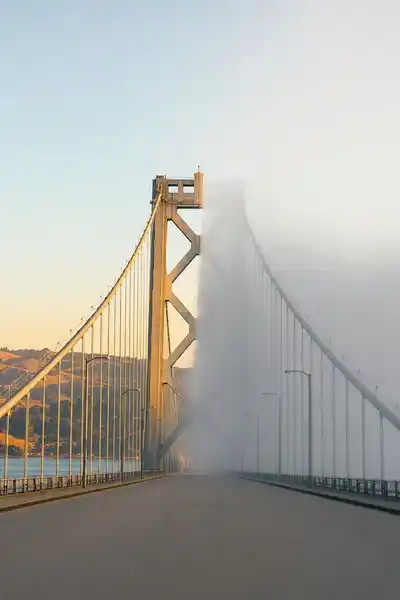
On a July afternoon, a visitor can stand in Berkeley in a t-shirt, sweating in the low eighties, drive across the Bay Bridge, and arrive in downtown San Francisco to find people in fleece jackets under a gray ceiling of fog, the temperature stuck in the high fifties. Fifteen minutes, a twenty-degree drop, a completely different sky. Mark Twain is supposed to have complained about the coldest winter he ever spent being a San Francisco summer — the line is almost certainly not his, but it survives because the underlying fact is real. The Bay Area does not have one weather. It has dozens, running at the same time, within sight of one another.
Harold Gilliam spent decades watching this. His book, first published in the sixties and later revised with the benefit of satellite data that transformed what meteorologists could actually see, argues that possibly no comparable patch of earth stages so many varieties of weather simultaneously. The reason is not luck. It is a specific arrangement of ocean, bay, rivers, and hills, acted on by a handful of large atmospheric forces that arrive from the Pacific and get sorted, funneled, and cooled by the land they meet.
What looks like chaos from a car window is, in Gilliam's telling, a legible system. The fog that swallows the Golden Gate on a summer evening obeys rules. The wind that whips through certain gaps and leaves others calm follows the terrain. Once we know the forces at work, the grand, confusing show around the Bay starts to read like a script — and we can begin to predict what the sky will do next.
The question we’re asking : Why does one small region stage so many kinds of weather at once, and what forces choreograph the show?What we’ll see : How ocean, bay, rivers and hills conspire with a few Pacific-scale forces to turn fifty miles of coast into a patchwork of separate skies.
Table of contents
01Chapter 1 — The city that keeps two thermometers
Start with the paradox that greets everyone. In most places, weather is roughly the same across a metropolitan area — a hot day in one suburb is a hot day in the next. The Bay Region refuses this. On a typical summer day, the coast at Ocean Beach might sit in the high fifties while inland valleys near Livermore or Antioch push past ninety. Both are the same afternoon, thirty or forty miles apart, and the difference is not a fluke. It repeats, day after day, all summer long.
The engine behind it is the Pacific Ocean, and specifically how cold it is. The water offshore of San Francisco runs surprisingly frigid even in July — often in the low fifties — because of upwelling, a process where prevailing northwest winds push surface water away from the coast and deep, cold water rises to replace it. Air sitting over that cold water stays cold. So the ocean acts as a giant natural air conditioner parked right beside the land, and any place close enough to feel the marine air stays cool while places shielded from it bake.

02Chapter 2 — The fog machine at the Golden Gate
No image belongs to San Francisco more than the fog pouring through the Golden Gate at dusk, spilling over the hills like something poured from a jug. It is beautiful, and it is also the most visible product of the whole system. Gilliam treats the summer fog not as weather that happens to arrive but as the direct consequence of the forces already in play — the cold ocean, the hot interior, and the one break in the coastal mountains where they meet.
The fog is made offshore. When warm, moist Pacific air drifts over that band of cold upwelled water, it cools until the moisture condenses into a low deck of cloud — advection fog, formed by air moving over a colder surface, not by air rising. This gray blanket sits out over the ocean, waiting. What pulls it ashore is the inland heat: as the Central Valley warms and its air rises, the resulting low pressure draws the marine layer landward, fog and all.
03Chapter 3 — A dozen climates inside fifty miles
Once the big forces are clear, the local variety starts to make sense. The Bay Region is not flat. It is a jumble of ridges, valleys, bays, and river gaps, and every fold of that terrain edits the marine air differently. A hill can block the fog entirely, keeping the town in its lee warm and sunny while the town on the seaward side stays cool and damp. A valley opening toward the water becomes a channel that funnels the cool air deep inland; a valley closed off from the sea traps heat.
Gilliam maps how the marine influence weakens with distance and obstruction. The city's Sunset and Richmond districts, facing the ocean, are among the foggiest and coolest spots. Cross the hills to the Mission District, sheltered in a warm pocket, and it can be sunny and mild while the avenues shiver. Push east past the ridgelines into the interior valleys and the ocean's reach fades almost entirely, leaving hot, dry summer days that feel like a different state.
04Chapter 4 — Reading the sky like a local
Step back from the individual gusts and fog banks, and what Gilliam has really assembled is a lesson in reading a landscape. The Bay Region's weather looks capricious only to someone who expects a single climate. To someone who knows the forces — the cold ocean, the hot interior, the pressure difference that pulls one toward the other, the mountain gaps that channel the flow — the region becomes almost transparent. A summer fog rolling through the Gate at six in the evening is not a surprise; it is the predictable exhale of a system that has been building heat inland all afternoon.
This is the deeper value of the book. It hands over the tools rather than just the observations. Learning that upwelling chills the sea, that inland heat drives the sea breeze, that the marine layer breathes in and out with the day, changes what a person sees when they look at the sky. The gray ceiling stops being gloom and becomes information. The direction and strength of the wind become a reading of where the pressure gradient is steepest that day.
05Conclusion
Return to that visitor crossing the Bay Bridge, warm in Berkeley and cold in the city fifteen minutes later. Nothing about the drive was strange; it was the ocean and the valley disagreeing, with a bridge laid across the argument. The twenty-degree drop was the cold Pacific reaching in through the one great gap in the hills, exactly where and when the day's inland heat had called it. Once the forces are named, the confusion resolves into a pattern that runs on schedule for most of the year.
Related books