

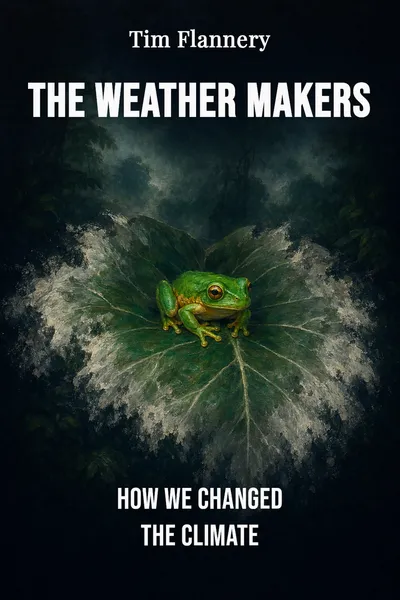
The Weather Makers
How we changed the climate
Description
In 2005, an Australian mammalogist named Tim Flannery published a book with an unusually confident title. He was not a climate scientist by training — he had spent his career naming new species, digging up fossils, and writing about the deep history of continents. But he had noticed something while doing that work: the living world he studied was already moving. Frogs were vanishing from Costa Rican cloud forests. Birds were nesting earlier. Sea ice was thinning. Flannery set out to gather the scattered evidence into one place and tell it the way a naturalist tells a story — from the ground up, species by species, rather than from the modeling paper down.
The result, The Weather Makers, became an international bestseller and one of the most widely read popular accounts of global warming ever written. It was praised by scientists, quoted by policymakers, and, strikingly, endorsed by some energy-industry executives who found its argument hard to dismiss. What made it land was not alarm for its own sake. It was the accumulation — the sense that dozens of unrelated observations, from Antarctic ice cores to Australian droughts, were all pointing in the same direction, and that the direction had a cause with a name.
The cause, in Flannery's telling, is us. Not humanity in the abstract, but the specific machinery of how we make energy and what comes out the other end. The book's argument is that the climate is not a fixed backdrop to human life but a system we have started to run, mostly without meaning to. And a system that can be run can, at least in principle, be run differently.
The question we’re asking : How did human beings become the ones setting the planet's thermostat — and how do we know?What we’ll see : How a naturalist assembled the evidence, traced it to its source in the way we make energy, and argued that the climate is now something we operate rather than merely inhabit.
Table of contents
01Chapter 1 — The thin blue envelope
Flannery starts not with carbon dioxide but with the atmosphere itself, because most of us carry a wildly wrong sense of its size. Seen from an airliner, the sky looks limitless. It is not. The layer of gas that holds all our weather and all the air we breathe is astonishingly thin — proportionally thinner, relative to the Earth, than the skin on an apple. Drive upward at highway speed and you would leave most of it behind in under an hour. This is the first move of the book, and it does a lot of quiet work: it shrinks the atmosphere down to something small enough to be affected by what a species does over a couple of centuries.
Into that thin envelope, Flannery explains, a handful of trace gases do an outsized job. Carbon dioxide makes up a tiny fraction of the air, yet it and other greenhouse gases are what keep the planet livable. Without them, Earth would freeze. The greenhouse effect, in his telling, is not a villain — it is the reason we exist at all. The problem is one of dosage. A blanket that keeps you warm is good; a blanket that keeps thickening while you sleep is a different matter.

02Chapter 2 — When the graph became a hockey stick
The single most quoted image in the climate debate of that era was a temperature reconstruction that came to be known as the hockey stick. It showed global temperatures wandering gently for a thousand years — the shaft of the stick — and then bending sharply upward in the twentieth century, the blade. Flannery uses it, but he is careful to explain that no lone graph is the argument. The reconstruction, assembled by researchers including the climatologist Michael Mann, was one line of evidence among many, and it was fiercely attacked precisely because it was so memorable.
What Flannery does better than the graph is show the same shape appearing everywhere he looks. Glaciers retreating on nearly every continent. Spring arriving earlier for migrating birds and flowering plants. The frozen ground of the far north beginning to thaw. Coral reefs bleaching white as warmer water drives out the algae that feed them. None of these observations depends on the others. A birdwatcher in England and a glaciologist in the Andes were not comparing notes. Yet their records bend the same way at the same time.
03Chapter 3 — The engine of the machine
Having established that the climate is changing and that it is changing unusually fast, Flannery turns to the harder question: what is doing it. His answer is unromantic and specific. It is the way industrial societies make energy — the burning of coal, oil, and gas, the fossilized remains of ancient life, dug up and combusted at a rate the planet took millions of years to bury. Every lump of coal and litre of petrol releases carbon that had been safely locked underground, sending it straight into that thin blue envelope.
The proof that this particular carbon is the culprit is, he explains, chemical rather than circumstantial. Carbon from fossil fuels carries a distinct isotopic signature, and the extra carbon dioxide accumulating in the atmosphere carries that same fingerprint. It is not carbon breathed out by forests or belched by volcanoes; it is old carbon, from underground. The atmosphere is, in effect, keeping a receipt of where the surplus came from. This is the moment the book pivots from diagnosis to responsibility — the warming is not just happening, it is being caused, and the causing has a source.
04Chapter 4 — Reading the climate we already changed
The deeper shift Flannery is after is not scientific but conceptual. For most of human history, weather and climate were the definition of what lay outside human control — the given, the fate, the thing you prayed about but could not touch. The Weather Makers argues that this ancient assumption has quietly stopped being true. Through the aggregate of billions of small decisions about energy, we have become, without ever intending to, participants in the system that sets the planet's temperature. The title is not a metaphor. It is a job description we did not apply for.
This reframing changes what climate change is. It stops being an environmental issue in the narrow sense — something that concerns polar bears and distant ice — and becomes a question about how a civilization runs itself. Flannery's insistence on isotopic fingerprints and cumulative evidence exists to close the escape route of treating warming as somebody else's weather. If the climate is now something we operate, then leaving it alone is also a choice, and a consequential one. There is no neutral setting on a thermostat that someone has a hand on.
05Conclusion
Flannery began his career naming animals and reading the deep past out of fossils and rock. The Weather Makers turns that same eye forward, treating the present as a layer of the record still being laid down. The book's achievement was to gather the scattered evidence — the thin atmosphere, the frozen air bubbles, the vanished toad, the isotopic receipt — into a single accessible account, and to give a general reader the sense that the case rests on things that can be drilled, counted, and touched rather than only modeled.