
The Serengeti Rules
Nature's invisible balance
Description
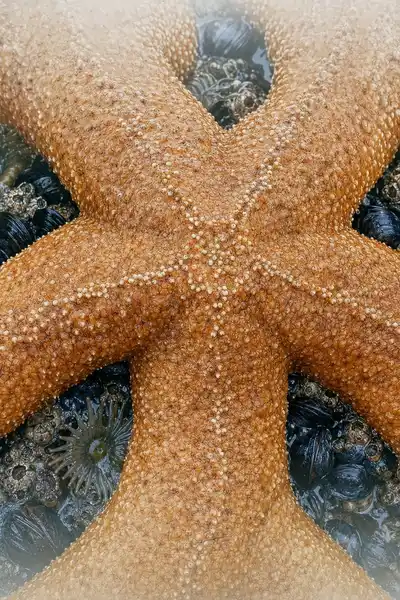
In 1960, a young ecologist named Robert Paine climbed down to a stretch of rocky tide pool on the Washington coast, near a place called Mukkaw Bay, and began prying starfish off the rocks with a crowbar and hurling them into the sea. He kept it up for years. It looked less like science than vandalism. But Paine wanted to know something nobody had a clean way to test: what happens to a natural community when you remove one of its members? The answer, when it came, was startling. Strip out a single predator and the whole shore unravels — mussels overrun everything, and a system that had held fifteen species collapses to a handful.
Sean B. Carroll, a molecular biologist who spent his career studying how genes switch on and off inside cells, noticed something odd about Paine's starfish. The logic sounded familiar. Inside every one of our bodies, invisible controls decide exactly how much of everything to make — how much sugar in the blood, how much cholesterol, how many cells in an organ. Too much or too little, and we get sick. A savanna faces the same arithmetic problem on a vast scale: how does it produce the right number of zebras, and the right number of lions to eat them, without either running away?
Carroll's wager in The Serengeti Rules is that these are not two questions but one. The mechanism that keeps a cell in balance and the mechanism that keeps an ecosystem in balance obey the same kind of logic — regulation, feedback, a few key players holding the rest in check. It is a claim that reaches from a molecule to a continent, and it changes how we read both a diseased body and a dying river.
The question we’re asking : How does life — a cell, a body, an entire savanna — figure out how much of everything to make?What we’ll see : How a handful of stubborn scientists, working on molecules and starfish and wolves, found the same hidden rulebook running through all of it.
Table of contents
01Chapter 1 — The molecule that told the story first
The story Carroll tells does not start on the Serengeti. It starts in a Paris laboratory in the 1950s, where two biologists, Jacques Monod and François Jacob, were trying to understand a mystery about bacteria. Feed the microbe E. coli one kind of sugar and it produces the enzyme to digest it. Take the sugar away and the enzyme production stops, almost instantly. The bacterium was somehow measuring its own environment and adjusting what it made. It was regulating.
What Monod and Jacob worked out, in research that won them a Nobel Prize in 1965, was that genes are not simply switched on by default. Most of the time they are held off by a molecular brake — a repressor — and only released to work when the right signal arrives. The cell, in other words, governs itself by negative regulation: the normal state is 'stop,' and life happens when the stop is lifted. Nothing runs flat out. Everything is held in check until it is needed.

02Chapter 2 — Keystones and the top of the chain
Back on the Washington coast, Robert Paine had stumbled onto the ecological version of the same idea, though it took him longer to say so. His crowbarred starfish, Pisaster, turned out to be doing something for the tide pool that the repressor did for the bacterial cell — holding a runaway process in check. The starfish ate mussels. As long as it did, no single species could dominate, and a rich patchwork of anemones, barnacles, limpets and algae shared the rock. Remove the starfish and the mussels, unchecked, simply paved over everyone else.
Paine gave this kind of animal a name that stuck: a keystone species, after the wedge-shaped stone at the top of an arch that holds the whole structure up. Pull it out and the arch falls, even though the keystone is only one piece among many. What mattered was not the starfish's abundance — it was never numerous — but its role. Some species, Paine realized, count for far more than their numbers suggest. They regulate.
03Chapter 3 — Turning the logic upside down
If predators regulate their prey from the top down, a fair question is how far the effect really reaches, and how you would ever prove it on the scale of a whole landscape. This is where the Serengeti itself enters the book, through the work of Anthony Sinclair, who spent decades tracking the great plain's herds. The natural experiment had already been run, tragically, by a virus. In the late nineteenth century, rinderpest, a cattle plague, swept into East Africa and devastated wildebeest and buffalo, keeping their numbers pinned low for generations.
When rinderpest was finally eliminated in the region around 1960, the wildebeest rebounded — from perhaps a few hundred thousand to well over a million. Sinclair watched the consequences cascade. More wildebeest meant more grazing, which meant less dry grass to fuel the fires that had regularly burned the plain. Fewer fires let trees survive to maturity, which brought back giraffes and other browsers, and shifted the fortunes of lions, hyenas and countless smaller creatures. A single regulated quantity — the size of one herd — reorganized the entire ecosystem.
04Chapter 4 — The rules were the same all along
Set the two halves of Carroll's book side by side and the resemblance stops being a metaphor. A cell keeps its cholesterol in range through a feedback loop that senses the level and throttles production; a plain keeps its wildebeest in range through predators and grass and fire doing much the same work. Both are regulated systems with control points, feedback and set points. Both spend their whole existence correcting toward a target most of us never notice. Life, at every scale Carroll examines, is not a pile of parts but a web of rules governing how much.
The unsettling corollary is that the diseases of a body and the ruin of an ecosystem begin to look like the same kind of failure. Cancer is regulation gone wrong — cells that have lost their brake and multiply without limit, exactly what mussels do to a tide pool when the starfish vanishes. An algae-choked lake, a deer-stripped forest, an ocean emptied of its big fish: each is an ecosystem that has lost a keystone and slipped its set point, a body politic of species with the controls torn out.
05Conclusion
Robert Paine never stopped tossing starfish into the sea, and by the time he died in 2016 the strange habit had become one of the founding experiments of modern ecology. What he saw in a tide pool, Monod and Jacob had seen in a bacterium and Sinclair in a million wildebeest: that living systems do not simply happen to hold together. They are held, actively and continuously, by rules that decide how much of everything there should be. Pull the right thread and the whole fabric moves.