

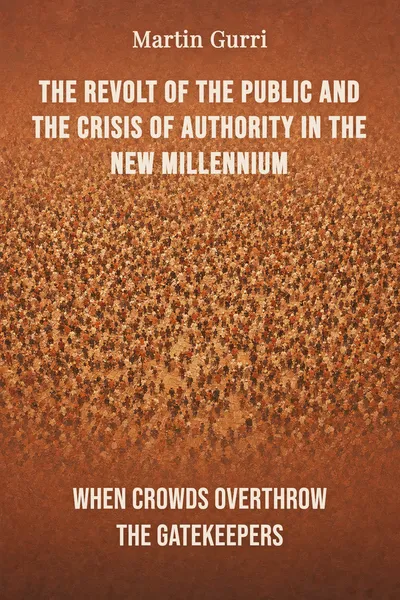
The Revolt of The Public and the Crisis of Authority in the New Millennium
When crowds overthrow the gatekeepers
Description
Martin Gurri spent years reading the world's information as a CIA analyst, watching foreign presses and broadcasts for the signals that governments wanted to control. Somewhere in the 2000s, he noticed the signal had changed. The volume of information circulating on the planet was no longer growing steadily; it was exploding, doubling and redoubling in ways no institution had planned for or could absorb. He started calling the moment a tsunami, and the book that came out of it, The Revolt of the Public, published in 2014, argued that this flood had quietly rearranged the balance of power between ordinary people and the people who used to speak for them.
For most of the twentieth century, a handful of institutions decided what counted as true. Governments, political parties, newspapers, television networks, universities: each sat at the top of a pyramid, holding a near-monopoly on facts and framing. The public received what these gatekeepers handed down. Then the pyramid started leaking. Blogs, forums, camera phones, and social platforms handed the crowd the one thing the elites had always kept for themselves, which was the ability to publish, contradict, and organize without asking permission.
What follows, in Gurri's telling, is less a series of unrelated upheavals than a single long tremor running under the decade: Tahrir Square, the Spanish indignados, Occupy, Brexit, the improbable arrival of Donald Trump. He wrote much of it before the events that seemed to prove him right, which is part of why the book keeps getting rediscovered. The revolt he describes has no leader and, stranger still, no program.
The question we’re asking : What happens to a society when the crowd can suddenly out-inform the institutions that used to speak for it?What we’ll see : How a flood of information turned the public against its gatekeepers, and why the revolt it produced can bring things down but not yet build them back.
Table of contents
01Chapter 1 — The fifth wave, and the flood it let loose
Gurri borrows a frame from the media scholar Elihu Katz, who counted the great expansions of human information as waves: writing, the alphabet, the printing press, mass media. Gurri adds a fifth, the one we are living in, and argues it dwarfs the others in raw scale. His figure of choice, drawn from a University of California study, is that more information was generated in the years around 2001 to 2002 than in all of prior human history combined, and the curve only steepened afterward. Whatever the exact numbers, the direction is what matters: an almost unimaginable surge in what could be known and said.
The crucial point is not the quantity itself but who now controls it. Under the older waves, each new medium was captured by an institution. The printing press became publishing houses; broadcasting became networks; the newspaper became a business with editors and owners. Authority flowed downward from a small number of sources, and the public's role was to receive. The fifth wave broke that pattern because the tools of publication landed in everyone's hands at once, at almost no cost.

02Chapter 2 — Cairo, Madrid, and the crowds without a plan
The clearest evidence arrived between 2011 and 2012, when the same shape of event kept recurring in places with almost nothing in common. In Cairo, crowds coordinated through Facebook pages and mobile networks filled Tahrir Square and, within eighteen days, forced Hosni Mubarak from power after three decades in office. In Madrid, the indignados occupied the Puerta del Sol in May 2011, tens of thousands of mostly young Spaniards protesting austerity and a political class they no longer recognized as theirs. In New York that autumn, Occupy Wall Street set up in Zuccotti Park under the slogan of the ninety-nine percent.
Gurri reads these as versions of one phenomenon. Each began outside the formal structures of opposition, without a party, a union, or a recognized leader. Each was organized horizontally, through networks rather than commands, which made it astonishingly fast to assemble and nearly impossible to negotiate with. When authorities looked for someone to bargain with, there was no one holding the authority to speak for the crowd. The movements were coalitions of refusal, powerful precisely because they demanded nothing specific.
03Chapter 3 — Elites who never lost the habit of certainty
The other half of Gurri's story is the elites, and here his sympathy runs thin. The men and women of the Center were trained in a vanished world, one in which their pronouncements traveled outward unopposed. They had internalized a posture of authority that assumed the public could not check their claims. The flood stripped that assumption away, and yet the posture remained. Officials kept speaking as if their word were the last one, in an environment where every word could now be fact-checked, ridiculed, and swarmed by millions within the hour.
Gurri argues that the elites' deepest problem is a habit of overpromising. Modern government, in his account, sold the public a vision of near-total competence: it would tame the business cycle, manage the economy, deliver security and steadily rising prosperity. These promises were made in the confident register of the industrial age, and for a while the monopoly on information hid the gap between promise and delivery. The fifth wave exposed that gap mercilessly. Every failure, every crisis mishandled, every expert forecast that missed became visible and permanent, endlessly available for replay.
04Chapter 4 — When negation becomes a politics
The updated edition, written after 2016, treats Brexit and Trump not as anomalies but as the revolt migrating from the street into the ballot box. Both, in Gurri's reading, were victories of the Border over the Center delivered through the machinery of the Center itself. The British referendum and the American election were, at bottom, votes against the credentialed class, its forecasts, and its confident assurances that no sensible person would choose otherwise. That the sensible people were so visibly wrong only confirmed the public's suspicion that the experts were less expert than advertised.
But Gurri refuses to celebrate. He steps back to a bleaker structural claim: the collapse of authority is not a phase that will pass once the right leaders arrive. It is a standing condition of a world where information is abundant and the public can no longer be managed from above. The same forces that delegitimize a failing elite also corrode any new authority the moment it tries to consolidate. A politics built on negation can win elections and topple governments, yet it inherits the same impossibility the squares ran into. It knows what it is against far more clearly than what it is for.
05Conclusion
Gurri began as an analyst watching the world's information from the inside, and the book's power comes from that vantage: he saw the flood before most people felt it rise. The revolt he traced from Tahrir to Zuccotti to the referendum and the election is not a story of heroes or villains so much as a story of an old balance breaking. The gatekeepers lost their monopoly on truth, the public discovered it could push back, and the collision left both sides diminished, one exposed as less competent than it claimed, the other capable of tearing down but not of building.