
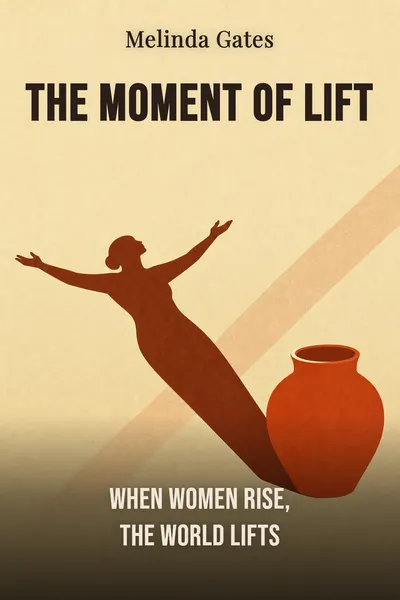
The Moment of Lift
When women rise, the world lifts
Description
For most of two decades, Melinda Gates traveled the world as one half of the largest private philanthropic operation on the planet, and she did it largely in the background. She sat in villages in Malawi and Bihar and Niger, took notes, asked questions, and left the podiums to her husband. The Bill & Melinda Gates Foundation, launched in 2000, moved billions of dollars against malaria, polio, and childhood death. Its co-founder, by her own account, spent years deciding it wasn't her place to speak about what she was seeing.
In 2019 she published The Moment of Lift, her first book, and the framing was a reversal. The woman who had stayed in the data now argued that the data itself had been pointing at one thing all along. Wherever she went, the poorest of the poor were women, and the fastest way to lift a family, a village, a country turned out to be lifting the woman inside it. The evidence had been there in the foundation's own numbers. What had been missing was the willingness to say it out loud, and to act on where it led.
The book is part memoir, part field report, part argument with her own institution and her own faith. It moves between a mother in a mud-walled home and a boardroom in Seattle without treating either as more real than the other. And it keeps circling one uncomfortable question that a foundation built on measurable outcomes could not easily dodge.
The question we’re asking : What does it actually take to lift a woman — and why does lifting her lift everyone around her?What we’ll see : How a philanthropist's field notes turned into an argument about the single most overlooked lever in global development.
Table of contents
01Chapter 1 — The woman who almost stayed in the data
Melinda French grew up in Dallas, the daughter of an aerospace engineer, went to a Catholic girls' school, studied computer science and economics at Duke, and joined Microsoft in 1987. She rose to general manager, married the company's founder in 1994, and left to raise their children. When the foundation began in earnest, she and Bill split the labor in a way that felt natural and, she later admitted, quietly lopsided. He was the public face. She was the one on the ground, kneeling in doorways, holding the babies.
Those visits are where the book earns its authority. She describes sitting with women who had walked for hours to reach a clinic, who had buried children they could name, who fed everyone else in the house before themselves. She keeps returning to a particular kind of encounter: a woman who takes her hand and asks for something the foundation wasn't offering. Not a vaccine. Not a bed net. Something for herself — a way to space her births, a way to stay in school, a way to keep the money she earned.

02Chapter 2 — Contraceptives, and the argument that split a foundation
The clearest test of that realization was contraception, and it put Gates in direct collision with her own church. Raised Catholic, still practicing, she found herself convinced that access to birth control was the highest-leverage investment in global health she had ever seen — and that saying so publicly would draw fire she had spent years avoiding. She decided the women asking her mattered more than her own comfort.
The case, as she lays it out, is not primarily about population. It is about a woman's ability to decide whether and when to have a child, which turns out to reshape almost everything downstream. When mothers can space their pregnancies, the children who are already born survive at higher rates and are better nourished. Girls stay in school longer. Family incomes rise. Gates cites the striking pattern that in the poorest countries, hundreds of millions of women want to avoid pregnancy but have no reliable means to do it — a gap between desire and access, not a question of persuasion.
03Chapter 3 — The unpaid work nobody measured
If contraception is the book's sharpest single argument, unpaid labor is its quietest and, in some ways, most far-reaching. Gates turns to the hours women spend on work that no economy counts: hauling water, gathering fuel, cooking, cleaning, caring for children and the sick and the old. Globally, women do the large majority of it — several hours more per day than men, in country after country — and none of it shows up in a wage, a pension, or a measure of national output.
She draws on the economist Diane Coyle and on the broader tradition of feminist economics to make a point that sounds abstract until she grounds it: what a society chooses to measure is what it chooses to value, and unpaid care has been rendered invisible by leaving it off the ledger. A woman doing eight hours of unpaid work has no time to earn, to learn, or to organize. The time poverty compounds every other poverty.
04Chapter 4 — What lift actually means
Step back from the specific campaigns and the book resolves into a single claim, stated plainly enough that it risks sounding obvious: the treatment of women is the most reliable lever a society has on its own health. Gates arrives at it not as a slogan but as a pattern she watched repeat across every problem the foundation touched. Child mortality, education, agriculture, sanitation — trace any of them back far enough and a woman's lack of power sits near the root. Move that, and the others move with it.
The title carries the thesis. A moment of lift, in her borrowing from physics, is the instant when the forces pushing something up finally overcome the forces holding it down. She uses it for a rocket and for a person. The point is that a woman held down by custom, by law, by unpaid hours, or by lack of choice is not lacking capacity — she is lacking lift. Supply it, and she rises on her own power, carrying her children and her community with her.
05Conclusion
The book closes roughly where it opened, with a woman in a doorway asking for something the visitor hadn't come to give. But the visitor has changed. The Melinda Gates who spent two decades letting others speak now argues, in her own name, that everything she measured for twenty years kept pointing at the woman she was too cautious to center. The field notes had been an argument all along; she had simply not been ready to make it.