
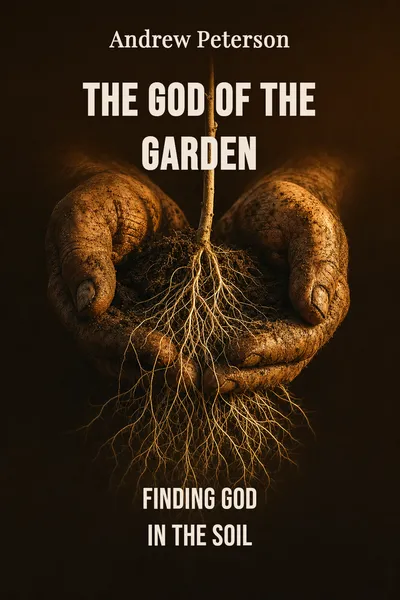
The God of the Garden
Finding God in the soil
Description
Andrew Peterson is a songwriter and novelist, the kind of person who has spent a career putting words to things that resist words. But in 2021 he wrote a book that starts somewhere unexpected for a man known for stages and stories: on his knees, in the dirt, on a stretch of Tennessee land he and his family call the Warren. The God of the Garden opens not with an argument but with trees — the ones he grew up under, the ones that were cut down, the ones he planted himself and watched fail and try again. It is a book about soil written by someone who came to gardening late, and who found, once his hands were in the ground, that the ground had something to say back.
The premise sounds gentle enough to miss. Peterson is not offering a how-to for the backyard, nor a set of nature-themed devotions to read with morning coffee. He is making a slower and stranger claim: that the act of tending a place — knowing a particular patch of earth, staying with it, watching it change across seasons and years — is one of the ways a person comes to know God at all. Not as an idea about God, but as an encounter with the Maker in the made thing. The garden, for Peterson, is not a symbol borrowed to decorate a spiritual point. It is the point.
That is a difficult thing to pull off without slipping into sentiment, and the book knows it. So it grounds itself constantly — in memory, in loss, in the mundane failures of a man who kills more plants than he saves. What emerges is a meditation on rootedness written for people who feel, in Peterson's phrase, unrooted: those who move too often, who scroll past the world instead of standing in it, who have forgotten what it means to belong to a place.
The question we’re asking : What does it mean to find God not in abstraction but in the slow, particular work of tending a place?What we’ll see : How memory, loss, and the humble labor of the garden become, for Peterson, a way of touching the goodness of creation.
Table of contents
01Chapter 1 — The trees that raised a boy
Peterson begins with trees because trees begin with him. He grew up in Florida and the American South, the son of a preacher, moving between towns the way many pastors' families do, and the constants of his childhood were not addresses but the particular trees he climbed, hid in, and returned to. He writes about them the way other people write about first loves — the live oaks, the pines, a specific tree in a specific yard that meant something because he had spent hours in its branches. Trees, in his telling, are the memory-keepers of a place. They outlast the people who plant them and stand there holding the years.
This is why the book carries a thread of grief. Peterson returns as an adult to some of the landscapes of his boyhood and finds the trees gone — cleared for development, cut for convenience, simply vanished. The loss is disproportionate to what a stranger would feel, and he knows it, but he also insists the disproportion is the point. To lose a tree you knew is to lose a witness to your own life. When the physical world is erased, the memories anchored to it lose their footing, and a person becomes, quite literally, less rooted.

02Chapter 2 — What roots know that we forget
From trees the book descends to what holds them up, and here Peterson turns to the language of rootedness in earnest. He is honest about being an unlikely gardener. He came to it as an adult, clumsily, full of enthusiasm and short on competence, and much of the book's warmth comes from watching him fail — the plants that die, the projects that overreach, the humbling gap between what he imagined and what the soil would actually grant him. Gardening, he learns, cannot be hurried or willed. It runs on the plant's schedule, not the gardener's, and that alone is a kind of instruction for a restless man.
The deeper lesson is about attention. To garden well you have to know one place intimately — its light, its water, its particular soil, what will grow here and what stubbornly will not. Peterson contrasts this with the frictionless, placeless way many of us now live, moving through the world with our eyes on screens, treating landscapes as backdrops to scroll past. The garden demands the opposite. It requires you to slow down, stay put, and pay the kind of sustained attention that the modern world is designed to interrupt.
03Chapter 3 — Gardening as an act of faith
It is here that the book's theological heart shows itself, and Peterson approaches it the way a gardener approaches a seed — carefully, without forcing. The Christian story, he reminds us, opens in a garden and, in its way, ends in one; the scriptures are full of soil, seed, harvest, and vine. But Peterson resists making the garden into a tidy allegory where every plant stands for a doctrine. The garden is not a lesson dressed up as dirt. It is, he insists, a real place where a person can actually meet the God who made it.
The meeting happens through the work itself. When Peterson kneels to plant, weed, or water, he is doing on a tiny scale what the Maker did on a cosmic one — bringing order out of chaos, coaxing life from the ground, tending what has been given rather than manufacturing it from nothing. Gardening is participation, not imitation. The gardener does not create the seed's power to grow; he only makes room for it and waits. That posture — of cooperation with a life you did not author and cannot command — is, for Peterson, very close to the posture of faith itself.
04Chapter 4 — A theology you can hold in your hands
Step back from the individual meditations and a larger claim comes into focus, one that quietly resists the way faith is often practiced today. Much religion has become an affair of the mind and the screen — ideas debated, sermons streamed, spirituality consumed like everything else, at a distance and on demand. Peterson's whole book pushes against this by insisting that the soul is not merely a thinking thing but an embodied, located one. We were made from dust, placed in a garden, and given work to do with our hands. Faith, on this account, is not less than intellectual, but it is more than intellectual; it wants soil under the fingernails.
This is why Peterson keeps returning to particularity. Not gardens in general but this garden; not creation as a concept but this stubborn Tennessee clay. The temptation of modern spirituality is to float free of any particular place, to be a citizen of everywhere and therefore of nowhere. Peterson's answer is that God tends to meet people not in the abstract but in the specific — in a named tree, a known field, a plot of ground kept faithfully over years. The kingdom of God, he suggests, is less like a grand theory and more like a seed: small, hidden, planted in real dirt, growing slowly where you least expect it.
05Conclusion
The book ends where it began, among the trees — the ones Peterson lost and the ones he keeps planting on land he may not live to see mature. Nothing in the closing pages resolves into a neat conclusion, because gardens do not conclude; they keep going, season into season, long after the gardener has laid down his tools. Peterson leaves the reader not with an answer but with an invitation to kneel down, pay attention, and stay put long enough for a place to become home.