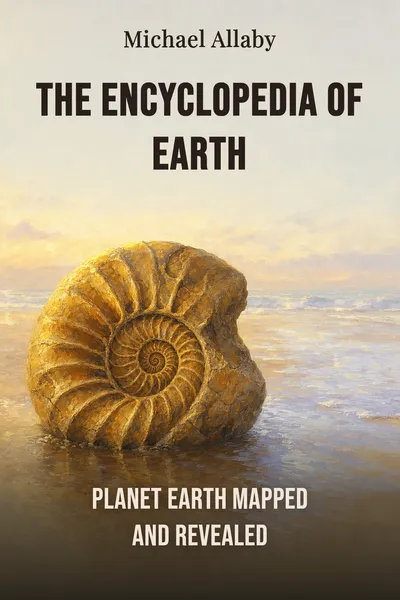
The Encyclopedia of Earth
Planet Earth mapped and revealed
Description
Somewhere in the outer arm of an ordinary galaxy, roughly four and a half billion years ago, a disc of gas and dust circling a young star began to clump. The clumps collided, grew, heated, and eventually one of them settled into a molten ball that would cool, crack, flood, and — against most odds — come alive. That ball is under our feet right now. Michael Allaby's The Encyclopedia of Earth takes exactly this improbable object as its subject, and its opening move is to refuse to treat it as background. The planet is the character. Everything else — oceans, weather, tectonic plates, forests, us — is what the character does.
Most of us carry a version of Earth in our heads, stitched together from school diagrams, weather apps and the occasional nature documentary. It is usually a set of separate facts: continents drift, volcanoes erupt, the climate is warming, coral is dying. What a reference book like this one attempts is harder than any single fact. It tries to put the whole system on one table at once — the deep interior and the thin skin of air, the four-billion-year story and this morning's forecast — and to make the connections between them visible rather than merely asserted. Thousands of photographs, maps and diagrams do work here that sentences alone cannot.
That ambition is also what makes the book worth slowing down for. An encyclopedia of a whole planet is a strange promise: it claims that everything from the Big Bang to a coastal wetland can be held between two covers and made to hang together. Whether that promise can be kept, and what we gain by trying, turns out to be as interesting as the geology.
The question we’re asking : How does a single illustrated volume try to hold an entire planet — its origin, its machinery and its present crisis — inside one coherent picture?What we’ll see : How the book assembles Earth from a cloud of gas into a working, self-recording, endangered system — and what its very form says about how we come to understand the ground beneath us.
Table of contents
01Chapter 1 — From a cloud of gas to a living rock
The encyclopedia opens where the planet does — earlier, in fact, than most people expect. Before there was an Earth there was a universe, and Allaby's team starts with the cosmic backstory: the formation of stars, the forging of heavier elements in their cores, and the death of earlier suns that scattered the carbon, iron and oxygen from which our world is built. The point is not to show off the scale. It is to establish a lineage. The rock underfoot is recycled stardust, and the book wants that continuity felt before it narrows to a single planet.
From there the story tightens. Around four and a half billion years ago the young Earth accreted from the disc around the Sun, heated by collisions and the decay of radioactive elements until it was largely molten. Heavy material sank to form a metallic core; lighter material floated up to form the crust; in between settled the mantle, the vast layer that still drives almost everything at the surface. A collision with a Mars-sized body, in the leading account, threw off the debris that became the Moon. Slowly the surface cooled, water arrived, and oceans formed on a planet that was still being bombarded from space.

02Chapter 2 — The machinery that never stops
Having built the planet, the book turns to how it runs, and here its instinct for connection pays off. Plate tectonics is the organising idea. The crust is carried on a dozen or so rigid plates that drift a few centimetres a year, driven by heat rising from the mantle. Where plates pull apart, new ocean floor is born; where they collide, mountains rise and one plate dives beneath another; where they grind past each other, the ground periodically lurches. Earthquakes, volcanoes, ocean trenches and the slow reshuffling of the continents are, in this telling, not separate hazards but symptoms of the same underlying circulation.
The atmosphere and oceans get the same treatment. The book presents weather and climate as an engine powered by the Sun and steered by the planet's rotation. Heat arrives unevenly — the tropics receive far more than the poles — and the whole system of winds and currents exists to move that surplus around. Warm water pushed poleward, cold water sinking and returning along the deep sea floor, great atmospheric cells lifting air at the equator and dropping it in the desert latitudes: these are drawn as loops, because loops are what they are. The reader is meant to see circulation everywhere, from the mantle to the jet stream.
03Chapter 3 — A planet that keeps a diary
If the planet is a machine, it is also an archive, and this is where the encyclopedia becomes quietly thrilling. Earth keeps a record of its own past, and much of the book is devoted to reading it. Rock strata stack up like pages, each layer a slice of time. Fossils preserved inside them mark which creatures lived when. Ice cores drilled from Antarctica and Greenland trap tiny bubbles of ancient air, letting scientists measure the atmosphere of hundreds of thousands of years ago. The planet, in other words, has been taking notes the entire time, and the encyclopedia is partly a manual for how to read them.
That archive tells a dramatic story. Life has not risen smoothly toward the present; it has been repeatedly knocked back. The book walks through the great extinctions — the end-Permian event roughly 250 million years ago that erased most species on Earth, the impact and upheaval around 66 million years ago that ended the dinosaurs — as chapters in the same volume, moments when the machinery lurched and the cast of living things was largely rewritten. Each recovery reshuffled which forms would dominate next, and one of those reshuffles eventually made room for mammals, and then for us.
04Chapter 4 — The book as a way of seeing
Step back from the contents and the encyclopedia itself becomes the interesting object. Here is a single volume that presumes to hold a whole planet — its birth, its inner machinery, its four-billion-year memory and its present emergency — and to make all of it fit together on facing pages. That is an audacious thing to attempt, and the way Allaby's team attempts it says something about how we actually come to understand the ground beneath us. We do not grasp Earth by living on it. We grasp it by building representations of it: maps, cross-sections, cutaway globes, timelines, diagrams of currents no eye could ever see whole.
This is why the visual format matters more than it first appears. A photograph of a glacier, a map of the ocean's deep currents, a cutaway of the mantle — each is a way of making something too large, too slow or too hidden into something a reader can take in at a glance. The encyclopedia's thousands of images are not decoration around the text; they are the argument. They let the reader do what no single human vantage point allows: see the entire system at once, and see the connections between its parts as spatial facts rather than abstract claims.
05Conclusion
The book ends more or less where it must: with the present, and with us. Having traced the planet from a clump of stardust through molten beginnings, moving continents, repeated extinctions and swinging climates, Allaby's encyclopedia arrives at a world being reshaped faster by one species than by most of the forces that preceded it. The conservation chapters do not moralise; they simply close a loop the whole book has been drawing. If everything on this planet is connected — rock to water to air to life — then altering one part reverberates through the rest, and the diary in the ice makes plain how quickly the tone can shift.
Related books