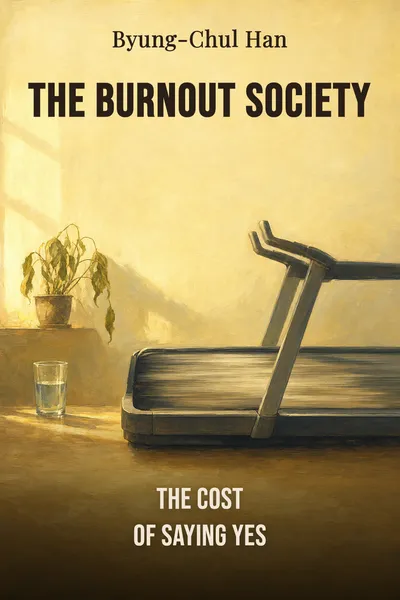
The Burnout Society
The cost of saying yes
Description
There is a particular kind of tiredness that sleep doesn't fix. You clear the inbox, close the laptop, and the fatigue stays — not in the muscles but somewhere behind the eyes, a low hum of never quite being done. Nobody forced the extra hour. No boss stood over the desk. The pressure came from inside, from a voice that said you could do more, be more, optimize a little further. This is the feeling Byung-Chul Han set out to name in a slim, sharp book published in German in 2010 as Müdigkeitsgesellschaft — The Burnout Society — that made the Berlin-based philosopher one of the most translated thinkers of his generation.
Han's claim is deceptively simple. The twentieth century, he argues, was a world of prohibition — of walls, rules, and things you were not allowed to do. The twenty-first is a world of permission, where the loudest command is that everything is possible. That sounds like liberation. Han reads it as a trap. When there is nothing left to forbid, the only limit becomes the self, and the self turns out to be a relentless taskmaster. We stopped answering to overseers and started supervising ourselves, harder than any overseer ever would.
What follows from that shift is not just a mood but a whole pathology of the age — the depression, the attention deficits, the sense of being frayed that so many people describe without quite knowing why. Han insists these are not private failures. They are the symptoms of a society that mistook exhaustion for freedom, and he traces the cost of a culture built entirely on the word yes.
The question we’re asking : Why does a world that lets us do anything leave us more depleted than one that forbade so much?What we’ll see : How a philosopher reads modern exhaustion as a symptom, and what a culture of relentless positivity quietly costs us.
Table of contents
01Chapter 1 — From viral to neural
Han opens with a distinction that sounds almost medical. Every age, he suggests, has its signature illness, and the illness tells you how the society is organized. The last century was bacterial and then viral — an era obsessed with intruders, with the foreign body crossing a border and infecting the whole. Its logic was immunological: there was a self and an other, an inside and an outside, and the work of health was keeping the other out. Cold War politics, hygiene, the very grammar of defense all ran on the same wiring.
The twenty-first century, Han argues, has quietly changed illnesses. The dominant afflictions are no longer infections but what he calls neuronal disorders — depression, attention deficit hyperactivity disorder, burnout, borderline personality disorder. These are not caused by an invading enemy. There is no virus to expel, no other to blame. They come from within, from an excess of the same rather than a threat from the different. The immune model, built to fight what is foreign, simply cannot describe them.

02Chapter 2 — The self as its own overseer
The heart of Han's argument is a shift in who holds the whip. He borrows from the sociologist and philosopher Michel Foucault, who described modern society as disciplinary — a world of hospitals, prisons, barracks and factories, organized around what you were forbidden to do. The disciplinary subject was a subject of obedience, shaped by the word no. Han's thesis is that this era has passed. We now live in what he calls the achievement society, and its subject is not obedient but driven — a subject of the word yes.
The achievement-subject is free in a specific and cruel sense. No one commands it. It commands itself. It is, in Han's memorable formulation, both master and slave at once, exploiting itself voluntarily and calling that exploitation freedom. The factory owner has been replaced by an internal project manager who never clocks off. There is no boundary between the exploiter and the exploited because they are the same person, which is exactly why the pressure feels boundless. You cannot go on strike against yourself.
03Chapter 3 — The tyranny of the positive
If the self is exhausting itself, Han asks what capacity it has lost along the way. His answer turns on a distinction between two kinds of attention. There is the scattered, hyperactive attention of multitasking — the mind flicking between screens, tabs, notifications, tasks, keeping many things half in view at once. And there is the deep, contemplative attention of dwelling on a single thing for a long time. The achievement society treats multitasking as an advance, a mark of the agile modern worker. Han treats it as a regression, closer to the vigilance of a wild animal that must watch everything at once to survive, never able to sink into anything.
Deep attention, he argues, is where genuine thought and culture come from, and it depends on something the positive society has learned to despise: boredom. Han cites the critic Walter Benjamin, who called boredom the dream bird that hatches the egg of experience. Profound boredom, the empty stretch where nothing happens, is the soil of contemplation and creativity. A culture allergic to pause, that fills every gap with stimulation and every idle moment with a feed, kills the dream bird before it can hatch. We are so busy staying connected that we have forgotten how to be interrupted from within.
04Chapter 4 — Learning to say no again
Step back from the diagnosis and Han's book is really an argument about what a whole society forgets when it organizes everything around yes. His title in German, Müdigkeitsgesellschaft, is often flattened to burnout, but the word is tiredness — and Han draws a careful line between two kinds. There is the exhausted, isolating fatigue of the achievement-subject who has depleted itself alone, the tiredness that separates people and kills speech. And there is another tiredness he wants to rescue: a calm, shared, restful fatigue, the kind that follows real effort and opens onto trust, presence, and community rather than closing them down. One tiredness ends the world; the other lets it begin again.
What the burnout society has lost, in this reading, is the whole repertoire of the negative — the capacity to hesitate, to refuse, to leave something undone, to be unavailable. Han leans on Nietzsche here, who prized the ability to say no, to resist a stimulus rather than react to it, as a mark of strength rather than weakness. The achievement society mistakes ceaseless reactivity for vitality. Han suspects the opposite: that the power to not-do, to pause and withhold, is where sovereignty actually lives.
05Conclusion
Return to that tiredness behind the eyes, the one sleep doesn't touch. Han's achievement is to relocate it — to take a feeling we experience as intimate failure and show it as a social and historical condition, the signature exhaustion of a world that replaced prohibition with permission and called the result freedom. The self that supervises itself, that treats every yes as ambition and every no as weakness, is not weak or lazy. It is doing exactly what the culture of positivity trained it to do, and being consumed by it.
Related books