The Age of Revolution
Dual revolution, 1789 to 1848
Description
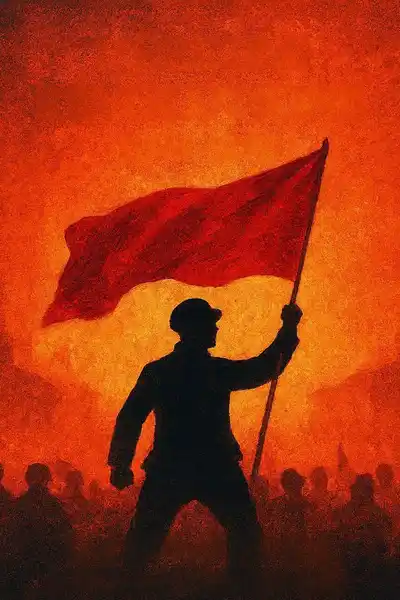
In 1789 the Estates-General met at Versailles to solve a fiscal crisis, and within months the Bastille had fallen and a monarchy that had run France for eight centuries was being rewritten from scratch. A few years earlier and a few hundred miles north, in the mill towns of Lancashire, cotton spinning had begun moving out of cottages and into factories driven by machines. Eric Hobsbawm, the British historian, looked at these two events — one political, one economic — and refused to keep them in separate books. In The Age of Revolution, published in 1962, he treats the six decades between 1789 and 1848 as a single hinge on which the modern world turns.
His argument has a name: the dual revolution. On one side, the French Revolution supplied the politics — the vocabulary of citizenship, nation, rights, and the idea that a social order could be made and unmade by human will. On the other, the British Industrial Revolution supplied the economics — the factory, the steam engine, the self-expanding logic of capital that would eventually reach every corner of the planet. Hobsbawm's claim is that these were not two stories running in parallel but two halves of one convulsion, and that we still live in the world they produced together.
Reading them as one thing is harder than it sounds. It means holding a Manchester weaver and a Parisian sans-culotte in the same frame, and asking what a bourgeoisie rising to power in politics had to do with a bourgeoisie rising to power in the counting-house. Hobsbawm builds the connection with a historian's patience and a partisan's eye, and the payoff is a way of seeing the nineteenth century — and much of our own — that is hard to unsee.
The question we’re asking : How do a political revolution in France and an industrial one in Britain add up to a single transformation of the world?What we’ll see : How Hobsbawm reads six decades of upheaval as one movement, and the modern order it left standing.
Table of contents
01Chapter 1 — Two upheavals, one transformation
Hobsbawm opens with a wager most historians would hesitate to make: that two revolutions usually told apart belong together. The Industrial Revolution is a British story of coal, cotton and iron; the political revolution is a French story of assemblies, guillotines and rights. Textbooks file them under economics and politics respectively, and rarely make them shake hands. Hobsbawm insists the separation is an accident of academic filing, not of history. Between roughly 1789 and 1848, he argues, a single overturning was underway, and its two engines happened to fire in two different countries.
The connecting thread is the class that rose on both fronts at once. The same broad social layer — the commercial and manufacturing middle class, what the nineteenth century called the bourgeoisie — was pushing against the old aristocratic and monarchical order in the political sphere and building the new productive machinery in the economic one. In France it demanded a constitution; in Britain it built a factory. The French Revolution gave this class its ideology and its confidence; the Industrial Revolution gave it its wealth and its means. Neither would have travelled as far alone.

02Chapter 2 — The British engine of industry
Why Britain, and why cotton? Hobsbawm has little patience for the idea that industry took off because Englishmen were unusually clever with machines. The technology involved — the spinning jenny, the water frame, eventually the steam engine — was often crude, and the key breakthroughs were made by tinkerers rather than scientists. What Britain had was a particular alignment: a strong commercial fortune already built on overseas trade, a state that served merchant interests, agriculture productive enough to release labour, and above all a vast captive market for cheap cloth, much of it colonial.
Cotton is his chosen example because it shows the logic in its rawest form. Raw cotton came from slave plantations in the American South; finished cloth was sold across the empire and beyond. The industry had no traditional guild structure to slow it down, its raw material was imported so it faced no landed lobby, and demand seemed bottomless. Between the 1780s and the 1840s the volume of cotton the mills consumed rose to levels that would have been unimaginable a generation earlier. Manchester grew from a modest town into the shock city of the age, the place foreign visitors came to see the future and often recoiled from it.
03Chapter 3 — The French forge of politics
If Britain supplied the machinery, France supplied the language. Hobsbawm treats 1789 less as a single event than as the moment a whole political vocabulary was invented and set loose. The idea that sovereignty belongs to the nation rather than the crown, that men have rights simply as men, that a society's institutions are human constructions open to redesign — these were not obvious before the Revolution and have been inescapable since. France did not just change its own government; it handed every future rebel a script.
He is unsentimental about who made the Revolution and who benefited. The driving force, in his reading, was the bourgeoisie — lawyers, merchants, officials — seeking to break the privileges of birth and open careers to talent and money. But the bourgeoisie could not have toppled the old order alone. It needed the crowd, the peasants burning feudal deeds, the Parisian sans-culottes storming and rioting. The radical phase of 1793 and the Terror pushed far beyond what the moderate revolutionaries had wanted, and the tension between a middle-class revolution and a popular one runs through the whole story.
04Chapter 4 — The world the double revolution built
Step back from the wars and the mills, and Hobsbawm's larger claim comes into focus: the dual revolution did not just change events, it installed the categories we still think with. Nation, class, capital, industry, liberalism, socialism — much of the political and economic vocabulary that feels timeless was forged or transformed in these sixty years. When we argue about markets and states, workers and owners, nations and rights, we are arguing in terms the age of revolution handed us. That, for Hobsbawm, is the real measure of its scale.
The transformation was also, unmistakably, the triumph of a particular class. The bourgeoisie that had risen in politics and in industry emerged from the period dominant on both fronts. It had won the argument that societies could be remade and the machinery to remake them. Hobsbawm, writing from the left, does not disguise his view that this victory was partial and self-serving — that the liberty it proclaimed was bound up with the wage labour and colonial extraction that made it rich. The new order carried its own contradictions from birth.
05Conclusion
Return to those two scenes: the assembly at Versailles and the mill in Lancashire. Kept apart, each is a familiar chapter — the birth of modern politics, the birth of modern industry. Hobsbawm's achievement is to fuse them, to show that the citizen and the factory hand were shaped by the same historical pressure, and that the years between 1789 and 1848 were not two revolutions but one, working through two engines in two countries and refusing to stay in either.
Related books