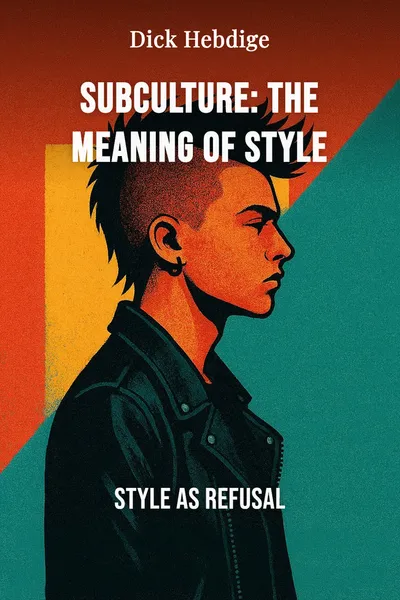
Subculture: The Meaning of Style
Style as refusal
Description
In the summer of 1977, walking down the King's Road in Chelsea, we might have passed a teenager wearing a bin liner held together with safety pins, a torn school blazer, a swastika armband worn with no belief behind it, and hair dyed a green that occurred nowhere in nature. The overwhelming instinct, then as now, is to file this under noise: attention-seeking, delinquency, kids being kids. Dick Hebdige, a young cultural theorist writing at the University of Birmingham, refused that reading. In 1979 he published a slim book, Subculture: The Meaning of Style, that took the bin liner and the safety pin as seriously as a critic takes a poem.
His claim was quietly radical. The clothes were not chaos. They were a language — a system of signs assembled to say something that could not be said out loud. The punk, the teddy boy, the mod, the rasta: each had built a visible code out of the ordinary objects around them, and each code carried a charge of refusal aimed at a society that had already decided what those objects meant. Hebdige borrowed his tools from semiotics, from Barthes and Gramsci and a French thinker named Genet, and pointed them at Vaseline-slicked quiffs and pork-pie hats.
What makes the book endure is that it does not stop at admiring the revolt. It follows the whole arc, all the way to the shop window, where the safety pin ends up on a designer's runway and the threat quietly evaporates. That last movement is the one we still live inside, every time a rebellion becomes a range of T-shirts.
The question we’re asking : What is a teenager in a torn blazer actually saying, and to whom?What we’ll see : How everyday objects get rewired into a language of refusal — and what happens to that language once the market learns to read it.
Table of contents
01Chapter 1 — A safety pin becomes a weapon
Hebdige starts from a small, stubborn fact: the objects subcultures use are almost never invented. They are found. A safety pin holds up trousers; punks pushed it through a cheek or a lapel. A bin liner keeps a kitchen tidy; punks wore it as a dress. The Vespa scooter was a cheap Italian runabout; mods turned it into a chromed altar covered in mirrors. Nothing here is manufactured for rebellion. The rebellion lives in the act of taking an object out of its ordinary use and forcing it to mean something else.
He borrows a word from the anthropologist Claude Lévi-Strauss to name the process: bricolage. The bricoleur makes do with whatever is at hand, recombining bits and pieces into new arrangements whose meaning comes from the recombination itself. A subculture, in this reading, is a kind of collective bricoleur. It raids the wardrobe of the dominant culture — school uniforms, work boots, the union jack — and reassembles the pieces so they read against the grain. The swastika a punk pinned to a sleeve did not signal fascism; it signalled the will to offend, to wear the single most forbidden symbol available precisely because it was forbidden.

02Chapter 2 — The theatre of the sign
If style is a language, it needs a grammar. Hebdige finds it in semiotics — the study of how signs carry meaning — and specifically in Roland Barthes, whose book Mythologies had shown that even a bar of soap or a plate of steak could be read as loaded cultural messages. The everyday, Barthes argued, is never innocent; it quietly tells us what is normal, natural, the way things simply are. Subcultures, for Hebdige, are the moment when someone refuses to let the everyday stay innocent and makes its coded quality glaringly visible.
The crucial idea he takes from the Marxist thinker Antonio Gramsci is hegemony: the way a ruling order keeps power not mainly by force but by consent, by making its own view of the world feel like plain common sense. Wearing a suit, keeping your hair neat, using objects for their intended purpose — none of this feels ideological, which is exactly why it works. It passes as nature. Subcultural style jams that machinery. By garishly misusing the signs of the ordinary, punk and mod and skinhead make visible the fact that the ordinary was a construction all along.
03Chapter 3 — How the outsiders got read
Hebdige is careful not to treat British subcultures as isolated inventions, and this is where his account gets its texture. He reads the whole postwar sequence — teddy boys, mods, rockers, skinheads, punks — against a single hidden presence: Black British and Caribbean culture. The music, the slang, the styles of the white working-class youth were, again and again, a set of responses to the arrival and settlement of a Black population in Britain, and to the reggae, ska and rasta styles that came with it.
The relationship was tangled and contradictory. Mods borrowed heavily from Black American soul and Jamaican rhythm and blues, styling themselves on an imagined cool. Skinheads adopted ska and the reggae of the early rude boys, wearing the affiliation openly even as some of them later turned to racist violence. Punk, Hebdige argues, worked out its own noisy relationship to reggae — admiring its stance of exile and refusal, borrowing its rhythms of dissent while remaining unmistakably white, English and its own thing. The Black presence was the mirror against which white subcultures kept defining themselves.
04Chapter 4 — The moment the shop window wins
The most durable part of Hebdige's book is its account of what happens next, because in his telling the ending is not defeat by police but absorption by the market. He describes two ways a subculture is defused. The first is ideological: the outsiders are converted into a spectacle, made strange and then made familiar, turned into a story the culture tells about its own troublesome children. The second, and for Hebdige the more decisive, is the commodity form. The signs of refusal are turned into things you can buy.
Watch the safety pin. It begins as a piece of hardware pushed through a punk's cheek, an object whose whole meaning is that it should not be there. Within a season or two it appears, in gold and diamanté, as a fashion earring; the bin liner reappears as an expensive black dress; the ripped shirt is manufactured pre-ripped and sold at a premium. Hebdige points to the boutiques of the King's Road, to designers picking over the wreckage of punk for a look. The moment the style can be purchased, its charge quietly drains away. It no longer breaks the fit between object and meaning — it is the meaning, on sale.
05Conclusion
We can go back to that teenager on the King's Road in 1977, bin liner and safety pins and impossible green hair. Hebdige's achievement was to insist that this was not noise but a message, written in borrowed objects, aimed at a culture that pretended its own arrangements were simply natural. The style was a refusal made visible on the body, a way of saying that the settled fit between things and their meanings could be broken. For a season, it was.
Related books