Rats
City's hidden underworld
Description
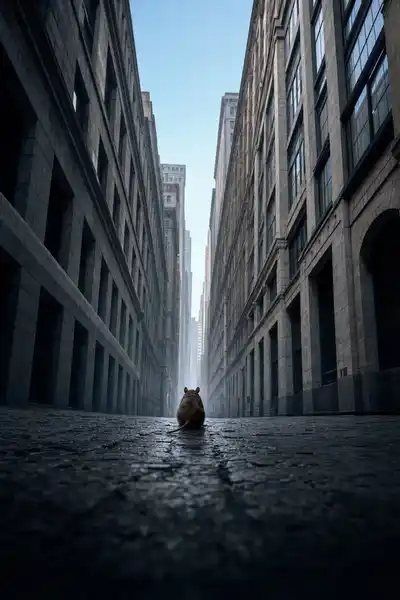
In the fall of 2001, a writer named Robert Sullivan started spending his evenings in a narrow, garbage-strewn alley in lower Manhattan, a few blocks from Wall Street, with a folding stool and a pair of night-vision goggles. He was not there for the humans. He came to watch the rats — to sit through the cold hours and observe the animal that shares the city with us and yet remains, for almost everyone, invisible. He kept a notebook. He timed the rats' runs from the restaurant grease to the trash bags. He learned, night after night, the geography of an alley most people would cross the street to avoid.
The idea had a deliberate literary joke buried in it. A century and a half earlier, Henry David Thoreau had gone to Walden Pond to strip life down to essentials and contemplate his place in nature. Sullivan went the other way — into the most man-made place imaginable, a dead-end alley between two office buildings — and picked the least loved creature alive to be his subject. The rat, he decided, was the wildlife of the city. And if you wanted to understand the city, you could do worse than to sit still and watch what fed on its leftovers.
What came out of those nights, and the year of digging that followed, was a book that reads like nature writing but keeps turning into something else: a history, a portrait of the people the official record forgets, an unlikely comedy. The rat, it turns out, is never just the rat. It travels with exterminators, sanitation workers, rent strikers, and everyone who has a rat story to tell — and, Sullivan discovered, everyone does.
The question we’re asking : What does a man learn about a city when he chooses, of all things, to sit in an alley and watch its rats?What we’ll see : How the least-loved animal in New York becomes a way into the city's garbage, its history, and the people it prefers not to see.
Table of contents
01Chapter 1 — A Walden of garbage
The alley Sullivan chose was real and unglamorous — a slot of asphalt in the financial district, hemmed by old buildings, fed by the back doors of restaurants. He gave it the reverence a naturalist gives a meadow. He noted the seasons, the light, the way the trash accumulated and thinned. He learned that the garbage did not simply sit there; it moved, in a slow current from door to bag to curb to truck, and the rats moved with it. He came to see the whole thing as a kind of stream, and himself as a man sitting on its bank, waiting for the wildlife to appear.
And it did appear. Once the human traffic thinned and the restaurants dumped the night's scraps, the rats came out of the walls and the sewers and worked the bags with a precision that surprised him. He timed them, counted them, watched them establish routes and defend them. Rattus norvegicus, the brown rat, the one that runs New York, turned out to be a creature of habit and territory, living its whole life within a small radius, rarely straying more than a few dozen yards from the burrow where it was born.

02Chapter 2 — Everything we never wanted to know
Along the way Sullivan dispenses rat facts with the relish of a man who cannot quite believe what he keeps finding. The brown rat can chew through lead and cinder block, tread water for days, fall five stories and scurry off, and squeeze its body through a gap the width of a quarter. A single pair, in ideal conditions, can in theory produce a staggering number of descendants in a year — the reproductive arithmetic is one of the reasons a city can never really win. Rats are neophobic, wary of new objects, which is precisely why they are so hard to trap and why the good exterminators think less about poison than about psychology.
He is honest about the parts that turn the stomach. The bite wounds, the diseases carried in the fur and the fleas, the sheer physical reality of an animal that lives in filth and travels between the sewer and the kitchen. And he goes looking for the legends, too — chief among them the rat king, the fabled knot of rats bound together by their tangled tails, a thing museums have preserved and naturalists have argued over for centuries. Whether it is real, staged, or a rare freak of the burrow, the rat king becomes for Sullivan an emblem of how the rodent gathers stories around itself the way it gathers grease.
03Chapter 3 — The oldest war in the city
The rat has a history, and Sullivan digs into the largely unrecorded version of it. In the Gangs of New York era, rats were entertainment: saloons ran rat fights, dumping dozens of captured rats into a pit with a terrier and betting on how many the dog could kill against the clock. There were men who made a living catching rats to supply these pits, city dwellers who knew the burrows and tunnels intimately. The rat was woven into the low economy of the nineteenth-century metropolis, part of a subterranean life that rarely made it into the respectable record.
More striking is the way the rat became a political instrument. In twentieth-century Harlem, tenants living in neglected buildings turned the rat into a weapon of protest. Rent strike organizers understood that a landlord could ignore a complaint but not a rat — that the animal was the most visible, undeniable proof of a slum. Activists brought rats to hearings, held them up, used them to force the city and the courts to see conditions that officials preferred to look past. The rat, the ultimate symbol of the unwanted, became a means for the unwanted to be heard.
04Chapter 4 — The rat is us
Step back from the alley and the book's real subject comes into focus: the rat is a mirror, and what it reflects is the human city. The brown rat is not native to New York any more than New Yorkers are; it arrived, most likely, on ships, following commerce and settlement across the globe. It goes where we go, eats what we eat, breeds in proportion to our surplus. Its fortunes rise and fall with ours. In a real sense, the rat is not an intruder in the human world — it is a creature almost entirely made by it, a shadow that settlement casts wherever settlement lands.
Sullivan keeps this parallel gently in view without hammering it. When he travels to the Midwest — to Chicago, to Milwaukee, to other American cities and their rat control programs — he is testing whether the New York alley was a local curiosity or a universal condition. It is universal. The rat is a constant of the American city, and each city's relationship to it says something about that city's relationship to its own waste, its own poor, its own underside. The rat is a portable measure of how a place lives.
05Conclusion
By the end, Sullivan folds up the stool and leaves the alley, and the animal he spent a year watching remains exactly where it was — under the sidewalk, in the walls, working the current of garbage that never stops flowing. He trapped his rat, chased the legend of the rat king, met the men who hunt them and the people who once wielded them as weapons, and traveled halfway across the country to confirm that the story is the same everywhere there are people. Nothing has been solved. The rat is still winning, quietly, the way it always has.
Related books