
Physics of the Future
Tomorrow's world in physics
Description
In 2011, a theoretical physicist named Michio Kaku published a book with an unusually bold promise on the cover: a description of everyday life in the year 2100. Kaku had spent his career on string theory and the very small, but for this project he did something a novelist would never do. He interviewed more than three hundred working scientists — the people running the labs, building the prototypes, writing the grant proposals — and asked them not what they dreamed of, but what they were actually building. The book that came out of it, Physics of the Future, is his attempt to forecast the next hundred years by trusting the machinery already humming in university basements.
His governing rule is simple and a little severe. Anything that violates the known laws of physics is out. No faster-than-light travel, no perpetual motion, no magic. Everything else — computers woven into contact lenses, robots that learn, medicine that edits our genes, energy pulled from fusion — is fair game, because prototypes of all of it already exist somewhere. Kaku's bet is that the distance between a lab bench in 2011 and a living room in 2100 is a matter of engineering and time, not of miracles.
What makes the book more than a catalogue of gadgets is the through-line underneath it. Kaku keeps circling the same tension: the physics is on schedule, but the humans are not. The same tools that could cure hereditary disease could also let parents order the traits of their children; the same networks that make us omniscient could make us permanently watched. He wants us to see the machines coming, and to notice who gets to decide what they do.
The question we’re asking : When a physicist forecasts the next century by asking the scientists who are actually building it, what does he see coming — and what does he admit he cannot?What we’ll see : A tour through Kaku's method and the futures it produces, across computing, the body and energy, and the quiet limits of prediction itself.
Table of contents
01Chapter 1 — The physicist who asks the scientists themselves
Kaku's first move is to distrust the professional futurists. History, he points out, is littered with confident predictions that aged badly — the ones that promised flying cars and forgot the internet, or that declared a handful of computers would be enough for the whole world. The failures, he argues, tend to share a cause: they were guesses, not extrapolations. So he builds his forecast on a different foundation. Rather than imagining what might be nice, he tracks what is already technically underway and asks how far the known laws of physics will let it run.
The interviews are the spine of the book. Kaku talked to hundreds of researchers across robotics, genetics, energy and computing, and he treats each of them the way a good reporter treats a source — someone with a stake, a specialty and a horizon. What emerges is less a single prophecy than a layered one, sorted by time. He splits the century into the near future (to roughly 2030), the mid-century, and the far future toward 2100, on the reasoning that the closer things are more certain because their prototypes already work.

02Chapter 2 — Computers that vanish into the walls
The most immediate of Kaku's futures is the one about computing, and his central claim is that the computer as an object will disappear. Not because it stops existing, but because it dissolves into everything else. He borrows the idea of ubiquitous computing: chips grow so cheap that they end up embedded in walls, furniture, clothing and eyeglasses, until the word computer means as little as the word motor does today. We are surrounded by hundreds of motors and never count them. Chips, he says, are heading the same way.
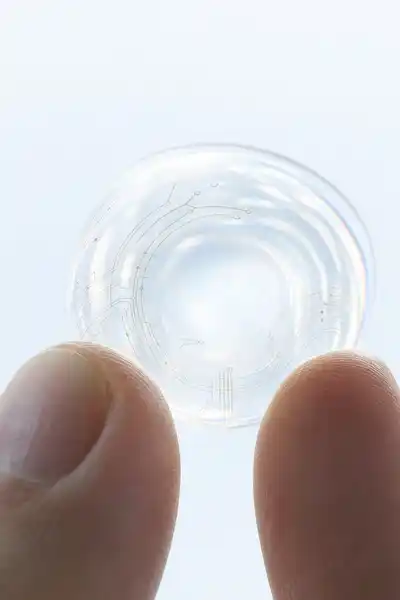
From there the picture gets vivid. Kaku describes internet-enabled contact lenses that overlay information onto whatever we look at, walls that respond to voice, and medical sensors woven into the bathroom that read our health before we feel sick. He leans on the trajectory of Moore's Law — the observation that computing power roughly doubles every couple of years — while being careful to note that the trend cannot continue forever, because silicon transistors eventually hit the hard limit of atomic scale and quantum leakage.
03Chapter 3 — Rebuilding the body, molecule by molecule
When Kaku turns to biology, the tone shifts from convenience to something more intimate. The core of his medical forecast is that the twenty-first century will move medicine from treating symptoms to editing causes. He describes a future where our full genome sits on a chip, where doctors read the specific mutations behind a cancer rather than guessing, and where gene therapies switch off the errors that cause hereditary disease. The dream, stated plainly, is a world in which conditions passed down through families are corrected before they ever express themselves.
Underneath the medicine sits nanotechnology — the engineering of matter at the scale of individual atoms and molecules. Kaku is drawn to the idea of tiny machines that patrol the bloodstream, hunting cancer cells one at a time, or of a smart toilet quietly analyzing our biology every day and catching a tumor when it is a handful of cells rather than a mass. He extends the same molecular thinking outward, imagining nanomaterials that make bridges lighter and stronger, solar cells more efficient, and manufacturing less wasteful. The unit of engineering, in his view, keeps getting smaller until it reaches the atom.
04Chapter 4 — The prophecy problem
Step back from the individual predictions and the more interesting object comes into view: the method itself. Kaku is doing something specific and unusual — treating the future as a physics problem, bounded by conservation laws and the speed of light, and populated by whatever survives those constraints. It is a genuine discipline, and it produces its own kind of confidence. When he says fusion or quantum computing is coming, he is not wishing; he is extrapolating from a prototype and a trend line. The laws of nature are the firm floor under his forecast, and they rarely move.
But the same method exposes its blind spot, and Kaku is unusually willing to name it. Physics can tell us what is possible. It cannot tell us what we will do with the possible. His energy chapters are the clearest example. He lays out a plausible path from fossil fuels toward solar, fusion and even space-based collectors beaming power to Earth — the physics of each is sound. Whether we build them, and how fast, depends on politics, markets, subsidies and habit, none of which appear in a wave equation.
05Conclusion
Kaku set out to describe the year 2100 by refusing to guess. He asked the people already building the future what was on their benches, filtered their answers through the laws of physics, and assembled a world of invisible computers, editable genes and molecular medicine — a world that feels less like science fiction than like a long engineering to-do list. The prototypes exist; the timelines are the only thing in doubt, and even those he sorts with a physicist's care.