
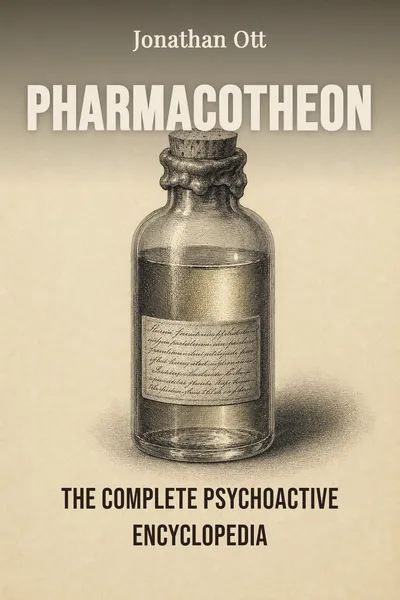
Pharmacotheon
The complete psychoactive encyclopedia
Description
In 1993, a chemist and ethnobotanist named Jonathan Ott published a book that most publishers would have refused on sight: 639 pages, dense with molecular structures, Latin binomials and footnotes that sometimes run longer than the paragraphs above them, on a subject that had spent most of the twentieth century pushed to the edges of respectable science. He called it Pharmacotheon — a coinage that fuses pharmakon, the Greek word for drug, with theon, the divine. The book came with a foreword by Albert Hofmann, the Swiss chemist who first synthesized LSD in 1938 and stumbled onto its effects five years later. When Hofmann vouches for your book on psychoactive substances, the field pays attention.
What Ott assembled was not a manifesto and not a memoir, though the field around it was full of both. It was a reference work in the oldest sense of the term: a catalogue that tries to hold everything known about its subject in one place. More than a thousand species and compounds, organized by chemistry rather than by folklore or fashion, each entry tracing what the substance is, where it comes from, what it does, and — crucially — where the claim comes from. The bibliography alone was the largest ever compiled on psychoactive plants and molecules, and it was the part Ott seemed proudest of.
The book has kept its standing for three decades for a reason that has little to do with its size. Plenty of thick books get quietly abandoned. Pharmacotheon stayed because of how it treats its reader and its evidence — a combination of encyclopedic reach and a refusal to let a single sentence pass without a source behind it.
The question we’re asking : Why does a 639-page catalogue of psychoactive substances, published in 1993, still function as the definitive reference three decades later?What we’ll see : How Ott built a book that decodes an entire field through chemistry and citation, and what that method quietly argues about how we're allowed to know things.
Table of contents
01Chapter 1 — A book that refuses to be casual about anything
The first thing that strikes anyone who opens Pharmacotheon is how seriously it takes precision. Ott does not write like a man trying to convert you, and he does not write like a man trying to entertain you, though the book turns out to be more entertaining than its heft suggests. He writes like someone who has watched the field he loves get buried under loose claims, tall tales and secondhand reporting, and has decided the only fix is to check everything himself and show his work.
The consequence is a book that treats a folk claim about a Mexican mushroom with the same scrutiny as a laboratory result about a synthetic molecule. Ott is relentless about distinguishing what is documented from what is merely repeated. Where a story has traveled from book to book without anyone verifying it, he says so. Where a compound has been reported in a plant but never properly confirmed, he flags the gap. Much of the popular literature on these substances is a chain of citations that trace back to nothing; Pharmacotheon exists partly to break that chain.

02Chapter 2 — The word entheogen, and why it matters
Running under the whole book is a single word Ott helped popularize: entheogen. He did not invent it alone — it was proposed in 1979 by a group of scholars including Carl Ruck and Gordon Wasson — but Pharmacotheon is where the term does its heaviest lifting. Literally it means something like generating the divine within, and it was offered as a replacement for words the group found misleading. Hallucinogen implies false perception. Psychedelic, coined by Humphry Osmond in the 1950s, had by the 1990s picked up so much cultural baggage that it named a decade and an aesthetic more than a class of molecules.
The choice of vocabulary is not a decoration. It signals the frame Ott builds the entire book around: that many of these substances were used, across many cultures and many centuries, in religious and ceremonial contexts rather than recreational ones, and that the modern Western words for them distort that history. The Eleusinian mysteries of ancient Greece, the mushroom rites of Mesoamerica, the ayahuasca traditions of the Amazon — Ott treats these as data about how humans have actually used these plants, not as exotic color.
03Chapter 3 — Chemistry as the great equalizer of plants and pills
The organizing principle of Pharmacotheon is chemistry, and that decision does more work than it first appears. Rather than sorting substances by their cultural reputation — sacred plants here, laboratory drugs there — Ott groups them by molecular family. Tryptamines, phenethylamines, the various alkaloids and their relatives. A mushroom picked in Oaxaca and a compound synthesized in a Berkeley lab can end up in the same chapter because they act on the body through related structures.
This flattening is deliberate and quietly radical. It refuses the moral hierarchy that treats a plant as natural and pure and a synthetic as artificial and suspect. To Ott the chemist, the distinction is often meaningless: the active molecule in a revered plant may be identical to one made in a beaker, and the body cannot tell where the molecule came from. Organizing by chemistry forces the reader to reason about mechanism rather than about mood or myth.
04Chapter 4 — What a reference book is really for
Step back from the individual entries and Pharmacotheon turns out to be making an argument that is not about any one substance at all. It is about how knowledge on a taboo subject survives. When a field is pushed to the margins — legally suspect, academically unfashionable, wrapped in decades of propaganda from every direction — the first casualty is usually rigor. Claims stop being checked because checking them is difficult or dangerous, and the literature fills with confident assertions that no one can trace to a source.
Ott's response is not to argue louder but to catalogue better. The enormous bibliography is the real thesis of the book: the insistence that even a criminalized, sensationalized subject deserves the full apparatus of scholarship, that every claim should be traceable to where it came from, that a reader should be able to follow the chain back and judge for themselves. In a domain governed more by fear and enthusiasm than by evidence, the boring virtues — sourcing, precision, admitting uncertainty — become a form of quiet resistance.
05Conclusion
Hofmann's foreword sits at the front of the book like a blessing from the field's founding chemist, and it frames what follows accurately: this is a work of chemistry and scholarship first, whatever else it is. Ott spent years assembling more than a thousand entries and the largest bibliography the subject had ever seen, and he built the whole thing on a single stubborn conviction — that a taboo subject deserves the same care as any other, and probably more, because the loose claims have had longer to accumulate.