
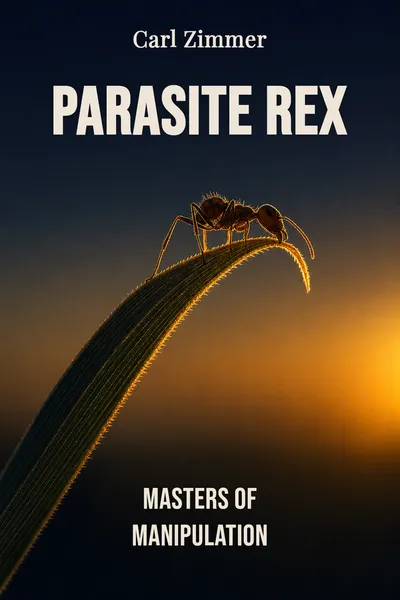
Parasite Rex
Masters of manipulation
Description
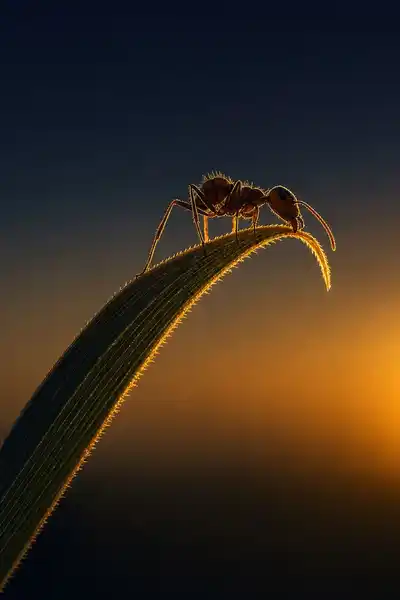
In the early 1990s, a young science writer named Carl Zimmer went to a parasitology lab and watched a fluke — a flatworm no bigger than a grain of rice — do something that had no business working. It had spent part of its life inside a snail, part inside an ant, and it wanted to end up inside a grazing cow or sheep. So it rewired the ant. Every evening, the infected ant climbed to the tip of a blade of grass and clamped its jaws shut, waiting to be eaten. Come morning, if it hadn't been, it climbed back down and went about its day. A worm was running the schedule.
That image sits at the center of Parasite Rex, the book Zimmer published in 2000. For most of us, a parasite is a nuisance — a tapeworm, a tick, a word we throw at people we don't like. Zimmer's argument is that we have the whole thing backward. Parasites are not the losers of the living world, the freeloaders scraping by on borrowed life. By most counts they may outnumber free-living species several times over. They are among the most refined organisms on the planet, and they have been quietly steering the evolution of everything they touch, including us.
What makes the book land is that Zimmer refuses to treat these creatures as villains or curiosities. He treats them as engineers — precise, ancient, and shockingly good at their job. Once we stop flinching, a different picture of life comes into focus, one in which the manipulation is the point, not the exception.
The question we’re asking : What if the creatures we treat as biology's afterthought are actually running much of the show?What we’ll see : How Zimmer reframes parasites from pests to master manipulators — and why that changes the whole picture of life.
Table of contents
01Chapter 1 — The half of life we learned to ignore
Zimmer opens by pointing at a blind spot. For two centuries, biology built its grand narratives around the visible and the charismatic — the predators, the flowering plants, the great migrations. Parasites got filed under "degenerate," organisms that had thrown away eyes, guts, and legs on the road to becoming little more than a mouth and a reproductive system. They were treated as evolution going backward, a kind of failure to be a proper animal.
The book dismantles that verdict. A tapeworm without a gut isn't a creature that lost something; it's a creature that no longer needs it, because it lives bathed in a host's digested food. Stripping down to essentials is not degeneration — it's specialization taken to an extreme. What looks like simplicity is the residue of relentless editing, everything unnecessary cut away until only the machinery of survival inside another body remains.

02Chapter 2 — The puppeteers
The most unsettling chapters are the ones about control. Zimmer's parasites do not merely live inside their hosts; they reach into their hosts and change what they do. The lancet fluke and its suicidal ant is only the opening move. The point he presses is that this manipulation is not crude poisoning — it is targeted, specific, and eerily well-suited to the parasite's own next step in life.
Consider the hairworm, which grows to extraordinary length coiled inside a cricket or grasshopper. The worm needs water to reproduce, but its host is a land insect with no reason to go near a pond. So the worm alters the insect's behavior until it does something a cricket almost never does: it seeks out water and drowns itself, releasing the worm into exactly the environment it requires. The host's final act serves the tenant, not itself.
03Chapter 3 — An arms race with no finish line
If parasites were simply winning, life would have surrendered to them long ago. Zimmer's third movement is about the counterpunch — the ferocious, ongoing struggle hosts wage to keep their tenants in check. This is where the immune system enters the story, not as a tidy defense mechanism but as a battlefield that parasites have been probing for hundreds of millions of years.
The trouble is that parasites are exquisitely fast learners. Zimmer describes organisms like the blood fluke that causes schistosomiasis, which can cloak itself in molecules borrowed from the host so the immune system reads it as self and leaves it alone. Others change their surface proteins so relentlessly that by the time the body has learned to recognize one disguise, the parasite has already switched to the next. The defender is always fighting the last war.
04Chapter 4 — The engineers of the living world
Step back from the individual horror stories and Parasite Rex is making a claim about how nature is put together. Parasites, Zimmer argues, are not a disturbance in otherwise stable ecosystems — they are load-bearing. Remove them and the whole structure can shift. In a salt marsh or an estuary, a single fluke passing through snails, fish, and birds can quietly govern how many of each survive, which species dominate, and how energy moves through the system. The creatures we can't see may be steering the ones we can.
This inverts the usual image of a healthy environment. We tend to imagine wildness as pristine, parasite-free, the animals lean and clean. Zimmer suggests the opposite is closer to the truth: a genuinely intact ecosystem is thick with parasites, because parasites are a sign that the food webs and life cycles they depend on are all still intact. When they vanish from a place, it is often a symptom that something upstream has already broken. Their presence is less a wound than a pulse.
05Conclusion
The fluke that sends an ant up a blade of grass each evening turns out to be a small key to a very large door. Zimmer began with a creature that could commandeer another animal's behavior and ended with the suggestion that such creatures have been shaping bodies, immune systems, ecosystems, and possibly the existence of sex itself. Parasite Rex asks us to look at the thing we instinctively recoil from and see, instead, refinement — organisms so precisely tuned to their hosts that their manipulation reads almost as authorship.