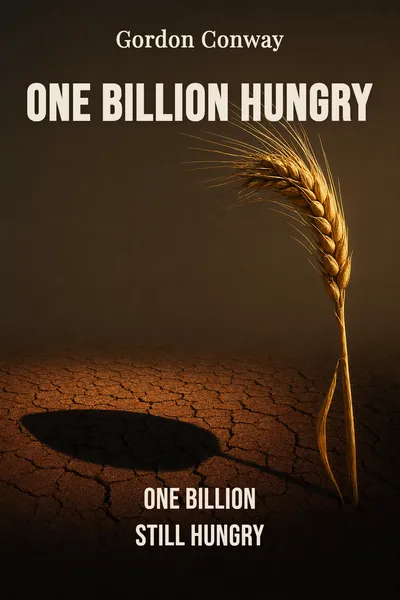
One Billion Hungry
One billion still hungry
Description
In 1968, an American agronomist named William Gaud stood before a Washington audience and gave a name to something already underway in the wheat fields of Mexico and the rice paddies of the Philippines. New high-yield seeds, fertilizer, irrigation and pesticides were pushing harvests to levels nobody had thought possible. India, which had been importing grain to stave off famine, would soon feed itself. Gaud called it a Green Revolution, and for a while the phrase carried the confidence of a problem being solved. Norman Borlaug, the plant breeder behind much of the new wheat, would win the Nobel Peace Prize in 1970, credited with saving perhaps a billion lives.
More than half a century later, the arithmetic that made that celebration possible has stalled short of the finish line. Global harvests kept climbing. The world grew enough food, in aggregate, to feed everyone alive. And yet by the count Gordon Conway works from, close to a billion people still go to bed hungry, and roughly two billion more suffer the quieter deficits of missing vitamins and minerals. The revolution that was supposed to end hunger reached most of the planet and then left a hard remainder untouched.
Conway, an agricultural ecologist who once ran the Rockefeller Foundation, spent a career inside that gap between abundance and hunger. He is neither a technology cheerleader nor a technology skeptic, which is what makes his account unusual. His question is not whether we can grow more food — we plainly can — but why growing more has repeatedly failed to reach the people who need it most, and what a smarter attempt would look like on a planet that is warming, crowding and running short of water.
The question we’re asking : If the world already grows enough food for everyone, why does close to a billion people remain hungry — and can that be undone?What we’ll see : How the promise of feeding the world was half-kept, what hunger really is up close, and why the fixes that worked once will not simply work again.
Table of contents
01Chapter 1 — The revolution that fed billions and left a billion behind
The Green Revolution was, on its own terms, one of the great successes of the twentieth century. Between the 1960s and the 1990s, cereal yields in the developing world roughly doubled. Borlaug's dwarf wheat varieties, bred to carry heavy heads of grain without toppling over, spread across South Asia and Latin America. New rice from the International Rice Research Institute did the same across Asia. India went from famine relief to grain exports. China fed a population that kept growing. Hundreds of millions of people who might have starved simply did not.
But the revolution was selective in ways that matter to Conway's story. It worked best where farmers had flat, well-watered land, access to fertilizer and pesticides, and enough capital to buy into the package. It rewarded the wheat and rice belts of Asia and largely bypassed the crops poor farmers actually grow in the harder places — sorghum, millet, cassava, the dryland staples of much of Africa. Sub-Saharan Africa, with its rain-fed soils, thin markets and weak roads, saw comparatively little of the yield surge that transformed the Punjab.

02Chapter 2 — What hunger actually is when you look closely
The word hunger flattens something that comes in several forms, and Conway insists on separating them. There is acute hunger — the famine, the emergency, the images that reach television screens. It is real and lethal, but it accounts for a small fraction of the total. Far more common is chronic hunger: not the dramatic collapse but the daily shortfall, the person who eats but never quite enough, whose body and mind operate below capacity year after year. This is the condition of the roughly billion Conway counts.
Then there is what he calls hidden hunger, the deficiency of micronutrients. A diet can supply enough calories and still lack iron, vitamin A, iodine or zinc. The consequences are quieter but vast: anemia in women, blindness in children, immune systems that cannot fight off ordinary infections, cognitive development that never fully arrives. Perhaps two billion people carry some form of this hidden deficiency. A child can look fed and still be starved of the things a body needs to grow properly.
03Chapter 3 — The doubly green revolution
If the first Green Revolution raised yields at a heavy environmental price, Conway argues the next one has to do both jobs at once — grow more food and repair the land it grows on. He calls this a doubly green revolution, and the phrase is his answer to a false choice that dominates the debate. One camp wants high-tech intensification; another wants low-input, agroecological farming that works with nature. Conway refuses to pick a side. The scale of the problem, he argues, needs the best of both.
On the technology side, that means seeds bred for the conditions poor farmers actually face — drought tolerance, resistance to local pests and diseases, crops fortified with the micronutrients hidden hunger craves. He treats genetic modification as a tool to be judged case by case, not worshipped or banned. A rice engineered to carry vitamin A, or a cassava resistant to the viruses that wipe out African harvests, is worth having if it reaches the field and does what it promises. The test is always whether it helps the smallholder, not whether it thrills the laboratory.
04Chapter 4 — The next fifty years look harder
Step back from the toolkit and Conway's book is really an argument about whether hunger is a solvable problem or a permanent feature of how the world is arranged. The technical case for solving it is strong: we know how to grow more, waste less, and fortify what we eat. What has been missing is not knowledge but the political decision to treat a hungry billion as intolerable rather than as background noise. Hunger endures partly because the people who suffer it have the least power to demand otherwise, and the systems that pass them by are not accidents but choices.
And the choices are about to get harder, because the conditions that made the first revolution possible are turning against the next one. The population Conway wrote toward is climbing past nine billion, most of the added mouths in exactly the regions least able to feed themselves. Climate change is shifting rainfall, intensifying droughts and floods, and pushing heat past the tolerance of major crops in the tropics. Water tables are falling, soils are eroding, and the cheap fossil-fuel energy that powered synthetic fertilizer is neither cheap nor clean. The tailwind of the 1960s has become a headwind.
05Conclusion
The Green Revolution that William Gaud named in 1968 did roughly half of what it set out to do. It fed billions, held off the famines that demographers of the era had predicted, and bought the world time. What it did not do was reach the people farming the dry margins, the women without land, the families with no money to command the food that surrounds them. Six decades on, that remainder is still there — a billion chronically hungry, two billion quietly deficient — and the easy gains have been taken.
Related books