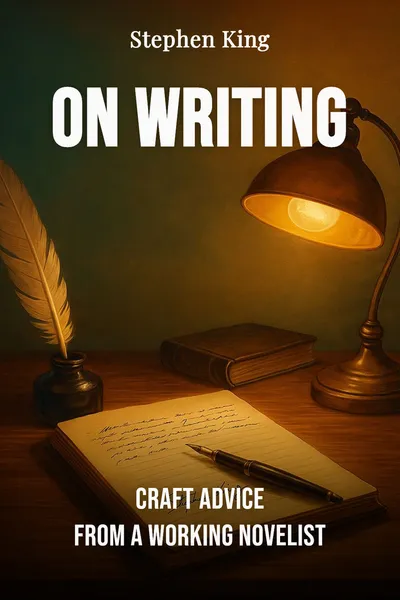
On Writing
Craft advice from a working novelist
Description
In June 1999, Stephen King was walking along the shoulder of Route 5 in Lovell, Maine, when a van driven by a distracted local hit him and threw him into a ditch. He came out of it with a shattered leg, a collapsed lung, and a hip broken in several places. He was fifty-one, the best-selling novelist alive, and for a while it was not clear he would write again. What he had left unfinished on his desk was a slim book about the craft of writing — half memoir, half instruction manual — that he had started, abandoned, and doubted for over a year. Finishing it became part of his recovery.
That book, On Writing, came out in 2000 and has quietly outlasted most of the horror novels that made his name. It sells to people who have never touched Carrie or The Shining — students, hobbyists, professionals looking for a straight answer from someone who has actually done the work at scale. King has published dozens of novels and sold hundreds of millions of copies. When he sits down to explain how the thing is done, we tend to lean in, because whatever else you think of the books, the man clearly knows how to keep a reader turning pages.
What makes the book unusual is that it refuses to be one thing. It is not a memoir with tips bolted on, and not a how-to manual softened with anecdotes. King treats his own life and his own method as the same material, and the argument that emerges from the braid is stranger and more useful than either half would be alone. It is also, in places, a book about coming back from an accident that nearly ended the only work he ever wanted to do.
The question we’re asking : What does a working novelist actually mean when he says writing can be taught — and what does he insist it can't?What we’ll see : How a life and a method turn out to be the same story, told by someone writing his way back from a ditch.
Table of contents
01Chapter 1 — The kid who kept the rejection slips on a nail
King opens not with rules but with what he calls a C.V. — a series of snapshots from a childhood in Maine and Connecticut, raised by a single mother after his father walked out to buy cigarettes and never came back. He was a sickly, imaginative kid who wrote stories in bed, copied comic books word for word, and sold his first efforts to his brother's friends for a quarter until a teacher told him that was against the rules. The through-line of these scenes is not sentiment. It is the slow discovery that the impulse to make things up and write them down was, for him, non-negotiable.
The detail readers remember is the nail. As a teenager submitting stories to magazines, King pounded a spike into his bedroom wall and impaled every rejection slip on it. By the time the weight of paper bent the nail, he replaced it with a longer one and kept going. He was not romanticizing failure; he was keeping score, and treating each rejection as data rather than verdict. His first sale, a story to a men's magazine, came while the pile was still growing.

02Chapter 2 — The toolbox on the top shelf
When King finally turns to craft, he reaches for a memory of his uncle Oren's toolbox — a heavy three-tiered thing the old man carried across the yard to fix a screen door, even though the screwdriver he needed sat in the top tray. Why lug the whole box? Because, Oren said, you want to have your tools with you when you find the work, so you don't have to go back for the one you didn't bring. King builds his entire instruction around that image. Every writer, he says, should have a toolbox, and the trick is knowing which tools sit on which level.
On the top, most-used tray go vocabulary and grammar. His advice on vocabulary is bracing in its modesty: use the first word that comes to mind, if it's the right one and it's vivid. Don't dress the plainest word up in a fancy coat because you're ashamed of it. He is scathing about writers who reach for a thesaurus to sound smart, and equally firm that grammar is not a set of manners but a way of keeping your meaning from collapsing. The parts of speech, sentence and paragraph — these are the plain, everyday tools you keep on top.
03Chapter 3 — Story is a fossil, not a machine
The heart of King's method is a distinction he draws hard and refuses to soften: he does not believe in plot. Plot, to him, is the clumsy tool of the writer who wants to control everything in advance, and its results feel manufactured because they are. He prefers to think of stories as fossils — pre-existing things, already whole, buried in the ground. The writer's job is not to invent them but to excavate them, brushing away the dirt with as little damage as possible. You start with a situation, drop a character or two into it, and watch what they do.
This is where the book earns its keep, because King means it operationally, not mystically. Most of his novels, he says, began as a simple what-if. What if a town were quietly taken over by vampires? What if a writer were held prisoner by his most devoted fan? He puts his people in the trap and then, genuinely, does not know how they will get out. The suspense he feels while writing is the suspense the reader will feel — and if he engineered the escape in advance on an index card, he suspects we would smell the machinery.
04Chapter 4 — What survives after the van
Step back from the individual rules and a single wager holds the book together. King is arguing, against a durable cultural myth, that writing is a craft rather than a visitation. He carves out a small class of naturally great writers who cannot be taught and a small class of hopeless ones who cannot be helped, and then says the interesting truth: the vast middle — competent writers — can, with a great deal of hard work and dedication, become good ones. That is a democratic and slightly unfashionable claim. It says the door is not guarded by a mystery. It is guarded by the willingness to sit down and do the reps.
What gives the claim its force is where he finishes writing it from. The last chapter, added after Route 5, describes learning to sit up again, the pain of the first sessions back at the desk, the doubt about whether the words would still come. Writing, he found, did not fix his leg, but it did what it had always done: it made the hours bearable and reminded him who he was. The craft he had spent the book demystifying turned out, under the worst conditions of his life, to be the thing that carried him.
05Conclusion
On Writing ends where it needs to, back at the desk, with a man who nearly lost everything discovering that the ordinary discipline of putting down words was still available to him. The two halves of the book — the life and the method — turn out to be one argument. King's biography is not decoration on the craft advice; it is the evidence for it, the proof that a competent writer, kept at it long enough and honestly enough, becomes a good one and stays one even when the body fails.
Related books