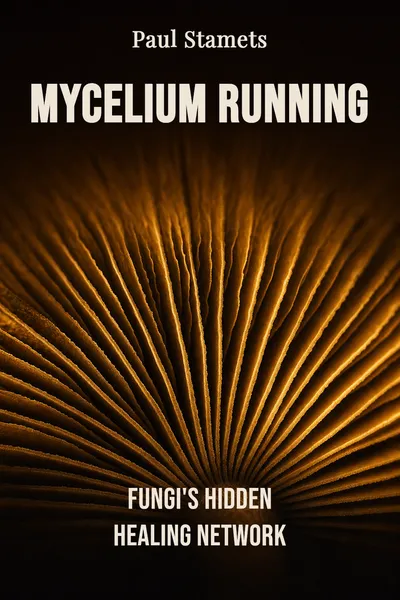
Mycelium Running
Fungi's hidden healing network
Description
Kick over a rotting log in a damp forest and you'll see them — pale threads spreading through the wood and the soil like a fine net someone left behind. That net has a name: mycelium, the living body of a fungus, of which the mushroom we recognize is only the fruit. Paul Stamets, a mycologist who has spent decades on his knees in the Pacific Northwest, opens his 2005 book Mycelium Running with a claim that sounds outsized until he backs it up: these threads form the largest and oldest living systems on Earth, and we have barely begun to understand what they do.
Stamets is not a detached observer. He is a cultivator, an experimenter, someone who has poured motor oil onto contaminated soil to watch fungi devour it, and who talks about mushrooms the way other people talk about old friends. His book is part field manual, part manifesto. It argues that the same underground networks that recycle dead trees could clean up our poisons, feed us, defend crops, and even help fight disease in our own bodies — if we learned to work with them rather than around them.
What makes the book compelling is not just the list of applications, striking as it is, but the shift in perspective it asks for. We tend to notice fungi only when they spoil bread or sprout on a stump. Stamets wants us to see the vast, patient intelligence running beneath that surface — and to consider that it might be the most powerful ally we have overlooked.
The question we’re asking : What can a network of fungal threads actually do for a damaged planet — and for us?What we’ll see : How mycelium quietly holds ecosystems together, and why Stamets thinks we should let it do far more.
Table of contents
01Chapter 1 — The web under our feet
Before he asks us to do anything with mycelium, Stamets wants us to understand what it is. A single cubic inch of forest soil can hold miles of these microscopic threads, called hyphae, branching and fusing into a mat that can stretch for acres. In eastern Oregon, one honey fungus was mapped across roughly 2,200 acres and estimated to be thousands of years old — a candidate for the largest single organism alive. Most of the time it stays invisible. It only announces itself when it pushes up a mushroom to release spores, the way a tree flowers.
What the mycelium does down there is essential and mostly thankless. It is the planet's primary recycler, breaking down fallen wood, leaves, and dead animals into the nutrients that everything else depends on. Without fungi doing this decomposition, forests would drown in their own debris and the carbon and minerals locked in dead matter would never return to circulation. Stamets calls mycelium the "grand disassemblers" of nature, the layer that turns endings back into beginnings.

02Chapter 2 — Cleaning up what we broke
The most dramatic chapters of the book are about what Stamets calls mycoremediation — using fungi to clean contaminated land. His reasoning is disarmingly simple. Fungi evolved to dismantle the tough, complex molecules in wood, especially lignin, using powerful enzymes. Many industrial pollutants happen to be built from similar molecular bonds. A fungus that can digest a fallen fir has no particular trouble digesting petroleum, and Stamets set out to prove it.
In one experiment he recounts, piles of soil soaked in diesel and oil were treated in different ways — some with bacteria, some with enzymes, one inoculated with oyster mushroom mycelium. Weeks later the untreated piles were still dark and dead. The one seeded with oyster fungus was covered in mushrooms, and as those mushrooms decayed they drew insects, then birds, then seeds, until the toxic mound had turned into a small green island. The hydrocarbons had been broken down to a fraction of their original level. The fungus had not just removed the poison; it had restarted an ecosystem.
03Chapter 3 — Medicine that grows in the dark
If fungi can heal soil, Stamets argues, it should not surprise us that they carry compounds able to help heal bodies. Humans have leaned on mushrooms medicinally for a very long time — the five-thousand-year-old iceman found in the Alps was carrying a birch polypore fungus, likely for its antibacterial and antiparasitic properties. Stamets treats that as a clue rather than a curiosity: fungi live in a fierce chemical war with the bacteria and viruses around them, and the molecules they evolved to survive that war are often useful to us.
The clearest example is one we rarely credit to fungi at all. Penicillin, the antibiotic that reshaped modern medicine, is a fungal product. Stamets points out that the same evolutionary pressure that produced penicillin is still running in countless species we have never screened, and that the fungal kingdom may hold a pharmacy we have barely opened. He is especially interested in polypores and other wood-decay mushrooms, several of which have shown activity against viruses in early testing.
04Chapter 4 — The case for a mycelial future
Step back from the individual applications and a larger argument comes into focus. Stamets is not really cataloguing tricks that fungi can do for us. He is proposing a change in relationship. For most of our history we have treated the living world as either a threat to be managed or a stockpile to be drawn down. Mycelium, in his telling, invites a third posture: partnership with an organism that was building and repairing ecosystems for hundreds of millions of years before we arrived, and that may be better at it than we will ever be.
The reframing matters because of what fungi represent structurally. A mycelial network senses damage, redistributes resources, and routes around dead spots — behaviors we associate with intelligence, arising in something with no brain. Stamets suggests we have a great deal to learn simply from the design: decentralized, regenerative, running on waste and sunlight's leftovers rather than on extraction. Where our systems tend to break down complexity into landfill, fungal systems turn breakdown into fertility. That is closer to a philosophy than a technique.
05Conclusion
Kick over that rotting log again and the threads look different now. What seemed like decay is a working system — dismantling, feeding, sensing, repairing — and it has been doing this job since long before forests as we know them existed. Stamets's achievement in Mycelium Running is to make that invisible layer legible, and then to argue, application by application, that its capacities line up almost eerily with the problems we most need solved: poisoned soil, failing crops, stubborn disease, an economy that produces more waste than it can absorb.
Related books