
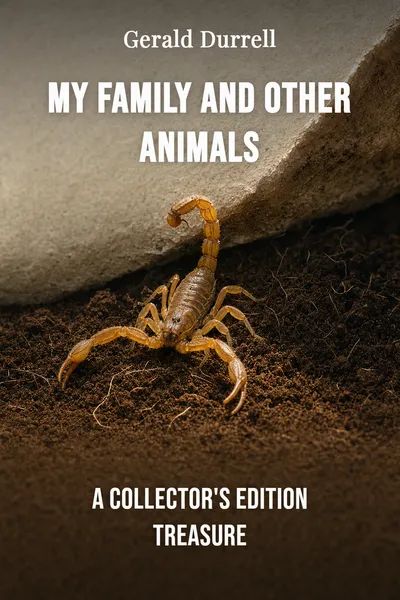
My Family and Other Animals
A collector's edition treasure
Description
In 1935, a ten-year-old boy stepped off a boat onto the Greek island of Corfu with his widowed mother, three older siblings, a dog named Roger, and no particular plan. The family had left grey, drizzling Bournemouth on the advice of the eldest brother, Larry, who had decided England was making everyone miserable. What the boy found instead was a landscape swarming with life: scorpions under stones, geckos on whitewashed walls, tortoises trundling through olive groves, and a warm sea he could wade into at any hour. That boy was Gerald Durrell, and the five years the family spent on the island became, two decades later, one of the most beloved memoirs in the English language.
Durrell wrote My Family and Other Animals in 1956, and it was an immediate success — funny, warm, and unusually alive to the natural world. He always insisted the book was meant to be a gentle study of Corfu's wildlife, and complained, half-seriously, that his relatives kept elbowing their way into the pages. That tension is the whole charm of the thing. It is a naturalist's notebook and a family comedy at the same time, and it refuses to choose between the two.
The edition in hand belongs to the Macmillan Collector's Library: a clothbound, pocket-sized hardback with gilded page edges and a ribbon marker, the kind of book made to be kept rather than merely read. It closes with an afterword by Peter Olney, former Keeper of Birds at London Zoo. Which raises a small, pleasant puzzle worth sitting with.
The question we’re asking : What is this book actually about, and why does a light childhood memoir keep earning the kind of careful, collectible edition usually reserved for weightier classics?What we’ll see : A boy's five years on a Greek island, the double life of the book as comedy and natural history, and what makes it endure.
Table of contents
01Chapter 1 — An island where nobody looked at a clock
The Durrells arrived in Corfu in the mid-1930s, and the island Gerald describes is one of almost total freedom. There was no school to speak of, no schedule anyone enforced, and a succession of villas — the family kept moving as circumstances demanded, from a strawberry-pink one to a daffodil-yellow one to a snow-white one. For a boy obsessed with animals, this was close to paradise. He spent his days wandering the hills and shorelines with Roger the dog, collecting specimens, watching insects, and bringing home whatever crawled, flew, or slithered into his reach.
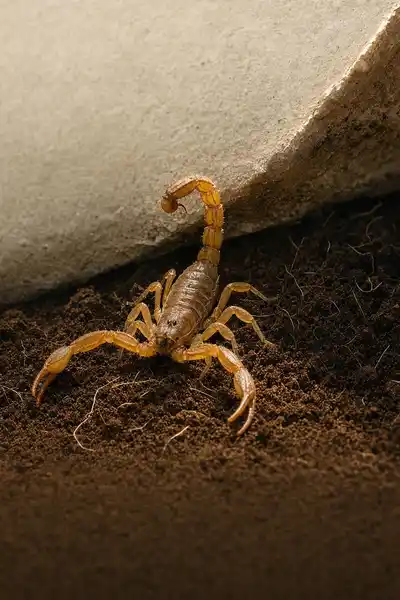
The wildlife is genuinely the heart of the book, and Durrell writes about it with a precision that never turns dry. He watches trapdoor spiders spring their hinged lids, follows the courtship of tortoises, and keeps a pet scorpion whose escape at the dinner table produces one of the book's great set pieces. These are not decorative nature notes. Durrell had the eye of a working naturalist even as a child, and he renders each creature with real attention to how it moved, hunted, and lived. The reader comes away actually knowing something about the animals, without ever feeling lectured.

02Chapter 2 — The naturalist and the novelist in one house
The title carries a joke that Durrell meant seriously. The animals get top billing, but the family are impossible to ignore, and they nearly steal the book. There is Larry, the eldest, pompous and literary, forever announcing grand schemes and then blaming everyone else when they collapse; this was Lawrence Durrell, who would go on to write the Alexandria Quartet, here rendered as a comic monster of self-regard. There is Leslie, gun-obsessed and perpetually aggrieved, and Margo, the teenage sister absorbed in her complexion and her romances.
Presiding over all of them, gently and ineffectually, is Mother — Louisa — who responds to every crisis by proposing a cup of tea and worrying that the children are not eating enough. Durrell writes her with enormous affection. She is the calm centre around which the chaos revolves, indulgent to a fault, and quietly heroic in her refusal to be scandalised by scorpions in matchboxes or magpies loose in the house. The comedy of the family comes from their collisions: Larry's outrage when Gerald's menagerie disrupts his writing, the shouting matches, the escalating disasters that always seem to end with everyone somehow reconciled at the table.
03Chapter 3 — Corfu as it was, and never would be again
Part of the book's enduring pull is that it preserves a world that has since vanished. The Corfu of the 1930s was rural, poor, and largely untouched by the tourism that would later transform the Greek islands. Durrell's Corfu is one of donkey tracks and oil lamps, of fishermen who knew every cove and old women who told fortunes, a pre-war Mediterranean that the Second World War and the decades after it would sweep away entirely. Reading it now is a kind of time travel to a place that no longer exists in the form he knew.
Durrell captures the local people with the same generosity he extends to his family. There is Spiro, the fiercely loyal taxi driver who adopts the Durrells and bulldozes every obstacle on their behalf, and Theodore Stephanides, the polymath doctor and naturalist who becomes Gerald's mentor and friend. Theodore is one of the book's quiet treasures — a man who could discuss microscopic pond life, Greek folklore, and murder statistics with equal enthusiasm, and who took the boy's passion seriously when the rest of the household mostly tolerated it.
04Chapter 4 — Why a childhood memoir keeps earning a clothbound spine
It would be easy to file My Family and Other Animals as a charming minor classic — a funny book about a nice family and some lizards. The clothbound Collector's Library edition, with its gilt edges and ribbon, quietly argues otherwise. The physical object treats the book as something to keep and return to, and the choice is not merely decorative. A book earns a permanent shelf because it holds up on the second and fifth reading, and this one does, because there is more under the comedy than the comedy alone suggests.
The afterword by Peter Olney is a clue to what that something is. Olney was Keeper of Birds at London Zoo and a distinguished ornithologist, awarded the Zoological Society of London's Silver Medal in 2003 — precisely the kind of reader who might have been expected to smile at a popular memoir and move on. That such a figure engages seriously with the book confirms that Durrell's natural history is real natural history. The observations are accurate, the affection for the living world is genuine, and the science holds. Durrell went on to found a zoo in Jersey dedicated to conservation and captive breeding, and the seeds of that life's work are visible in the boy chasing beetles across Corfu.
05Conclusion
The boy who stepped off the boat in 1935 spent five years turning a Greek island into a private laboratory and a family into a comic cast, and then, two decades on, turned all of it into a book that has never gone out of print. My Family and Other Animals endures because it refuses the usual trade-off: it is warm without being sentimental, funny without being slight, and scientifically observant without ever slowing down for a lecture. The scorpion at the dinner table and the courtship of tortoises share the page with equal life.