Modernist Cuisine
Science meets the kitchen
Description
In 2011, a set of cookbooks arrived that weighed close to fifty pounds and cost about six hundred dollars. It came in a custom case, ran to five volumes plus a spiral-bound kitchen manual, and had been assembled in a laboratory outside Seattle by a team that included food scientists, professional chefs, a former Microsoft executive, and a photographer who had learned to cut cooking equipment in half so the camera could see inside a pan mid-boil. The whole thing was called Modernist Cuisine, and the man behind it, Nathan Myhrvold, had a doctorate in theoretical physics and had once studied under Stephen Hawking before spending years as Microsoft's chief technology officer.
It could have been an eccentric rich man's folly. Instead it won the 2012 James Beard Award for Cookbook of the Year, landed in the Gourmand Cookbook Hall of Fame, and got named by the New Yorker as one of the finest cookbooks of the century. Chefs who had spent decades at the stove found things in it they had never known — why a steak keeps cooking after it leaves the heat, what actually happens to an egg white as it stiffens, how a pressure cooker rewrites the chemistry of a stock. The book was not trying to give anyone recipes. It was trying to explain the machine.
That is the odd promise at the center of the project. For most of history, cooking has been passed down as craft — watch, imitate, adjust by feel. Modernist Cuisine treats it instead as a set of physical processes that can be measured, photographed, and understood from first principles. The tension between those two ways of knowing a kitchen runs through all six volumes, and it is where the book earns its reputation.
The question we’re asking : What happens when someone decides to explain cooking not as a tradition to inherit but as a physics problem to solve?What we’ll see : A physicist's improbable route into the kitchen, the sheer scale of what his team built, and how looking closely enough at heat and water quietly rewrites what a cook thinks they know.
Table of contents
01Chapter 1 — A physicist walks into a kitchen
Nathan Myhrvold did not come to cooking the way most authors of celebrated cookbooks do. He earned a doctorate in theoretical and mathematical physics, did postdoctoral work with Stephen Hawking on quantum theories of gravitation, then joined a small software company that became Microsoft and rose to chief technology officer. He was a man trained to distrust intuition and ask for the underlying mechanism — and at some point he turned that instinct on his own dinner.
The trigger, by his account, was sous vide. He had become obsessed with the technique of cooking food sealed in plastic and held in precisely controlled water baths, and when he went looking for a book that explained how it actually worked, he could not find one. The existing literature told him what to do without telling him why. For someone used to the standards of physics, that gap was intolerable. A recipe that says "cook until done" is describing a result, not a process, and Myhrvold wanted the process.

02Chapter 2 — 2,438 pages, and not one of them is a shortcut
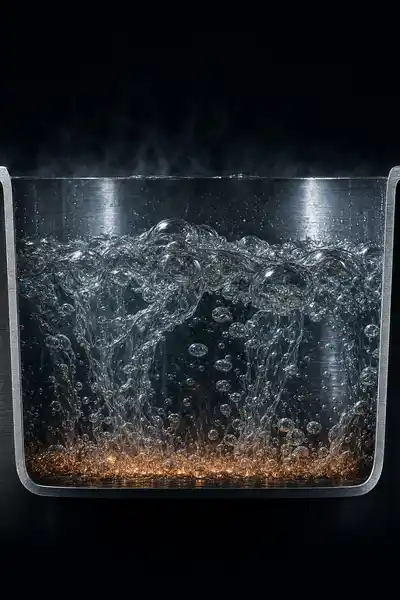
The finished work is genuinely enormous. Six volumes, 2,438 pages, produced over years by a standing team of scientists, chefs, editors, writers, and photographers. Nothing about it is casual. The photography alone became a project of its own: to show what happens inside cooking equipment, the team physically cut pots, pans, ovens, and grills in half, then sealed the exposed side with heat-resistant glass so the camera could capture the interior of a wok or the cross-section of a hamburger as it seared.
Those cutaway images are not decoration. They carry argument. A photograph of a pan sliced open mid-fry lets you see the layer of oil, the crust forming, the moisture escaping — evidence for claims that a paragraph alone could only assert. The book is built on the conviction that if you can see the mechanism, you can reason about it, and if you can reason about it, you can change it. Beauty and explanation are doing the same job on the same page.
03Chapter 3 — When the microscope changes the recipe
The most persuasive parts of the book are where careful measurement contradicts received wisdom. Searing meat, cooks have said for over a century, seals in the juices. It does not. Controlled tests show that a seared piece of meat and an unseared one lose moisture at broadly similar rates; what searing actually does is trigger the Maillard reaction — the cascade of chemistry between amino acids and sugars that produces the browned crust and hundreds of new flavor compounds. The old rule described the right action for the wrong reason, and once you know the real reason, you sear differently and better.
This is the book's method in miniature: not to demolish tradition for sport, but to replace a mistaken model with an accurate one so the cook can act with intention. Take resting a roast. The instruction is old and correct, but the usual explanation — that the juices "redistribute" — is only part of it. What the book emphasizes is carryover cooking: heat stored in the outer layers keeps flowing inward after the meat leaves the oven, so the center can rise several degrees on the counter. Understand that, and you pull the roast early, on purpose, and let physics finish the job.
04Chapter 4 — The line between craft and laboratory
Behind Modernist Cuisine sits a quiet argument about two kinds of knowledge. For nearly all of human history, cooking has lived as craft: knowledge held in the hands and the senses, transmitted by demonstration, refined by repetition, and often impossible to put fully into words. A great cook knows when a sauce is ready the way a musician knows a note is in tune. That knowledge is real, and it is not what a physicist means by knowing.
What Myhrvold's project does is insist that the two need not be rivals. The book never claims that measurement replaces the trained palate — it claims that measurement can explain what the palate already senses, and that the explanation is worth having. A cook who understands why an egg sets at a particular temperature has not lost the feel for eggs; they have gained a second, independent way to be right. The craft becomes more powerful, not obsolete, when the mechanism underneath it comes into view.
05Conclusion
The project began with one man's irritation that no book could tell him why sous vide worked, and ended as five volumes and a kitchen manual assembled by a physicist, a lab, and a team of chefs. Along the way it cut ovens in half, retired a century of folklore about searing, and made the case that resting a roast, thickening a sauce, and boiling a stock are all describable physical events. The awards followed, but the real achievement was quieter: it took the ordinary act of cooking seriously enough to explain it.
Related books