Introduction to Electrodynamics
Mastering electromagnetic forces
Description
Somewhere right now a physics student is staring at a page that begins with a definition of a vector field and ends, three hundred pages later, with light itself falling out of the mathematics. The book is almost certainly David J. Griffiths's Introduction to Electrodynamics, first published in 1981 and now in its fourth edition. For four decades it has been the book handed to undergraduates the world over when they reach the moment where electricity and magnetism stop being two separate curiosities and start being one thing. Ask a physicist of a certain age what they read to understand fields, and a striking number will say the same name, often with a small smile.
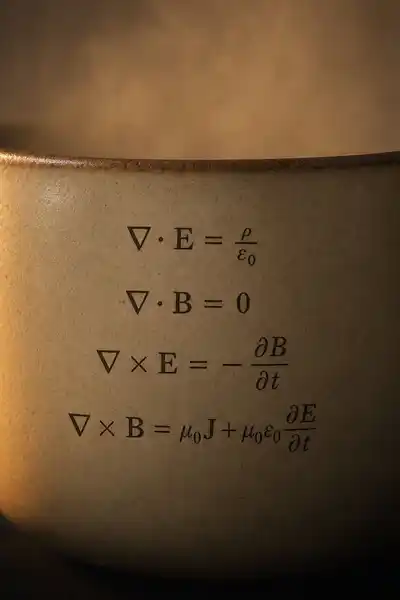
That smile is worth noting, because electrodynamics is not an easy subject. It asks us to believe that empty space is full of invisible structure, that a wire carrying current bends something we cannot see, that a changing magnetic field creates an electric one out of apparently nothing. The equations behind all this — four of them, credited to James Clerk Maxwell — are compact enough to fit on a coffee mug and deep enough to occupy a career. Getting from the mug to the understanding is the whole problem.
Griffiths's answer was not to make the subject shorter or softer, but to make it a conversation. His book talks, argues with itself, poses a question and then works it out in the margin, treats the reader as a curious equal rather than a vessel to be filled. That choice is why it stuck, and why it is worth looking at not just as a container of physics but as a particular way of teaching a genuinely hard thing.
The question we’re asking : How does a single textbook take one of physics's most abstract subjects and make generations of students actually feel they understand it?What we’ll see : We follow the ideas Griffiths builds — from the four great equations down to the moment they produce light — and watch how the teaching itself does the heavy lifting.
Table of contents
01Chapter 1 — The four equations that run the world
The spine of Griffiths's book, and of the whole subject, is a set of four equations that Maxwell assembled in the 1860s. They do not look like much on the page. One says that electric charges are the source of electric fields. One says there are no magnetic charges — no lonely north pole you can hold in your hand. One says a changing magnetic field stirs up an electric field. And one, the trickiest, says that both electric currents and changing electric fields stir up magnetic fields. Four sentences, really, dressed in the language of calculus.
What Griffiths does with them is refuse to hand them over as finished monuments. He builds toward them. The book opens not with Maxwell but with a long, patient chapter on vector calculus — divergence, curl, gradient — because without those tools the equations are just symbols. He knows that most readers arrive shaky on exactly this math, so he spends the pages to fix it, treating the detour as part of the physics rather than a chore to get past.

02Chapter 2 — Fields before charges, or charges before fields
Before any of the four equations can mean anything, a student has to accept a strange idea: the field. In everyday life a force needs something to push against something else. But electrodynamics insists that a charge does not reach across empty space to grab another charge. Instead it fills the surrounding space with a field, an invisible condition at every point, and a second charge simply responds to the field where it happens to sit. Griffiths spends real effort making this concrete rather than mystical.
The book builds this up in stages, starting with electrostatics — charges sitting still. Here the field is easiest to picture, and Griffiths uses the calm of the static case to install the intuition that will carry through everything harder later. He introduces potential, the idea that you can describe the field by a single number at each point rather than an arrow, and shows why that simplification is worth so much when the geometry gets messy.
03Chapter 3 — When it moves, everything changes
The quiet world of static charges is a warm-up. The real subject begins when things move and change, because that is when electricity and magnetism stop being separate topics and reveal themselves as one. Griffiths stages this shift carefully, and it is the emotional center of the book. A changing magnetic field, Faraday found, drives a current in a nearby loop of wire — this is how every generator and transformer on Earth works — and Griffiths treats the discovery as a genuine turning point rather than another formula.
The insight that follows is the one Maxwell supplied: the symmetry runs both ways. A changing electric field produces a magnetic field, just as a changing magnetic field produces an electric one. Once both are true, something remarkable becomes possible. An electric field that changes creates a magnetic field that changes, which recreates an electric field, and the pattern can sustain itself, rolling forward through empty space with no charges needed at all.
04Chapter 4 — Why one textbook keeps teaching the subject
Step back from the physics and a different question comes into view: why has this particular book endured when the equations it teaches belong to no one and appear in a hundred other texts? The content is not secret. What Griffiths supplies is not the material but a way through it, and that turns out to be the scarce thing. His book treats learning electrodynamics as a skill you develop by doing, not a body of facts you receive, and that stance shapes every page.
The clearest evidence is the problems. Griffiths's exercises are famous among physicists, and not because they are cruel. They are staged — a worked example shows the move, then a problem asks you to make it yourself, then a harder one asks you to make it somewhere unfamiliar. The book assumes you cannot understand a field by reading about a field; you understand it by calculating one, getting it wrong, and calculating again. The discussion points and examples are scaffolding for exactly that loop.
05Conclusion
The student staring at that page will, if the book does its work, reach the moment where light falls out of the equations and feel the floor shift a little. That is the promise Introduction to Electrodynamics has kept since 1981: not that the subject will be made easy, but that it will be made reachable, one honest step after another. Griffiths never pretends the four equations are simple. He pretends only that a curious person, given the right tools and enough good problems, can come to hold them.
Related books