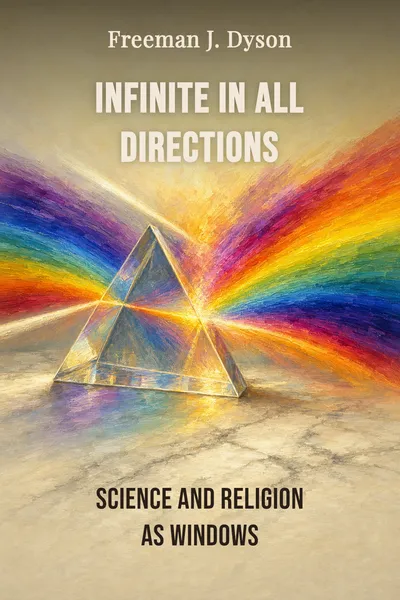
Infinite in All Directions
Science and religion as windows
Description
In April and November of 1985, Freeman Dyson stood before audiences in Aberdeen, Scotland, to deliver the Gifford Lectures — a series endowed a century earlier to promote the study of natural theology, the attempt to reach God through reason rather than revelation. Dyson was an unlikely fit. He was a physicist at the Institute for Advanced Study in Princeton, a man who had helped rebuild quantum electrodynamics in the late 1940s and had spent decades thinking about nuclear weapons, spaceflight, and the origin of life. He was not a theologian, and he made no pretense of proving anything about God. What he brought to Aberdeen instead was a naturalist's habit of looking hard at the world and refusing to tidy it into a single story.
The lectures became the book Infinite in All Directions, published in 1988. It ranges across cosmology, biology, the arms race, and the far future of the universe, held together less by argument than by a temperament. Dyson kept returning to one image: that science and religion are two windows through which human beings look out at the same world. Neither window shows the whole view. Neither cancels the other. The trouble starts, in his telling, only when someone insists on boarding one of them up and declaring that the remaining view is complete.
That image is easy to nod at and easy to misread as a polite truce. Dyson meant something more specific and more demanding — a claim about how many kinds of knowing the world actually rewards, and about why a universe as strange and various as ours resists being explained from any single vantage point at all.
The question we’re asking : What does a physicist mean when he calls science and religion two windows on the same world, rather than rival accounts of it?What we’ll see : A working scientist's case for diversity over unity, told through cosmology, evolution, and the future he thought the universe was open enough to hold.
Table of contents
01Chapter 1 — The lectures behind the book
The Gifford Lectures have a long and slightly awkward history. Founded by the Scottish judge Adam Gifford in 1888, they were meant to advance natural theology — knowledge of God pursued without appeal to scripture or miracle. Over the decades the lectureship drifted, and by the time it reached Dyson it had hosted plenty of speakers who used the platform to talk about almost anything. William James had given a famous set on religious experience; others had turned the podium toward physics or philosophy. Dyson accepted the invitation knowing he could not deliver theology in any orthodox sense, and he decided instead to talk about the things he actually knew, and to let the religious question sit at the edge of the room rather than in the center of it.
What he knew was a great deal. Dyson had come to America from England after the war, joined the circle around Robert Oppenheimer at Princeton, and made his name showing that the rival formulations of quantum electrodynamics by Richard Feynman, Julian Schwinger, and Sin-Itiro Tomonaga were secretly the same theory. He was, by temperament, a synthesizer who distrusted grand syntheses — someone drawn to the messy edges of problems rather than to the clean cores. The lectures reflect that. They move without much apology from the smallest scales of particle physics to the largest questions about the fate of the cosmos.

02Chapter 2 — Diversity as the master principle
If one idea runs under everything in the book, it is Dyson's preference for diversity over unity. Most popular science of his era sold the opposite dream: the search for a single unified theory, a final equation that would fold all of physics into one line. Dyson respected that quest — he had contributed to it — but he did not believe the world would ultimately reward it. Wherever he looked, he found not simplification but proliferation. The closer science examined nature, the more kinds of thing it turned out to contain.
He drew the point most vividly from biology. Life on Earth had not converged toward a single optimal form; it had exploded into millions of species, filling every niche, trying every strategy, wasting resources with a generosity that no engineer would tolerate. Dyson read this not as inefficiency but as a fundamental feature of how the world works. Evolution, in his view, was a machine for generating variety, and variety was the thing that made survival across changing conditions possible. A world of one perfect organism would be a fragile world. A world of countless imperfect ones was resilient.
03Chapter 3 — Two windows, not one wall
This is where the book's central image earns its keep. Dyson proposed that science and religion are two windows through which people look at the world, and that the reality outside is bigger than either frame can capture. Science works by observation, measurement, and the discarding of what cannot be tested. It is astonishingly good at what it does, and Dyson never suggested otherwise. But he insisted that its power came precisely from its narrowness. A method that succeeds by excluding whatever it cannot measure has, by construction, left things out.
Religion, in his account, was the name for the other window — the human effort to make sense of meaning, value, and the felt sense that existence matters. He was careful not to smuggle doctrine in through the back door. Dyson did not argue that any particular creed was true, and he was frank about his own loose, undogmatic relationship to the Christianity he had grown up around. What he defended was the legitimacy of the window itself: the idea that questions science does not ask are not therefore empty questions, and that people looking through the religious frame were seeing something real, even if the view was partial and often distorted.
04Chapter 4 — What the manifold does to certainty
The window metaphor does quiet work that only shows up when we step back from it. A window is not an explanation competing with another explanation; it is a limited opening onto something that exceeds it. To call science and religion windows is to say, before any particular argument, that whatever the world is, no single human vantage exhausts it. That reframing changes the temperature of the whole dispute. The usual fight assumes the two are rivals staking claims to the same territory, so that one must be winning. Dyson's picture assumes instead that both are partial by nature, and that partiality is not a defect to be overcome but the permanent human situation.
This is why the diversity running through the earlier chapters matters here rather than as a charming aside about beetles. A person convinced that reality is single will keep hunting for the one correct account and will treat every other as error waiting to be cleared away. A person convinced, as Dyson was, that reality is infinite in all directions holds beliefs differently — as views from somewhere, useful and real but never final. Certainty, on this reading, is less a mark of knowledge than a symptom of a boarded window.
05Conclusion
Dyson delivered his lectures in Aberdeen as a physicist who had spent forty years watching the world refuse to simplify. Infinite in All Directions is the record of what that watching taught him: that nature rewards variety over unity, that life spreads rather than converges, and that the universe he studied seemed built to stay open. The two-window image was his way of carrying that lesson into the oldest quarrel of all, the one between measurement and meaning. He did not settle it. He declined to.
Related books