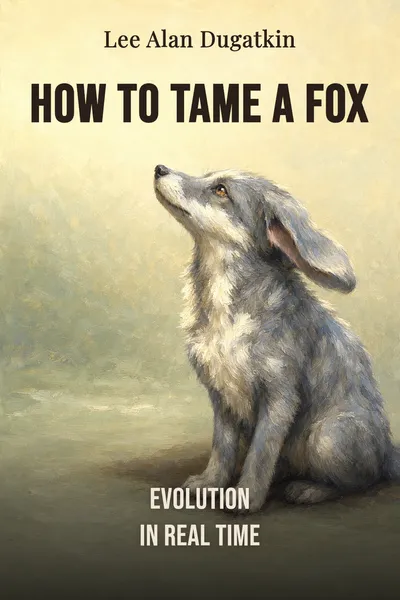
How to Tame a Fox
Evolution in real time
Description
In 1959, a Soviet biologist named Dmitri Belyaev traveled to a fox farm in the Soviet Union with a question no serious scientist was supposed to be asking. The farms bred silver foxes for their fur, thousands of animals in rows of cages, most of them snarling and biting at anyone who came near. Belyaev wanted to know what would happen if, generation after generation, you kept only the calmest ones. Not the prettiest, not the healthiest — just the ones least afraid of a human hand. He suspected that if he did this for long enough, something remarkable would emerge. He was more right than he could have known, and faster than anyone imagined.
The idea was audacious. Dogs took something like fifteen thousand years to emerge from wolves, a slow drift across the whole span of human prehistory. Belyaev wanted to compress that process into a scientist's lifetime and watch it happen in front of him — to run the tape of domestication in real time, in the cold of Siberia, with a young researcher named Lyudmila Trut doing the day-to-day work in the cages. Within a handful of generations, the foxes began to change. They wagged their tails. Their ears went floppy. Their coats broke into patches of white. And they started, unmistakably, to want human company.
Lee Dugatkin, a biologist and science writer, tells this story together with Trut herself, who has run the experiment since Belyaev's death in 1985. It is partly the story of an idea about evolution, and partly the story of the people who kept it alive through Soviet science politics, chronic underfunding, and the collapse of the country around them. The two threads are hard to separate, which is the point.
The question we’re asking : What can a few decades of breeding foxes tell us about how thousands of years of domestication actually work?What we’ll see : How a forbidden question became one of biology's longest-running experiments, and what the foxes' changing bodies revealed.
Table of contents
01Chapter 1 — A geneticist in a country that had banned genetics
To understand why Belyaev's experiment was dangerous, you have to know what kind of science was allowed in the Soviet Union at the time. For decades, Soviet biology had been dominated by Trofim Lysenko, an agronomist who rejected the entire field of genetics as bourgeois pseudoscience. Under Lysenko, believing in genes could cost you your job, your freedom, and occasionally your life. Belyaev's own brother, a geneticist, had been arrested and shot in 1937. This was the field Belyaev chose to work in anyway.
He was, officially, studying fur — how to improve the coats of foxes bred on Soviet fur farms, a perfectly respectable economic project. Underneath that cover, he was asking a genetics question that Lysenko's ideology forbade: was there a single underlying mechanism that turned a wild animal into a tame one? Belyaev's hunch was that domestication was not a hundred separate changes but one deep process, and that the trait doing the work was something like a shift in how an animal responds to fear and stress.

02Chapter 2 — One question, one rule: choose only the calm ones
The design was almost brutally simple. Each year, Trut and her colleagues would approach the foxes and score them on a single thing: how they reacted to a human. Did the animal cower and bite, or did it tolerate a hand, or — rarest of all — did it show curiosity, even interest? Only the calmest foxes, a small fraction of each generation, were allowed to breed. Everything else about the animals was left alone. No selection for looks, no selection for size. Tameness, and only tameness, was the filter.
The results came startlingly fast. By the fourth generation, a few fox pups did something no fox was supposed to do: they wagged their tails when a person came near. Within about six generations, some were whimpering for human attention, licking hands, competing to be picked up. Trut eventually created a class of foxes the team called the "elite" — animals that behaved, for all the world, like affectionate dogs. By later generations, more than half the population fell into this friendliest category. They were not trained. They were born this way, generation after generation, because their calm parents had been the only ones allowed to reproduce.
03Chapter 3 — The tame fox that came with a new body
Here is where the experiment stopped being merely charming and became genuinely strange. The team had selected for behavior — calmness toward humans, nothing else. But the tame foxes did not just act differently. They started to look different, in ways nobody had asked for. Floppy ears appeared, where wild foxes have stiff pricked ones. Tails curled up over the back. Coats broke into irregular patches of white and brown, especially a white blaze on the forehead. Some foxes had shortened, rounder snouts and shorter legs.
None of these traits had been on the checklist. They came along for the ride. And the list is uncannily familiar: floppy ears, curly tails, piebald coats, juvenile faces are exactly the features that distinguish dogs from wolves, cattle from their wild ancestors, domestic pigs from boar. Darwin himself had noticed, more than a century earlier, that domesticated animals across many species share a strange cluster of features. Belyaev's foxes were reproducing that whole cluster from scratch, and doing it in decades rather than millennia.
04Chapter 4 — What tameness turned out to be made of
Step back from the foxes and the experiment starts to look like a window onto how domestication works in general — including, quite possibly, the domestication that made dogs out of wolves. The old assumption was that early humans deliberately bred wolves for useful traits over countless generations. The foxes suggest something less intentional and more elegant. Perhaps the wolves that became dogs simply selected themselves: the calmer, less fearful animals crept closer to human camps and scraps, bred with each other, and were carried by their own tame biology toward the floppy-eared, patch-coated creatures we know. Nobody had to plan it. The single trait of tameness did much of the design.
This reframes what a domesticated animal actually is. It is not a wild animal that has learned manners. It is an animal whose developmental program has been shifted, so that features of youth — playfulness, reduced fear, a more open, curious temperament — persist into adulthood. The floppy ears and spotted coats are, in this reading, side effects of an animal that stays, in some deep sense, young. Belyaev's word for the whole idea was destabilizing selection: push on the stress system and a cascade of loosely connected traits comes unmoored together.
05Conclusion
More than sixty years after Belyaev walked into that fur farm, the experiment is still running. Fifty-some generations of foxes have now been bred, and Lyudmila Trut has been there for nearly all of it — through Belyaev's death in 1985, through the collapse of the Soviet Union that nearly starved the project of funding, through years when the survival of the foxes came down to whether anyone could pay for their food. The animals that greet visitors today wag their tails, whimper for attention, and press against the bars to be touched, indistinguishable in temperament from a lapdog.
Related books