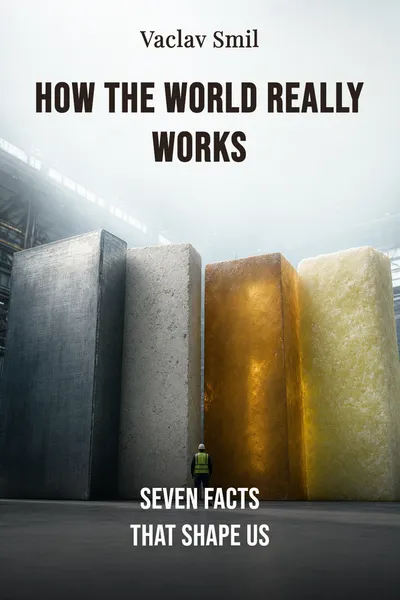
How the World Really Works
Seven facts that shape us
Description
Vaclav Smil is a Czech-Canadian scientist who spent decades at the University of Manitoba doing something deeply unfashionable: counting. He counts joules, tonnes of steel, calories per acre, barrels of oil. Bill Gates has said he waits for a new Smil book the way other people wait for a blockbuster, which is funny, because Smil writes the opposite of a blockbuster. His 2022 book, How the World Really Works, has no heroes, no villains, and no five-year plan to save the planet. It has arithmetic. And the arithmetic tells a story most of us, scrolling through opinions about energy and climate and supply chains, have never actually been told.
His premise is almost rude in its simplicity. We live surrounded by more information than any generation before us, and we understand the physical basis of our own survival less than our grandparents did. We know how to unlock a phone but not where the lithium in it comes from, or how much diesel it took to grow the wheat in this morning's toast. The people who run economies, Smil argues, are often no better informed than the rest of us. We have outsourced understanding to screens, and the screens rarely deal in tonnes and joules.
So Smil sits us down and walks us, patiently and without drama, through the material foundations of modern life. Not to comfort us, and not to frighten us either. He is allergic to both the doom merchants and the techno-optimists. What he offers instead is a reality check, grounded in facts that do not care how we feel about them.
The question we’re asking : What are the physical facts that actually determine whether modern civilization keeps running, and why do so few of us know them?What we’ll see : A scientist's tour of the energy, food, materials and risks that quietly hold up the world we take for granted.
Table of contents
01Chapter 1 — Energy is the currency everything else is priced in
Smil begins where he always begins: energy. Not as an abstraction, but as the thing that converts into everything else. Food is energy. Steel is energy. A city is a standing wave of energy pouring in continuously. Nothing happens without a flow of it, and for the entire modern era that flow has come overwhelmingly from fossil fuels. In 2020, despite decades of talk about a green transition, fossil fuels still supplied about 83 percent of the world's primary energy. In 1990 the figure was around 87 percent. Two generations of concern, trillions invested, and the needle has moved a few percentage points.
The reason is scale, and scale is where our intuitions fail. Smil is fond of pointing out that the global energy system is the largest infrastructure humanity has ever built, and you do not swap it out the way you upgrade a phone. He counts what wind turbines and solar panels are actually made of: steel, concrete, plastics, all of which today require fossil energy to produce. A single large wind turbine can contain hundreds of tonnes of steel and thousands of tonnes of concrete. The clean machine, for now, is born from the dirty one.

02Chapter 2 — The four pillars nobody photographs
If energy is the currency, four materials are what it mostly buys. Smil calls them the four pillars of modern civilization: ammonia, steel, concrete, and plastics. None is glamorous. None appears in a keynote about the future. Yet remove any one and the world we know collapses within a season. His point is that we have built a civilization on substances we barely think about, produced by processes we could not begin to describe.
Ammonia is the quiet giant. It is the basis of synthetic fertilizer, made through the Haber-Bosch process invented in the early twentieth century, and Smil estimates that roughly half the nitrogen in our bodies passed through that industrial reaction. Put plainly, about four billion people are alive today because we learned to pull nitrogen from the air and put it on fields. No ammonia, no fertilizer, no harvests at current scale, and a couple of billion of us are simply not here.
03Chapter 3 — Globalization runs on things, not clicks
We tend to picture globalization as data: money zipping between screens, apps connecting continents, the frictionless cloud. Smil drags the picture back to earth. Globalization is overwhelmingly the movement of physical stuff across physical distance, and that movement is powered by some of the least visible engines on the planet. The diesel engine and the marine turbine, not the microchip, are what actually shrank the world.
He lingers on the ocean-going container ship because almost nobody does. Around 90 percent of world trade by volume travels by sea. A single large vessel can carry twenty thousand containers, burning heavy fuel oil in a way that makes intercontinental shipping astonishingly cheap per item. The reason a garment sewn in Asia costs almost nothing to bring to a European shelf is not clever software. It is a very large ship and a very dense fuel. The invisible cheapness of modern life is a physical fact.
04Chapter 4 — The gap between the fear we feel and the risk we run
Having counted the machinery of survival, Smil turns to how badly we judge the risks to it, and this is where his stance sharpens into a worldview. We are, he shows, spectacularly bad at matching our fears to the actual odds. We dread the rare and vivid, the plane crash and the terrorist, while shrugging at the common and dull, the poor diet and the car ride, which quietly kill in far larger numbers. Our sense of danger is tuned by narrative, not by frequency.
On the biggest question, climate, Smil refuses both available comforts. He does not indulge the fantasy that a few good years of policy will fix it, and he has no patience for the counter-fantasy that it is a hoax or a trivial worry. Climate change is real, serious, and, crucially, extremely hard to solve fast, precisely because it is entangled with the energy and the four pillars he has just described. There is no clean lever to pull. Anyone selling one, in either direction, is selling a story rather than a fact.
05Conclusion
The scientist who spent his career counting joules and tonnes ends not with a forecast but with a posture. Smil declines to tell us whether the future is bright or doomed, because he thinks the honest answer is that we do not know, and that the range of outcomes is wide and largely in our hands. What he insists on is that any useful conversation about that future has to start from the same place his book does: the physical facts of energy, food, materials, and the machines that move them. Before we argue about what to do, we should agree on what is.
Related books