

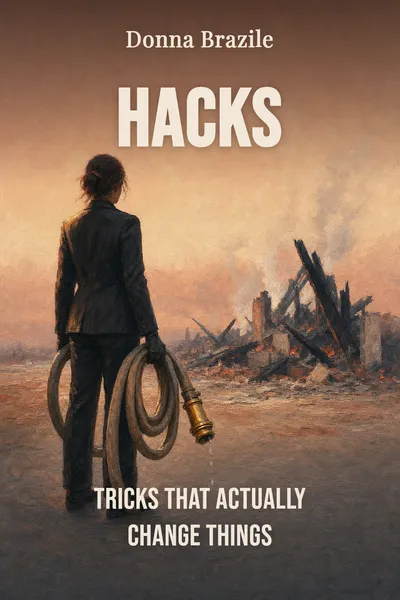
Hacks
Tricks that actually change things
Description
In the summer of 2016, Donna Brazile got a phone call that would rearrange her year. The FBI wanted the Democratic National Committee to know that its computer network had been compromised — and had been for months. Brazile, a veteran operative who had run Al Gore's 2000 campaign and spent decades inside Democratic politics, was not yet running the DNC when the intrusion began. She would be by the time the full scale of it landed, thrust into the chair after her predecessor resigned in disgrace over the very emails that had been stolen and leaked. Her book, "Hacks," is the account of what it felt like to inherit a burning building and be handed the hose only after the fire was out.
The title works on two levels, and Brazile means both. There is the literal hack — Russian intelligence inside the party's servers, reading the mail, feeding the contents to WikiLeaks at moments calibrated for maximum damage. And there is the older sense of the word, the political operators and shortcuts and quiet fixes that make a party run. "Hacks" is a book about how a foreign intrusion exploited an organization that had already been hollowed out from the inside, and about a woman trying to hold the thing together while the ground moved under her.
Brazile writes as an insider who decided to stop protecting the institution and start describing it. The result made a lot of people in her own party furious, which tells you something about how close it cut. She is not settling scores so much as insisting that the story be told accurately — that a hacked election was also a story about money, control, and a party that had quietly stopped being able to defend itself.
The question we’re asking : What happens when a foreign intrusion meets a political party that was already fragile from within?What we’ll see : A firsthand account of the 2016 breach, the finances and power struggles behind it, and what the whole episode exposed about institutions we assume are solid.
Table of contents
01Chapter 1 — A phone call in the dark
Brazile begins with the texture of dread rather than a tidy timeline. The DNC's network had been penetrated, and the people running the committee were slow to grasp what that meant. When the FBI first reached out, the warning traveled through the organization the way bad news often does — muffled, doubted, filed for later. By the time anyone treated it as an emergency, the intruders had been reading internal communications for the better part of a year. The technical breach was real, but Brazile's point is that the institutional response to it was almost worse than the breach itself.
She frames the early chapters around the human cost of the leaks. When WikiLeaks began releasing DNC emails in July 2016, on the eve of the party's convention, the immediate casualty was the committee's chair, Debbie Wasserman Schultz, whose messages suggested the party apparatus had tilted against Bernie Sanders. The staff were shattered. One of them, Seth Rich, had been murdered that summer in an unsolved shooting, and his death became the raw material for conspiracy theories that Brazile watched metastasize online with a mixture of grief and fury.

02Chapter 2 — The party that had already been hollowed out
The most contested passages of "Hacks" have nothing to do with Russia. They concern money. Brazile describes arriving at the DNC to find a party that was, in her telling, effectively broke — carrying debt from the 2012 cycle, dependent on the Obama campaign's fundraising machine, and structurally weaker than its public confidence suggested. An organization that presented itself as a formidable national operation was, behind the curtain, running on fumes.
Her account of the joint fundraising arrangement between the DNC and the Clinton campaign became the book's flashpoint. Brazile writes that the agreement gave the Clinton operation significant control over the committee's finances and decision-making well before the primary had been decided — a level of coordination she found troubling once she understood its terms. She stops short of the strongest reading her critics ascribed to her, but she does not soften the picture of a party whose independence had been quietly compromised by the candidate best positioned to fund it.
03Chapter 3 — Running a campaign with the lights off
From the chair, Brazile watched the general election unfold with a growing sense that the party could see less than it thought. The polling looked reassuring. The map looked manageable. But the leaked emails kept arriving in waves, each drop timed to bleed into a news cycle, and the committee had no way to get ahead of a story it could not predict. She describes the peculiar helplessness of an operation reacting to its own stolen words, always a beat behind the people releasing them.
Her frustrations with the Clinton campaign run through these chapters. Brazile felt the campaign underestimated the danger signs in states it assumed were safe, and she recounts pushing, sometimes fruitlessly, for more attention and resources to the ground game in places the models had written off. The tension was partly personal and partly structural — the same imbalance of power that had shaped the party's finances also shaped whose warnings got heard. When the person paying the bills is also the person setting strategy, dissent has nowhere to land.
04Chapter 4 — What a hacked election reveals about institutions
Step back from the specifics and "Hacks" becomes a book about how fragile solid-looking institutions actually are. The DNC, from the outside, was a permanent fixture of American life — a national party with a century-plus of history, offices, staff, and a seat at every table. From the inside, Brazile found something closer to a shell that had been coasting on reputation, its capacity to defend itself eroded by debt, dependency, and the assumption that nothing catastrophic would ever come for it. The gap between the public image and the private reality is the book's real subject.
Brazile's insight is that a foreign intrusion did not defeat a healthy organization. It found a weakened one and pushed. The Russian operation succeeded not because it was unstoppable but because the target had spent years neglecting the boring work of resilience — securing systems, keeping finances independent, maintaining the internal trust that lets an organization respond to a crisis without tearing itself apart. Every one of those defenses had been allowed to thin. When the pressure came, the structure bent where it had already cracked.
05Conclusion
Brazile left the DNC after the election, having steered it through a stretch that would have broken most operators. "Hacks" was her attempt to describe what she saw before the account hardened into myth — the FBI's early warning, the leaks timed for maximum damage, the debt, the fundraising arrangement, the campaign that could not quite hear its own alarms. She wrote it knowing it would cost her friendships and standing inside a party she had served for decades, and she wrote it anyway, because the version circulating publicly left out the parts that mattered most to her.