Gravity
How Einstein bent spacetime
Description
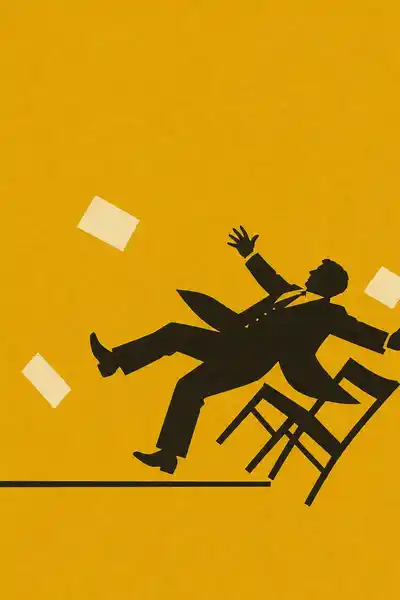
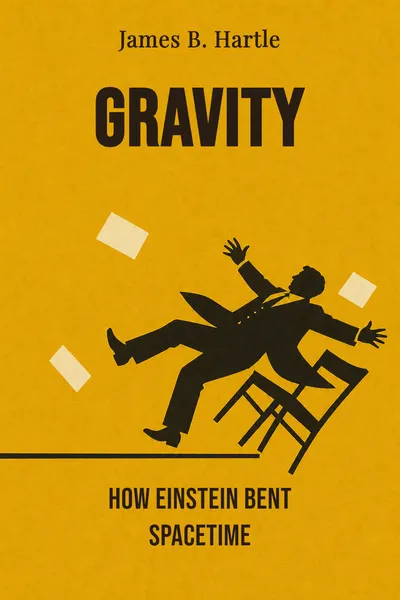
In 1907, a patent clerk in Bern named Albert Einstein was sitting at his desk when what he later called the happiest thought of his life occurred to him: a person falling from a roof does not feel their own weight. During the fall, they and everything around them drop together, so gravity, in that instant, simply vanishes from their experience. It is an ordinary observation — anyone who has ridden a fast elevator down has felt a whisper of it — and Einstein spent the next eight years turning it into the most radical rewrite of physics since Newton. The result, published in 1915, was general relativity: the idea that gravity is not a force pulling on things, but the shape of space and time itself.
For most of the twentieth century, that idea lived behind a wall of intimidating mathematics. Learning it meant years of abstract differential geometry before you ever reached anything you could point a telescope at. James B. Hartle, a physicist at the University of California, Santa Barbara, decided to flip the order. In his textbook Gravity, first published in 2003, he puts the phenomena first — bending light, slowed clocks, orbiting stars, black holes — and brings in the machinery only when the physics demands it. The bet is that Einstein's theory is easier to understand when you start from what it predicts about the world.
That inversion is more than a teaching trick. It reflects something true about how the theory earns its keep. General relativity is not admired only because it is elegant, though it is; it is trusted because clocks on satellites, images of distant galaxies, and the tremor of colliding black holes all match what its equation quietly demands. The theory and the observation are stitched together at every step, and Hartle's book is an argument for reading them that way.
The question we’re asking : How does the abstract claim that gravity is curved spacetime turn into things we can measure, photograph and predict?What we’ll see : How Einstein reframed falling as geometry, how that geometry is written down, and how the same equation reaches from a bending sunbeam to the ringing of merging black holes.
Table of contents
01 Chapter 1 — The apple that fell wrong
Newton's picture of gravity had worked for two centuries and worked beautifully. A mass pulls on another mass across empty space, instantly, with a force that weakens with distance. It predicted the orbits of planets, the return of comets, the tides. There was really only one thing wrong with it, and it was subtle enough that almost nobody worried: the force was supposed to act instantly, across any gap, with no explanation of how one body could reach out and tug another it never touched. Newton himself was uneasy about it and said, more or less, that he was describing gravity, not explaining it.
Einstein's falling-person insight cracked the picture open. If someone in free fall feels no gravity at all, then gravity cannot be a simple force pulling on them — because a force you cannot feel is a strange kind of force. He noticed something else, an old fact hiding in plain sight. The mass that resists being pushed (inertia) and the mass that responds to gravity turn out to be exactly the same number, which is why a feather and a hammer, in a vacuum, fall at the same rate. Newton treated that as a coincidence. Einstein treated it as a clue.

02 Chapter 2 — The four-dimensional stage
To bend the road, you first have to say what the road is. Hermann Minkowski, who had taught the young Einstein in Zurich, had already shown a few years before general relativity that space and time are not separate things but a single fabric — spacetime — with three dimensions of space and one of time woven together. Events don't just happen somewhere; they happen somewhere and somewhen, and the interval between two events mixes distance and duration in a way that all observers, however they are moving, agree on. This four-dimensional stage is the object that gravity gets to reshape.
The tool for describing shape is the metric. It sounds forbidding, but the idea is almost tactile: the metric is the rule that tells you the distance between any two nearby points. On a flat sheet it is the familiar Pythagorean rule. On a globe, or a saddle, the rule changes from place to place, and that variation is precisely what we mean by curvature. In general relativity the metric of spacetime is not fixed in advance. It responds to whatever matter and energy are present, and it in turn dictates how everything moves through it.
03 Chapter 3 — Reading the equation like a map
At the center of everything sits one line: the Einstein field equation, written down in 1915. In words, it says that the curvature of spacetime on one side equals the distribution of matter and energy on the other. The physicist John Wheeler compressed it into a sentence that has never been improved on: matter tells spacetime how to curve, and spacetime tells matter how to move. The equation is a two-way conversation, and that mutual dependence is what makes it so much harder to solve than Newton's tidy formula.
Harder, but not impossible — and this is where Hartle's approach earns its reward. Rather than treating the equation as an abstraction to be admired, he works through the specific solutions that describe real situations. The first and most important came within months, from Karl Schwarzschild, computing while serving on the Russian front during the First World War: the exact geometry around a single spherical mass. That one solution governs the orbit of Mercury, the bending of starlight past the Sun, and, taken to its extreme, the black hole.
04 Chapter 4 — The physics we can actually see
Step back from the symbols and general relativity reveals itself as something other than a beautiful abstraction: it is a working instrument, valued because its predictions keep arriving on schedule. The theory's first triumph was watched during a solar eclipse in 1919, when Arthur Eddington's expedition measured starlight bending around the Sun by roughly the amount Einstein's geometry demanded. The observation made Einstein world-famous overnight, and it set the pattern for everything after — the theory proposes, and the sky is asked to confirm.
The confirmations have only accumulated, and many are astonishingly ordinary. The satellites in the GPS constellation carry clocks that tick at a slightly different rate than clocks on the ground, precisely because time runs faster where gravity is weaker. Without correcting for that relativistic effect, the navigation in a phone would drift by kilometers within a day. A theory born from a thought about a falling man now quietly keeps delivery drivers on the right street. This is Hartle's deeper argument in miniature: the geometry is not remote, it is embedded in the infrastructure of daily life.
05 Conclusion
The line runs unbroken from a daydream in a Bern patent office to the tremor of two black holes recorded in Louisiana. Einstein's happiest thought — that a falling person feels no weight — turned into the claim that gravity is the curvature of spacetime, and that claim turned into a single equation that we have been reading like a map ever since. Hartle's book is really a case for reading it that way: start from what falls, what bends, what ticks, and let the geometry follow.
Related books