Gravitation
How gravity shaped modern physics
Description
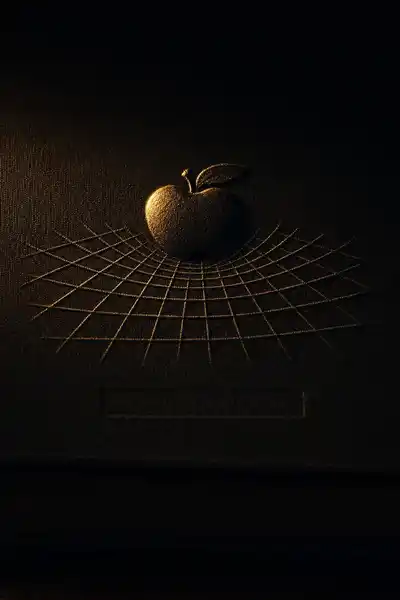
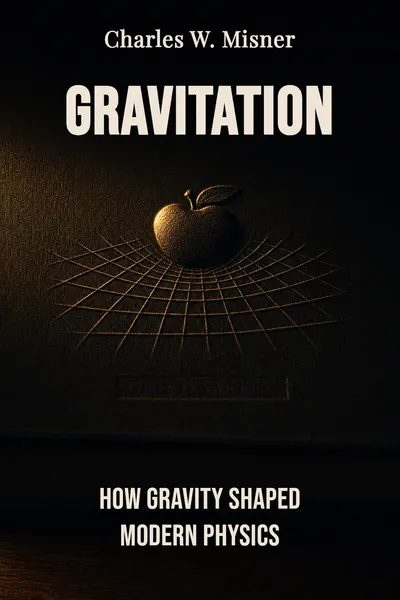
In 1973, three physicists — Charles Misner, Kip Thorne, and John Archibald Wheeler — published a book that weighed roughly six pounds, ran past 1,200 pages, and had a black cover with an apple falling toward a curved grid. Everyone who owns it just calls it the telephone book, or MTW, after the initials of its authors. It was a graduate textbook on gravity, which sounds like the least glamorous object imaginable, and it became one of the most beloved and most argued-over science books of the century. The review in Science called it "a pedagogic masterpiece." Students called it the book you could barely lift and never quite finished.
What makes the object strange is that it landed at a very particular moment. General relativity — Einstein's theory of gravity, published in 1915 — had spent decades as a kind of beautiful backwater. It was elegant, almost nobody worked on it seriously, and it had few experiments to keep it honest. Then, in the 1960s, the sky got interesting: quasars, pulsars, the cosmic microwave background, the first serious talk of black holes. Suddenly gravity was where the action was, and there was no single book that taught the whole thing to a new researcher who needed it fast.
Gravitation was written to be that book — a full year of physics, from why a dropped apple falls to how spacetime itself can ripple and collapse. It didn't just collect what was known. It took a stance on how the subject should be thought about, and on what a textbook is even for. Half a century later, physicists still open it, still quote it, still push back against it.
The question we’re asking : Why did a single enormous textbook come to define how physicists learn and think about gravity?What we’ll see : How three authors turned Einstein's theory into a way of seeing, and why the book they built still sits on the desk.
Table of contents
01Chapter 1 — The book that taught a generation how to think curved
The starting point of Gravitation is a fact so ordinary we stop noticing it: things fall, and they all fall the same way. Drop a feather and a hammer on the Moon, where there's no air to cheat, and they hit the ground together. Galileo knew this, Newton built a whole clockwork universe on it, and for two centuries it looked like a curious coincidence — why should the mass that resists a push be the exact same mass that gravity pulls on? Einstein's move, which the book treats as the emotional center of the whole subject, was to stop calling it a coincidence and start calling it the point.
If everything falls identically, then falling isn't really about a force at all. Inside a freely falling elevator, you float; you can't feel gravity, because gravity has become simply the shape of the space you're moving through. This is the equivalence principle, and Misner, Thorne, and Wheeler build outward from it patiently, because everything else follows. Mass and energy tell spacetime how to curve, and that curvature tells things how to move. The apple on the cover isn't falling toward the Earth so much as coasting along the valley the Earth has carved into spacetime.

02Chapter 2 — Geometry is the physics, and the physics is geometry
Once you accept that gravity is curvature, the job becomes measuring curvature honestly, and here the book makes its most demanding turn. To describe a bent spacetime you need tensors — mathematical objects that behave the same way no matter which coordinates a physicist happens to choose. The insistence is that the physics can't depend on the observer's arbitrary grid. Two people using different maps of the same landscape must agree on the mountains. Tensors are the machinery that guarantees the agreement, and Gravitation spends a long, careful stretch teaching readers to think in them fluently rather than to merely calculate with them.
The centerpiece of all this apparatus is the Einstein field equation, the compact relation that ties the curvature of spacetime on one side to the matter and energy filling it on the other. Written down, it looks almost modest. Unpacked, it is a set of coupled equations so tangled that exact solutions are rare and precious. The book treats each known solution as a landmark: the geometry around a star, the expanding universe of cosmology, the strange region around a collapsed mass where the equations point toward something that has no surface at all.
03Chapter 3 — Two tracks, one mountain
A book this size faces a practical problem: the reader who wants the big picture and the reader who wants every proof are not the same person, and often not even the same person on the same day. Gravitation solves this with an unusual structural trick. It runs on two tracks. Track one is the streamlined path — the ideas, the pictures, the results a working scientist needs to follow an argument. Track two is the full ascent, every derivation and technical subtlety spelled out. The reader chooses the route, and the typography marks which is which.
This sounds like a mere convenience, but it encodes a philosophy of learning. The authors did not believe understanding arrives all at once, in the correct logical order, the way a formal proof pretends. They believed you circle a hard idea, catch its shape from a distance, then come back and fill in the rigor once you know why it matters. The two-track design lets the same book serve a curious physicist skimming for intuition and a doctoral student grinding through the fine print, sometimes in the same afternoon.
04Chapter 4 — The textbook as an argument about a field
Step back from the equations and Gravitation becomes a story about what happens when a scientific field grows up. General relativity had spent fifty years as a scattered, half-neglected specialty — brilliant papers, few practitioners, no common curriculum. A field in that state has no shared language; two experts can work on the same theory and barely recognize each other's notation. What a definitive textbook does, at the right moment, is consolidate. It decides which ideas are central and which are footnotes, fixes the vocabulary, and hands the next generation a common ground to stand on.
That is a quieter kind of power than a discovery, but it may be more lasting. By choosing the geometric viewpoint as the spine of the subject, Misner, Thorne, and Wheeler shaped how tens of thousands of physicists would instinctively picture gravity for decades. A generation learned to think of spacetime as a flexible fabric first and to reach for the force picture second, because that is the order the book taught. When a way of seeing becomes the default across a whole discipline, the book that installed it has done something no single paper can.
05Conclusion
The apple on the black cover is still falling. Half a century after 1973, Gravitation remains on the shelves of people who study spacetime for a living, dog-eared and heavy, its two tracks still leading up the same mountain. The sky it was written to explain kept delivering: black holes went from contested speculation to routine astronomy, and in 2015 detectors finally caught gravitational waves — ripples in the fabric the book had taught a generation to imagine — earning Kip Thorne, one of its three authors, a share of a Nobel Prize two years later.
Related books