Gravitation and Cosmology
Gravity beyond pure geometry
Description
In 1972, the physicist Steven Weinberg published a thick textbook called Gravitation and Cosmology, and he did something in the preface that few textbook authors dare. He told the reader that the reigning way of thinking about his subject was, if not wrong, then at least misleading. General relativity had been taught for half a century as a theory about the shape of space and time, a theory of curved geometry through which planets and light supposedly rolled. Weinberg wanted to write the same physics with the geometry pushed off the stage.
This was not a small heresy. Einstein's theory had been sold, since 1915, on exactly the image Weinberg was setting aside: mass tells space how to bend, space tells mass how to move. Generations of students had learned gravity as geometry, and popular accounts still lean on the rubber-sheet picture today. Weinberg's book kept every equation and reversed the emphasis. Gravity, he argued, was better understood as one force among the others, a field like the electromagnetic field, and treating it as pure geometry only hid what it shared with the rest of physics.
He wrote it at a strange moment, too. The early 1970s were the first years in decades when general relativity had fresh data to answer to, and Weinberg knew more would arrive even as his pages went to the printer. So the book carried a double ambition: to arm the reader for evidence that hadn't landed yet, and to argue about what kind of theory gravity really is.
The question we’re asking : Why would a leading physicist write a whole book on gravity while quietly refusing to treat it as geometry?What we’ll see : How Weinberg rebuilt Einstein's theory as a field among fields, tied it to a flood of new data, and made the whole universe a problem in ordinary physics.
Table of contents
01Chapter 1 — A textbook written against its own tradition
To feel how contrarian the book was, it helps to remember what a relativity course looked like around 1970. The standard route ran through differential geometry: tensors on curved manifolds, the metric that measures distances, the curvature that encodes how much a region departs from flatness. Gravity, in that telling, was not a force at all. A falling apple was simply following the straightest available path through a warped four-dimensional landscape. The mathematics was elegant, and the elegance was part of the appeal. Einstein himself had leaned on the geometric language, and by the time Weinberg wrote, it had hardened into the natural way to teach the subject.
Weinberg's objection was not that the geometry was false. Every curvature tensor in his book is exactly where the geometers would put it. His objection was about emphasis, and emphasis, he insisted, shapes what a physicist can see. Give geometry the starring role and you quietly wall gravity off from the rest of physics. You stop asking why gravity should resemble electromagnetism, or how it might fit alongside the forces that hold nuclei together. You start treating it as a beautiful special case rather than as a member of the same family.

02Chapter 2 — Gravity as a field among fields
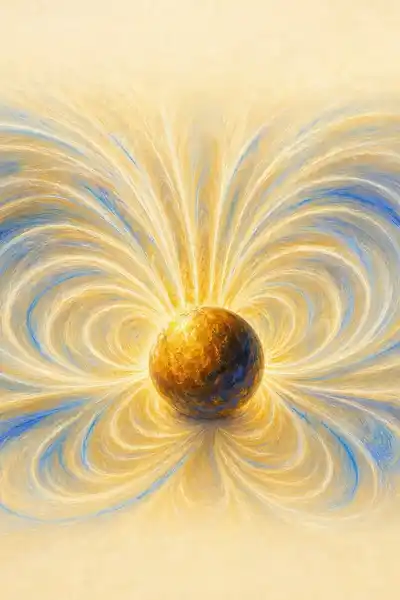
The alternative picture Weinberg pressed was that gravity is a field, in the same sense electromagnetism is a field. In this view the fundamental object is not the curvature of spacetime but the gravitational field itself, spread through a background, carrying energy and momentum, interacting with everything that has energy. Mass and energy generate the field; the field acts back on mass and energy. Written this way, gravity starts to look like the other interactions physicists were busy taming rather than a lonely geometric outlier.
The payoff of the reframing was conceptual reach. By the early 1970s Weinberg was among the physicists remaking the theory of the weak and electromagnetic forces in the language of fields and their carrier particles, work that would earn him a share of the Nobel Prize in 1979. Seen from that vantage, describing gravity as pure geometry looked like a habit that severed it from the most productive ideas in physics. If the strong and electroweak forces were fields with associated particles, then treating gravity as merely the bending of space made it harder, not easier, to imagine it belonging to the same scheme.
03Chapter 3 — The decade of data that wouldn't hold still
The other half of the book's purpose was thoroughly practical. For most of its life, general relativity had been a theory with almost nothing to test it against. Its classic confirmations were few and famous: the bending of starlight measured during a 1919 eclipse, the slow shift of Mercury's orbit, the reddening of light climbing out of a gravitational field. For decades the theory sat gorgeous and largely unexamined, a set of predictions with too little experiment to press on them.
Then, roughly across the 1960s, the sky filled with things a gravitational theory suddenly had to explain. Quasars turned up in 1963, blazing objects so distant and so bright they demanded gravity operating at extreme scales. The cosmic microwave background, detected in 1965, handed cosmologists direct evidence of a hot early universe. Pulsars arrived in 1967. Precision radar bouncing off planets and refined clocks made the old solar-system tests sharper by orders of magnitude. General relativity, long a spectator sport, was abruptly a subject with homework due.
04Chapter 4 — The universe as a physics problem
What ties the two ambitions together is a single instinct about how physics ought to be done, and it becomes clearest when Weinberg turns to cosmology. Treating the whole universe as an object of study can invite a certain grandeur, a temptation to speak in the register of first and last things. Weinberg refused the register. The expanding universe, its early hot state, the abundance of the light elements cooked in its first minutes, the microwave glow left behind, were all, to him, ordinary physics problems that happened to be very large. The same field equations, the same nuclear reactions, the same willingness to be checked against a number.
This is where the demotion of geometry does its real work. Insist that gravity is geometry, that cosmology is about the shape of everything, and the subject drifts toward the contemplative and away from the calculable. Insist instead that gravity is a field like the others and the universe becomes something you can compute, predict, and test, a laboratory rather than an icon. Weinberg wanted cosmology brought fully inside physics, subject to the same discipline of measurement as anything studied on a bench.
05Conclusion
Gravitation and Cosmology did what its author intended on both fronts. It handed a generation of physicists a working account of general relativity built from a physical principle rather than from geometry, and it assembled the era's evidence into a picture sturdy enough to absorb the results still coming. Weinberg had written the book precisely for a subject in motion, and a subject in motion is what he got: gravitational waves, dark energy, ever finer tests of the theory, most of it arriving well after the ink dried.
Related books