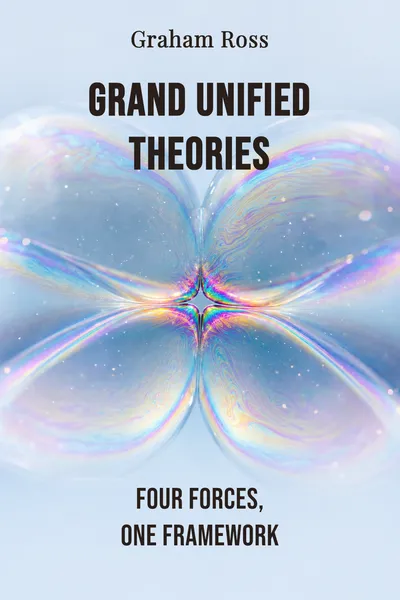
Grand Unified Theories
Four forces, one framework
Description
Look closely at the list of forces that run the physical world and something strange happens. There are four of them — gravity holding planets in orbit, electromagnetism running every wire and nerve, and two shorter-range forces, the strong one gluing atomic nuclei together and the weak one governing certain kinds of radioactive decay. Four separate stories, four separate strengths, four sets of rules. For most of the twentieth century that was simply the inventory: nature came in four flavors and you learned each one on its own terms. Graham Ross's book starts from a discomfort with exactly that arrangement — the suspicion that four is a placeholder, not an answer.
The suspicion isn't romantic. In the 1960s and 70s, physicists found that two of those forces — electromagnetism and the weak force — were the same thing viewed at high enough energy, splitting apart only as the universe cooled. If two forces could merge, why not three, or all four? Grand unified theories, and the gauge field theories that Ross builds them from, are the attempt to write the electromagnetic, weak, and strong interactions as facets of a single symmetry, with gravity waiting at the edge of the picture. It is a bold bet: that the messy quartet we observe is the low-energy debris of something cleaner.
Ross's book is a working physicist's account, aimed at people who will actually run the calculations. But underneath the machinery sits a question anyone can feel the pull of — whether the universe is, at bottom, built from one thing wearing four masks, and how we would ever know.
The question we’re asking : Can the four fundamental forces be described as fragments of a single underlying symmetry — and what would confirm it?What we’ll see : How gauge theories fold the forces together, why that unity hides itself, and what a beautiful theory owes to the experiments that haven't arrived yet.
Table of contents
01Chapter 1 — The forces refuse to stay separate
The starting point of Ross's book is a tool rather than a claim: gauge field theory. The idea sounds abstract but the intuition is manageable. A gauge symmetry is a rule saying that certain changes you could make to your description of a system — rotating an internal label at every point in space — must leave the physics untouched. Demanding that this hold everywhere, independently at each point, forces new fields into existence to keep the books balanced. Those fields turn out to be exactly the force carriers: the photon, the gluons, the W and Z particles. In other words, the forces aren't bolted on afterward. They fall out of insisting on a symmetry.
This was the quiet revolution of postwar physics, and it reframed everything. Electromagnetism had long been understood as a gauge theory built on the simplest possible symmetry. The strong force fell into place as a gauge theory too, with a richer symmetry describing the color charge that quarks carry and gluons exchange. The weak force joined via the electroweak synthesis worked out by Glashow, Weinberg, and Salam, which wove electromagnetism and the weak interaction into one structure. By the time Ross is writing, three of the four forces speak the same mathematical language.

02Chapter 2 — One symmetry, then it breaks
If the forces merge at high energy, why do we experience them as separate and unequal? Ross's answer runs through the mechanism physics already trusted from the electroweak case: spontaneous symmetry breaking. The underlying laws can be perfectly symmetric while the state the universe actually settles into is not. A pencil balanced on its tip obeys rules that don't prefer any direction; the moment it falls, a direction is chosen anyway. The symmetry is still there in the equations, just hidden by the outcome.
A grand unified theory takes a single large symmetry group — the classic candidate, worked through in the book, unites the color and electroweak structures into one — and lets it break in stages as the universe cools from its earliest instants. At the highest energies, one force. As things cool, the grand symmetry shatters, splitting off the strong force from the electroweak one. Cooler still, the electroweak symmetry breaks in turn, separating electromagnetism from the weak force and handing the W and Z particles their large masses while leaving the photon massless. What looks like four unrelated forces today is a fossil record of successive breakings.
03Chapter 3 — The proton that might not last forever
The most striking of those fingerprints is also the most unsettling. In the unified picture, quarks and leptons live in the same families, which means the symmetry allows processes that convert one into the other. Down at the energies of ordinary matter that possibility has a dramatic consequence: the proton, long assumed to be eternally stable, should very occasionally decay. A grand unified theory turns the bedrock of matter into something with a finite, if fantastically long, lifespan.
Ross treats this as the crux, because it is the rare prediction the framework offers that experiment can actually chase. The predicted lifetime is staggering — far longer than the age of the universe, so long that any single proton is overwhelmingly likely to outlast the cosmos. But probability rescues the experimenter. Gather a large enough number of protons in one place — a giant tank of purified water, watched by thousands of light detectors deep underground — and even a minuscule per-proton chance of decay means a handful of events should show up over a few years. You don't wait for one proton; you watch an ocean of them at once.
04Chapter 4 — What a unified guess is really for
Step back from the equations and grand unification becomes a case study in how physics reasons when a good idea outruns its evidence. Ross is writing about a framework that is mathematically compelling, internally consistent, and unifying in exactly the way physicists have learned to trust — and that remains, for all that, unconfirmed. The direct test lives at an energy we will never reach, and the best indirect test, proton decay, came back empty for the simplest model. The theory is beautiful and it is not proven. Both things are true at once, and the book asks its readers to hold them together.
What makes that posture defensible rather than wishful is the track record of the move itself. Unification has paid off before. Electricity and magnetism turned out to be one phenomenon. Electromagnetism and the weak force turned out to be one phenomenon, and that merger, once merely elegant, was confirmed when the W and Z particles were found with the masses the theory demanded. Each time, treating separate forces as facets of a single symmetry was not just tidy — it predicted things that were then observed. Grand unification is the same bet made one level deeper, and the case for taking it seriously rests on how often the bet has come good.
05Conclusion
The book ends more or less where the physics does: with a framework that has reorganized how we think about the fundamental forces without yet earning the final verdict. Three of the four forces already share the language of gauge theory, their strengths appear to converge at unreachable energies, and a single high symmetry breaking in stages would explain why we meet them as four unequal strangers. The one crisp thing the picture predicted for our energies — that protons decay — sent experimenters into deep mines to watch tanks of water, and the simplest version of the theory did not survive what they saw.
Related books