
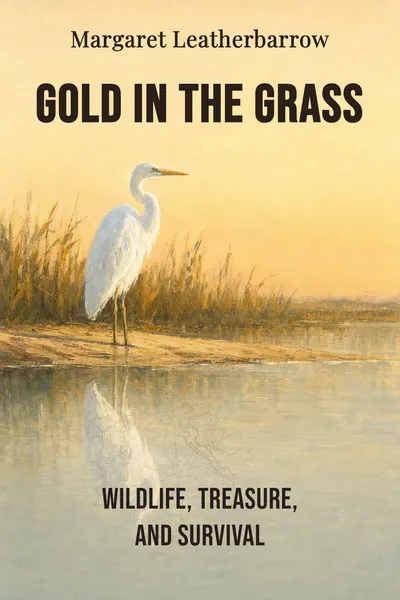
Gold In The Grass
Wildlife, treasure, and survival
Description
Margaret Leatherbarrow opens "Gold In The Grass" in one of the strangest landscapes on the continent: the Okavango Delta, a river that never reaches the sea. Water pours down from the Angolan highlands, spreads across the sands of northern Botswana, and simply vanishes into the Kalahari, leaving behind a seasonal maze of channels, islands and grasslands teeming with elephants, lions, wild dogs and birds. Into this place walks Sarah, a young woman with a stubborn passion for wildlife conservation and very little idea of what the bush will ask of her. She has come to join a team of researchers. She stays for something she never went looking for.
Because the delta, in Leatherbarrow's telling, keeps a secret under its reeds. Beneath the savannah that Sarah is there to protect lies a legend older than any research grant — a treasure that swallowed the ambitions of explorers for centuries and never gave anything back. When Sarah stumbles on the first thread of it, the book pivots. What began as a story about counting animals becomes a story about being hunted, as fortune seekers who have waited a lifetime for exactly this lead close in on her team.
That double movement — a naturalist's notebook turning into a treasure map, and the map turning into a target on her back — is the engine of the novel. Leatherbarrow uses the oldest shape in adventure fiction, the buried hoard, to ask a question that the genre usually skips past entirely. What is the gold actually worth, once you understand where it is lying and what would have to be torn up to reach it?
The question we’re asking : What does Sarah's hunt for buried treasure end up teaching her about the ground she was already trying to save?What we’ll see : A conservation posting that turns into a chase, and a legend that quietly changes what it means to strike it rich.
Table of contents
01Chapter 1 — A young woman heads into the delta
Sarah arrives with the equipment of a beginner: enthusiasm, a head full of documentaries, and the sense that wanting to do good is most of the job. Leatherbarrow is gentle with her but not soft. The Okavango does not care how much you love it. The research team Sarah joins is small, worn down by heat and funding worries, and long past the phase of romance about the work. They track lions, log sightings, patch broken vehicles, and argue about whether any of it is changing anything at all. Sarah's first lesson is that conservation is mostly patience, paperwork and diesel.
What the delta gives her instead of romance is scale. Leatherbarrow writes the landscape as a character in its own right — the flood arriving from a rainstorm that fell months earlier and a country away, the channels rerouting themselves overnight, the noise of a place that never really goes quiet. Sarah learns to read water levels, to sit still for hours, to notice the difference between the bush being empty and the bush pretending to be empty. Slowly, the team stops treating her as a visitor.

02Chapter 2 — The thing buried under the grass
The treasure, when Leatherbarrow reveals its shape, is deliberately half-legend. She resists handing the reader a neat inventory of chests and coins. What Sarah uncovers is first a story — fragments passed between old-timers, a name that surfaces in colonial-era records, a route that generations of explorers died trying to follow and none returned from with proof. The gold in the grass has the texture of a rumour that refuses to die precisely because it has never been confirmed.
This is a shrewd move. By keeping the hoard indistinct, the book lets it work on everyone differently. To the researchers, it is at first an irritation, a distraction from real work. To Sarah, it becomes a puzzle that fits her habits of mind — the same patience and pattern-reading that make her good at tracking animals make her dangerously good at reading a treasure trail. And to the outside world, once word begins to leak, it becomes a magnet. Leatherbarrow understands that a secret is only safe while nobody believes it.
03Chapter 3 — The chase across the savannah
Word has travelled. The fortune hunters who converge on the delta are not cartoon villains; Leatherbarrow gives them motives that rhyme uncomfortably with Sarah's own. Some are desperate, some are ruthless, some simply believe the treasure is theirs by right of having wanted it longest. What unites them is a willingness the researchers do not share — to burn the place down to get what is under it. The novel becomes a pursuit, and the pursuit is genuinely tense.
The landscape that felt majestic in the early chapters now turns hostile. The channels that make the delta beautiful also make it a trap: routes flood, islands strand, and the same water that shelters the wildlife can cut a team off from help for days. Leatherbarrow uses her setting with real skill, letting the delta be both refuge and threat depending on who is reading it. The team's knowledge of the ground is their only advantage over people with more money and fewer scruples.
04Chapter 4 — When the map stops pointing at money
The turn the book has been building toward is a reframing, not a plot twist. Standing at the site, Sarah understands that the true value of the treasure lies not in what it is worth on a market but in the ground it is buried under and the fragile web of life that ground holds up. To dig it out would mean tearing open a system that took the river ten thousand years to make. The gold in the grass, she realises, is worth more precisely because it stays in the grass.
This is where Leatherbarrow's use of the adventure form becomes pointed. The classic treasure story — the tradition that runs from Stevenson through a century of matinee serials — trains us to want the chest opened, the hoard counted, the hero rich. "Gold In The Grass" borrows all that machinery and then quietly refuses the payoff, because the payoff would cost the delta. The book is having a conversation with its own genre, using our appetite for the dig to make us feel the weight of leaving it undug.
05Conclusion
The young woman who arrived in the delta armed with documentaries and good intentions leaves it changed, and not in the way any of the fortune hunters would recognise. The treasure that pulled the story out of its research notebooks is still where it has always been, under the grass, guarded now less by legend than by a choice. Leatherbarrow closes the loop she opened — the naturalist's map that became a treasure map — by letting it become, finally, a map of what Sarah is willing to protect rather than take.