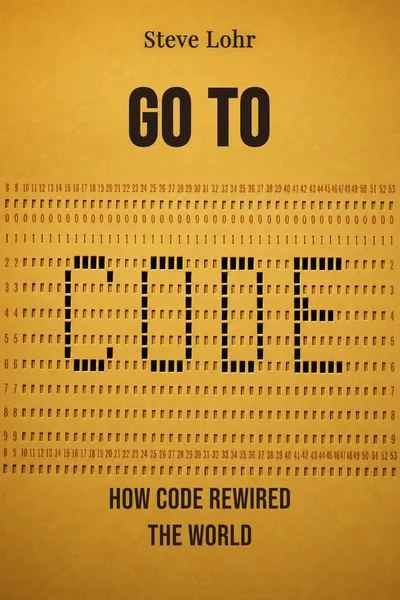
Go To
How code rewired the world
Description
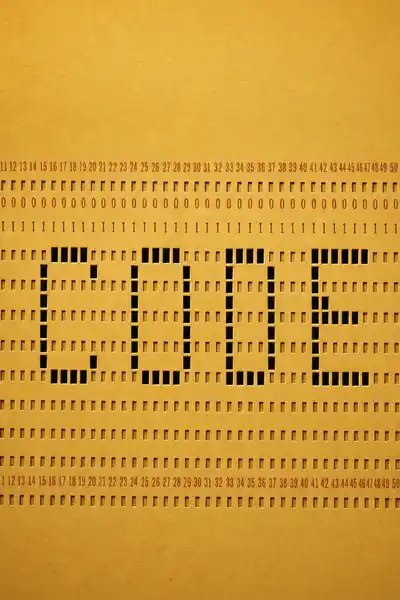
In the early 1950s, if you wanted a computer to do something, you spoke to it in numbers. Not commands, not words — raw machine instructions, strings of ones and zeros or the octal shorthand that stood in for them, fed into machines the size of rooms by a few thousand people worldwide who understood how. There was no software industry, because there was barely software. There were mathematicians, physicists, and a handful of odd, obsessive people who discovered they had a knack for thinking the way a machine had to think. They were, in every practical sense, a priesthood.
Steve Lohr, a longtime technology reporter for the New York Times, wrote Go To to trace what happened next — how that priesthood of a few thousand became a global profession of over six million, and how the strange act of writing instructions for a machine reshaped nearly everything. It is a history told through people: the wartime code-breakers and Cold War engineers, the language designers who fought over how a program should even be phrased, the misfits and the millionaires, and the open-source hackers who decided the code should belong to everyone.
What holds the book together is a single, quiet claim: that software is not really engineering, not really science, and not really art, but an uneasy blend of all three — and that the people drawn to it share a particular kind of mind. Lohr's interest is less in the machines than in the human beings who bent their thinking to fit them, and in what it cost, and what it built.
The question we’re asking : How did writing code go from an arcane skill held by a few thousand to the invisible substance the whole world runs on?What we’ll see : The people who taught machines to obey them, the languages that opened the gates, and a craft that reshaped the world without ever agreeing on what it was.
Table of contents
01 Chapter 1 — The priesthood of the first machines
Lohr opens in the years when programming had no name worth speaking. The first electronic computers — ENIAC, built at the University of Pennsylvania and unveiled in 1946, and its successors — were the province of engineers who thought in wiring and mathematicians who thought in equations. To make one of these machines calculate, you effectively rewired it or fed it instructions in its own native tongue: numeric codes tied to the specific hardware in front of you. Change the machine, and everything you knew became useless. The knowledge did not travel.
This produced a curious social fact that Lohr keeps returning to. The early programmers were not a profession; they were a cluster of talented individuals who had each, more or less independently, discovered they could think in the machine's terms. Many of the first were women — the ENIAC's original operators among them — because the men in charge assumed the coding was clerical drudgery beneath the real work of building the hardware. It was, in fact, the harder part, and Lohr is careful to record who did it.

02 Chapter 2 — The languages that broke the priesthood
The breakthrough, in Lohr's telling, was the idea that a program could be written in something closer to human notation and then translated automatically into the machine's own code. This was heresy at first. The reigning belief was that no automatic translator could ever produce instructions as efficient as those a skilled human wrote by hand, and that letting amateurs near the machine would only produce waste. Grace Hopper, pushing the concept of a compiler in the early 1950s, spent years being told it could not and should not be done.
The decisive case was FORTRAN, developed at IBM by a team led by John Backus and released in 1957. Backus, by his own cheerful admission, was in part just trying to make his own life easier — to spare himself the tedium of hand-coding. FORTRAN let scientists and engineers write formulas in a form they already recognized, and it worked well enough that the old objection collapsed. The translator's output was good, the time saved was enormous, and suddenly programming was something a physicist or an accountant could pick up without joining the priesthood.
03 Chapter 3 — The trade that never agreed on what it was
As the profession swelled, a question surfaced that Lohr never lets go of: what kind of activity is this, exactly? Programmers borrowed the vocabulary of engineering — the field would even name itself 'software engineering' at a famous 1968 NATO conference held partly in response to a sense of crisis, as projects ran late, over budget, and full of errors. But the practice never quite behaved like other engineering. Bridges do not develop mysterious flaws because a single character was typed wrong three months earlier.
Lohr's reporting circles the recurring 'software crisis' — the chronic tendency of large programs to become unmanageable, to defy schedules, to break in ways no one predicted. Every generation announced a cure: structured programming, object orientation, formal methods, new management doctrines. Each helped, none solved it. The difficulty, Lohr suggests, is intrinsic. Software is pure logic with no physical friction to constrain it, which means it can grow arbitrarily complex, and complexity is exactly what the human mind handles worst.
04 Chapter 4 — The invisible layer we all now live inside
Step back from the individual figures and Go To describes something larger than a profession: the arrival of an entirely new layer of the world, one made of instructions rather than matter. Lohr's argument, developed patiently across the decades he covers, is that software became the medium through which nearly every other human activity is now conducted — commerce, communication, medicine, warfare, art — and that it did so without most people noticing, because the whole point of good software is to disappear behind the thing it enables.
What makes this genuinely strange, in his telling, is that the layer was built by a craft that never settled its own identity. We have entrusted the operation of the modern world to something that is part engineering discipline, part scientific pursuit, part personal art form — and that has never fully behaved like any of them. The chronic unreliability the early programmers wrestled with did not go away as the field matured; it scaled up with it. The same logical fragility that made a single typo crash a 1950s calculation now sits inside the systems that move money, fly planes, and hold our records.
05 Conclusion
Go To ends more or less where the modern reader lives: in a world where writing software is an ordinary job held by millions, taught in schools, embedded in every industry, and utterly invisible in daily use. Lohr traces the whole arc — from the numeric codes fed to room-sized machines by a few thousand specialists, through the languages that pried the craft open, to the open-source ethos that turned code into a shared, living text. The distance covered in roughly half a century is the real subject, and it is vast.
Related books