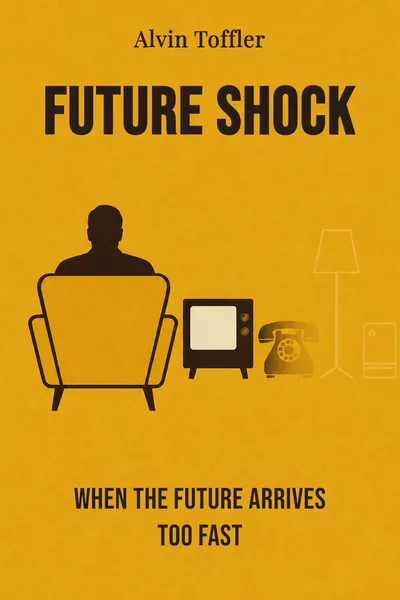
Future Shock
When the future arrives too fast
Description
In 1970, a former Fortune editor named Alvin Toffler published a book with a strange, clinical-sounding title. Future Shock ran to more than four hundred pages, sold in the millions, and named a condition that readers seemed to recognize the moment they saw it on the cover. Toffler borrowed the phrase from culture shock — the disorientation a traveler feels landing in a foreign country, unable to read the signals, exhausted by the constant effort of decoding. Future shock, he argued, was the same vertigo, except you never left home. The foreign country was your own, a few years from now, arriving early.
The claim underneath the title was deceptively simple. Toffler was not writing about any particular invention — not the computer, not the jet, not the birth-control pill, though all of them appear. He was writing about a single variable that he thought everyone had been ignoring: the rate at which things change. Human beings, he insisted, have a limited capacity to absorb novelty and process decisions, and industrial societies were now pushing that capacity past its limits. The result was not just anxiety. It was, in his telling, a genuine breakdown — physical, psychological, social — of people asked to adapt faster than adaptation allows.
More than half a century later, the book reads as both dated and eerily current. Some of its predictions missed; some of its scenarios now sound quaint. But the core diagnosis has outlived its examples, which is usually the sign of a book that found something real. What Toffler put his finger on was less a set of technologies than a feeling — one that has only grown more familiar since.
The question we’re asking : What did Toffler mean by future shock, and why did he treat speed itself, rather than any single technology, as the thing making people ill?What we’ll see : How a diagnosis of accelerating change reframed adaptation as a limited human resource that a society can exhaust.
Table of contents
01 Chapter 1 — The disease of change
Toffler opens not with a machine but with a symptom. People, he observed, were behaving like patients — confused, fatigued, irritable, prone to sudden withdrawals and irrational bursts of anger. He had spent five years, along with his wife and collaborator Heidi, interviewing scientists, executives, and ordinary families, and the same complaint kept surfacing in different vocabularies: the sense that the ground was moving too fast underfoot. He gave the complaint a name and, more provocatively, a clinical status. Future shock, he wrote, was a real illness — a response of the body and mind to being overstimulated by change.
The argument rested on an analogy he pressed hard. Culture shock had been well documented: drop someone into an unfamiliar society and their signals stop working, decisions become effortful, and the accumulated stress produces measurable exhaustion. But the culture-shock victim can at least go home. The future-shock victim cannot, because the disorienting country is the one they already live in, transforming around them while they stand still. Toffler was careful to insist this was not metaphor for effect. He drew on early work in stress physiology, on the idea that the body pays a price for every adaptive demand, and argued that a life of relentless adaptation runs down the same reserves that illness and trauma deplete.

02 Chapter 2 — Transience, or the throwaway life
The first of the forces Toffler identified was transience — the shrinking duration of our relationships to things, places, people, and organizations. He noticed it first in objects. The economy, he argued, was shifting from durability to disposability: paper dresses, non-returnable bottles, products designed to be replaced rather than repaired. This was not simply waste. It signaled a deeper change in how people related to the material world. When things are permanent, we form long attachments to them; when they are built to be thrown away, our bonds become shorter and shallower by design, and we get used to letting go.
The same acceleration, he claimed, was reshaping relationships that had always felt fixed. People were moving more often, so their ties to place had thinned into a series of temporary settlements. They changed jobs and whole careers with a speed that would have astonished their grandparents, so their loyalty to any single organization loosened. Even human relationships, Toffler suggested, were becoming modular — we now meet, use, and part from far more people than any previous generation, forming what he called limited-involvement friendships tuned to specific functions rather than the whole person. The old model of the lifelong bond was giving way to something faster and more provisional.
03 Chapter 3 — Novelty and the limits of choice
The second force was novelty — the sheer flood of the new. Toffler argued that industrial society was manufacturing unfamiliar situations faster than people could develop routines to handle them. Every routine we build is a way of not having to decide afresh, a saving of mental effort; the more novelty arrives, the fewer of our routines still apply, and the more of daily life becomes an active, effortful decision. A world of constant firsts is a world in which the brain never gets to coast. Toffler thought this helped explain the low-grade exhaustion he kept encountering — not laziness or weakness, but the fatigue of people forced to think consciously about things earlier generations could do on autopilot.
Then came the twist that gave the argument its edge. Toffler turned to choice, which everyone assumed was pure gain. More options meant more freedom, and more freedom meant a better life — this was close to an article of faith. He argued that the relationship inverts past a certain point. Choice is a good only up to the threshold where a person can actually handle it; beyond that, the proliferation of options stops liberating and starts paralyzing. He coined the term overchoice for the condition of being offered more decisions, more variants, more configurations than one can meaningfully sort. Freedom, taken too far too fast, curdles into a different kind of unfreedom.
04 Chapter 4 — Designing for the pace itself
The step Toffler took in the book's final movement is what separates it from a catalog of anxieties. Having diagnosed acceleration as the disease, he insisted the response could not be to attack any particular technology, because the technology was never the point. You cannot cure future shock by banning a machine, any more than you cure culture shock by redecorating one room of a foreign house. The variable that mattered was the rate, and the rate was the thing a society would have to learn to govern. This reframed the whole subject: the question was no longer whether the future was good or bad, but whether it was arriving at a tempo human beings could survive.
From there Toffler argued for something he called, only half-jokingly, the strategy of social futurism — a deliberate effort to anticipate change and pace it, rather than letting acceleration run unmanaged and picking up the casualties afterward. He proposed personal tactics, like consciously building islands of stability, zones of routine and permanence a person could hold constant to offset the churn everywhere else. And he proposed collective ones: that education stop preparing children for a static world and start teaching adaptability itself, that societies develop institutions capable of foresight, that people be brought into decisions about the futures being built for them rather than having those futures simply happen to them.
05 Conclusion
Toffler's specific forecasts have aged the way forecasts do — some vindicated, many overtaken, a few now merely charming. The paper dresses did not last; the disposable, provisional, high-choice, high-novelty life he sketched has spread further than even he imagined. Read now, the dated examples matter less than the frame around them. He took a diffuse modern feeling — the sense of running to stand still, of never quite catching up — and gave it a mechanism: adaptation as a limited resource, spent faster than it replenishes, by a pace nobody chose and everybody feeds.
Related books