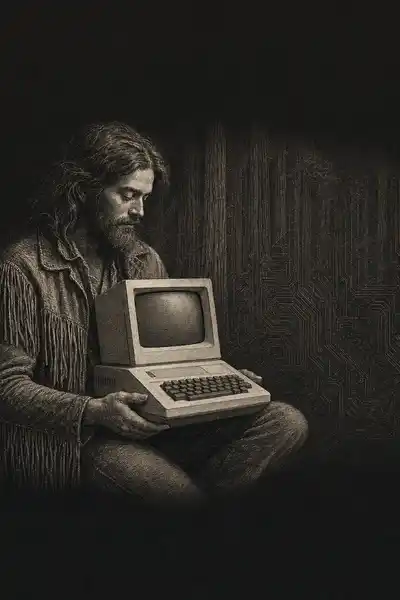
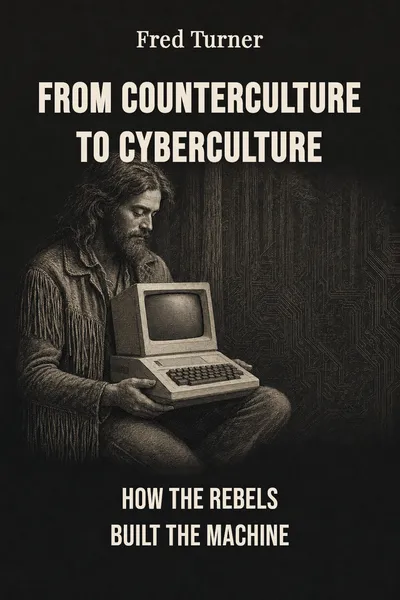
From Counterculture to Cyberculture
How the rebels built the machine
Description
In the early 1960s, the computer was a villain. Picture the room it lived in: refrigerator-sized cabinets humming behind glass, tended by men in white coats, funded by the Pentagon, spitting out punch cards that told you where to report and what you owed. To a generation coming of age against the Vietnam War, the mainframe was the physical embodiment of everything they were marching against—centralized power, the draft board, the military-industrial complex, the sense of being reduced to a number on a card that read, famously, do not fold, spindle, or mutilate. Students at Berkeley pinned those cards to their chests in protest. The machine was the enemy.
Thirty years later, the same object had switched sides. By the mid-1990s the personal computer wired to the internet was being sold as an instrument of liberation—a tool for building community, expanding consciousness, flattening hierarchy, and setting the individual free from the gray institutions of the postwar order. Wired magazine put digital entrepreneurs on its cover the way earlier magazines had put rock stars. The machine that had symbolized cold-war control had become the symbol of a coming utopia. And strangely, the language used to sell it—communal, holistic, personal, revolutionary—was borrowed almost word for word from the hippies who had once hated the thing.
How did that reversal happen? In From Counterculture to Cyberculture, the historian Fred Turner traces the surprising through-line connecting the back-to-the-land communes of the 1960s to the digital optimism of Silicon Valley. The bridge, it turns out, was not a wire but a small group of people who spent decades translating one world into the other—and one figure in particular who moved between both.
The question we’re asking : How did the computer go from cold-war villain to countercultural dream, and who did the translating?What we’ll see : A story of communes, a legendary catalog, and the man who taught a rebellious generation to see the machine as a friend.
Table of contents
01 Chapter 1 — The machine everyone learned to hate
To understand the reversal, we have to feel how deep the hatred ran. The computer of the early cold war was inseparable from the institutions that built it. The first electronic machines were funded by the military, designed to calculate artillery trajectories and, later, to coordinate continental air defense. The largest computing project of the 1950s, a Pentagon-backed radar network, was explicitly built to manage the threat of nuclear annihilation. The machine was born to run the war state.
Turner shows how thoroughly this image saturated the culture. Sociologists of the period described a new kind of organization man—the salaried employee whose individuality dissolved into the corporation, whose life was scheduled by systems he did not control. The computer was the beating heart of that vision. It stood for what critics called technocracy: rule by experts, planners, and machines, a society organized like a smoothly running program with no room for the human, the spontaneous, or the free.

02 Chapter 2 — The commune that wired itself
Turner's key move is to split the sixties in two. There was the New Left—the politically organized students who marched, protested, and tried to seize power through confrontation. And there was a second, less remembered strand he calls the New Communalists: the hundreds of thousands who abandoned politics for lifestyle, leaving the cities to found communes across the American West. They wanted to change the world not by fighting institutions but by transforming consciousness, one small self-sufficient community at a time.
And here is the twist that runs against every stereotype of the flower child. The communards were not anti-technology. Many of them were fascinated by tools—by geodesic domes, by whole-systems thinking, by the idea that the right gadget could set you free from dependence on the corporation and the grid. Their intellectual hero was Buckminster Fuller, the visionary engineer who preached that thoughtful design could do more for humanity than politics ever could. Their governing metaphor was the system: they read the cybernetics of Norbert Wiener, who described humans, animals, and machines alike as networks exchanging information and feedback.
03 Chapter 3 — Stewart Brand and the great translation
The translator was Stewart Brand. A Stanford-trained biologist, a veteran of Ken Kesey's psychedelic experiments, and a restless organizer of scenes, Brand had a rare gift: he could stand in two worlds at once and make each legible to the other. In 1968 he launched the publication that would become his life's signature, the Whole Earth Catalog—a fat, newsprint compendium of tools, books, and ideas for the back-to-the-land generation. Its slogan promised access to tools, and its premise was radical in its simplicity: give individuals the right instruments and information, and they can shape their own environment without kings, priests, or corporations.
The Catalog was, in Turner's reading, a paper network. It connected geographically scattered readers into an imagined community of tinkerers and seekers, all sharing knowledge across the pages. It reviewed camping gear beside cybernetics textbooks, beekeeping manuals beside early writing on computers. It made no distinction between hardware and consciousness. And it treated its own readers as contributors, blurring the line between producer and audience—a stance that would feel utterly familiar decades later online.
04 Chapter 4 — When the cold-war machine became the countercultural dream
Step back from the personalities and Turner's larger argument comes into focus: technologies do not carry their meanings inside them. A machine is just a machine. What tells us whether a computer is an instrument of control or of liberation is the network of people, publications, and gatherings that teaches us how to see it. The mainframe and the personal computer share the same silicon lineage. What changed between 1965 and 1995 was not chiefly the hardware but the story wrapped around it—and that story was written by the very people who had once feared the machine most.
This is why the through-line matters. The digital utopianism of the 1990s did not spring from nowhere, and it was not invented by engineers alone. It was assembled from countercultural materials: the commune's dream of a leaderless community, the cyberneticist's vision of the world as one connected system, Buckminster Fuller's faith in tools over politics, Brand's conviction that access to information could set individuals free. Silicon Valley did not reject the sixties. It absorbed them, and then sold them back to the culture as the future.
05 Conclusion
The computer that Berkeley students once pinned to their chests as a badge of protest ended up, a generation later, as the object those same milieus most wanted to sell the world. The reversal was not a change of heart about technology so much as a change of story. A small, mobile group of people—communards, cyberneticians, and a translator named Stewart Brand—spent thirty years carrying the counterculture's ideals across the gap that separated the farm from the network, until the machine that had stood for control could be experienced as the tool of freedom.
Related books