

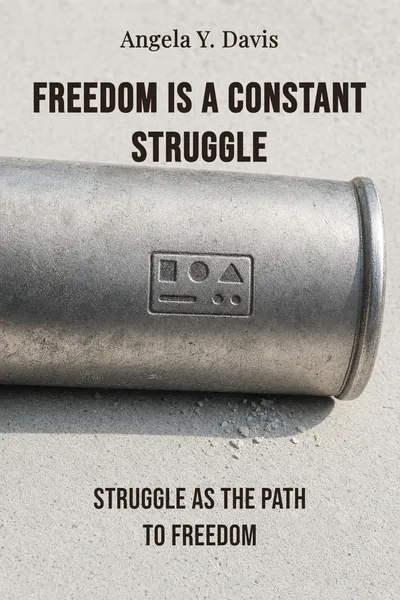
Freedom Is a Constant Struggle
Struggle as the path to freedom
Description
In August 2014, a police officer shot and killed Michael Brown, an unarmed eighteen-year-old, in Ferguson, Missouri. In the weeks that followed, as residents faced tear gas and armored vehicles on their own streets, messages started arriving from an unexpected place. Palestinians in the West Bank and Gaza were tweeting advice on how to handle tear gas — rinse with milk, not water, stay upwind. To many observers this looked like a coincidence of headlines. To Angela Davis, it was something else: two peoples separated by an ocean recognizing, in each other, the same machinery of state violence, sometimes even the same brand of weapon.
That recognition runs through every page of "Freedom Is a Constant Struggle," the collection of essays, interviews and speeches Davis published in 2016. By then she had spent roughly half a century inside movements — the Black liberation struggle, the campaign against South African apartheid, the long fight against what she calls the prison-industrial complex. The book is not a memoir of those years. It is an argument about how they connect, and about why the struggles that look separate on the news are, underneath, one struggle.
The through-line is unglamorous and deliberate. Davis keeps insisting that freedom is not a place a people finally reaches, and not a gift handed down by a charismatic leader. It is something built and rebuilt by ordinary people, across borders, and it is never finished. From that premise she reads the present through the past — and asks what solidarity would actually have to look like if we took the word seriously.
The question we’re asking : What links a police shooting in Missouri, an occupation in Palestine and an anti-apartheid boycott — and why does Davis call the connection freedom itself?What we’ll see : How a lifelong activist reads today's struggles against state violence through the movements that came before, and where she says liberation actually comes from.
Table of contents
01Chapter 1 — Ferguson is Gaza, Gaza is Ferguson
Davis opens most of these talks in the present, and the present she keeps returning to is Ferguson. The killing of Michael Brown, and the militarized response to the protests that followed, gave her a concrete image of something she had been arguing for decades: that American policing of Black communities and the machinery of occupation abroad are not distant cousins but close relatives. She points to a literal link. Police departments across the United States, including in the St. Louis area, have sent officers for training in Israel, and some of the same crowd-control tactics and equipment circulate between the two contexts. The tear gas canisters photographed in Ferguson carried the same manufacturer's markings as those used in the West Bank.
For Davis this is not a rhetorical flourish. It is evidence of what she means by the global reach of state violence. The technologies of control — surveillance, containment, the treatment of whole populations as suspect — move across borders even when the movements resisting them do not. Palestinians tweeting tear-gas advice to people in Missouri were not being poetic. They were recognizing a shared condition, and offering the practical knowledge that comes from living under it.

02Chapter 2 — The freedom movement was never only Black
Davis spends a good part of the book quarreling gently with how the Black freedom movement is remembered. The popular version is a story of great men — a march, a speech, a signed law — and then, supposedly, arrival. She has little patience for it. The version she insists on is collective, longer, and still unfinished. The people who built that movement were mostly anonymous, and many of them were women whose organizing made the famous moments possible in the first place.
Her favorite example is the Montgomery bus boycott. It is usually told as the story of Rosa Parks refusing to give up her seat, and then Martin Luther King Jr. leading the response. Davis reframes it. Parks was not a tired seamstress who happened to snap; she was a trained, seasoned organizer. And the boycott itself worked because thousands of Black women who cleaned houses across Montgomery agreed, for over a year, to walk. The boycott was carried on the aching feet of domestic workers, not on the shoulders of a single leader. That, she says, is what a movement actually is.
03Chapter 3 — Feminism that starts from the bottom
A recurring word in these pages is intersectional, and Davis uses it with precision rather than as decoration. She draws on the tradition of Black feminism — thinkers and organizers who insisted that race, gender, class and sexuality cannot be pulled apart because no one lives them separately. A Black woman working a low-wage job does not experience racism on Monday and sexism on Tuesday. She experiences them as a single, tangled condition, and any politics that addresses only one strand will fail her.
This is why Davis argues for what she calls a feminism that begins from the situation of the most marginalized rather than the most privileged. A feminism concerned mainly with breaking glass ceilings, she suggests, leaves most women exactly where they were. A feminism that starts from the domestic worker, the incarcerated woman, the undocumented migrant asks a different and more demanding set of questions — and, crucially, its gains would lift everyone above it too. She frames this not as charity but as method: start from the bottom and the whole structure comes into view.
04Chapter 4 — Freedom as a verb, never a possession
The title of the book is borrowed from an old freedom song, and Davis chose it carefully. The phrase insists on the word constant. Freedom, in her account, is not a noun you can own, store or inherit. It is closer to a verb — something a people does, and has to keep doing, or lose. This is the idea the whole collection circles back to, and it is the quiet reason she distrusts the tidy narratives of arrival she spent earlier chapters dismantling.
The claim has a hard edge to it. If freedom is a practice rather than a possession, then every gain is provisional. The rights won in one generation can be eroded in the next; the victories of the civil rights era did not abolish the machinery of racism so much as force it to change shape, resurfacing in mass incarceration and in the policing on display in Ferguson. Davis is not being pessimistic when she says this. She is refusing the fantasy that struggle has an end point after which everyone can rest. The work is the point.
05Conclusion
Those tear-gas tweets from Palestine to Missouri, where the book more or less begins, turn out to carry its whole argument. Two peoples who had never met recognized each other across a distance because they were up against the same thing, and that recognition became, briefly, a form of solidarity. For Davis this is not a heartwarming coincidence. It is a working model of how freedom moves — sideways, between struggles, carried by people who decide that someone else's fight is also theirs.