
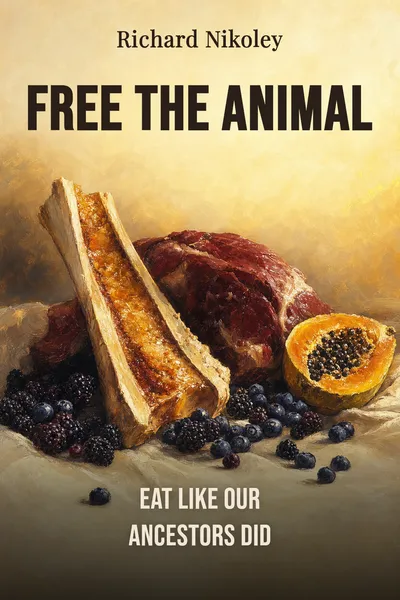
Free The Animal
Eat like our ancestors did
Description
In the mid-2000s, a software entrepreneur named Richard Nikoley was overweight, medicated for high blood pressure, and doing everything the official guidelines told him to do. He ate his whole grains, watched his saturated fat, kept his portions modest, and got heavier anyway. The numbers on the blood tests kept drifting the wrong way. What he did next was not especially scientific. He started writing about it online, on a blog he called Free the Animal, and he started eating in a way that every mainstream authority told him was reckless: more meat, more fat, far fewer of the grains and sugars that the food pyramid had put at its base.
The weight came off. The blood pressure normalized. The medication stopped. Nikoley was not a doctor or a nutritionist, and he never pretended to be — he was a self-experimenter with a comment section, and the book that grew out of the blog reads like it. Its argument is blunt: the body we carry around was shaped over hundreds of thousands of years by what our ancestors could hunt, catch, and gather, and the modern industrial diet of refined flour, seed oils, and sugar is a recent break with that inheritance. Reconnect with the older pattern, he says, and a lot of what we call chronic disease starts to loosen its grip.
It is a provocative claim, and Nikoley makes it with the confidence of a convert rather than the caution of a researcher. The interesting part is not whether he is right about every detail — he is not, and the field has kept moving since. The interesting part is what happens when someone takes the evolutionary premise seriously and follows it all the way down.
The question we’re asking : What is Nikoley actually arguing when he tells us to eat like our ancestors, and what does the claim rest on?What we’ll see : A self-taught argument about food, fat, and the gap between the body we have and the world we built for it.
Table of contents
01Chapter 1 — The blogger who lost the weight and kept the argument
Nikoley's story is the engine of the book, and he tells it without much modesty. By his early fifties he weighed well over two hundred pounds, carried the standard cluster of middle-aged complaints — high blood pressure, poor blood markers, low energy — and had followed conventional advice for years with nothing to show for it but a slow decline. He was, in his own telling, a case study in doing the right thing and getting the wrong result.
The turn came when he stopped trusting the guidelines and started reading the older thinkers of the low-carbohydrate and ancestral world — the ideas that would later travel under the banner of paleo. The logic was simple enough to fit on an index card. Agriculture is roughly ten thousand years old. Industrial food processing is barely a century old. The human genome is far older than either. For the overwhelming majority of the time our species has existed, nobody ate breakfast cereal, drank soda, or cooked with refined vegetable oil. If the body is adapted to anything, it is adapted to what came before all that.

02Chapter 2 — What the food pyramid got backwards
The central villain of Free the Animal is the official dietary advice of the late twentieth century — the food pyramid, with its wide base of bread, cereal, rice, and pasta and its narrow cautionary tip of fats and meats. Nikoley's charge is that this structure got the priorities almost exactly inverted, and that it did so for reasons that had as much to do with politics and momentum as with settled science.
His account leans on a story that has since become familiar in the low-carb world. In the 1970s and 1980s, American health authorities settled on the idea that dietary fat, and saturated fat in particular, was the main driver of heart disease and obesity. The advice that followed was to cut fat and load up on carbohydrates instead. Food manufacturers were happy to comply, replacing fat with sugar and refined starch in an endless line of low-fat products. Nikoley's point is that the decades of that advice coincided with the fastest rise in obesity and type-2 diabetes the country had ever seen. Correlation is not proof, and he knows it, but he treats the timing as too pointed to wave away.
03Chapter 3 — Fat, protein, and the fear that never fit the evidence
If the pyramid is the villain, the rehabilitation of fat is the book's central argument. Nikoley spends much of it dismantling the fear of dietary fat, and animal fat especially, that had defined mainstream advice for decades. Eat fat, he insists, and you do not automatically become fat or clog your arteries. The equation was always cruder than the biology.
He builds the case around a few load-bearing ideas. Fat is satiating in a way that refined carbohydrates are not, so a meal built on protein and fat tends to leave you full and steady rather than hungry again in an hour. Animal foods are dense in the nutrients bodies actually need — the fat-soluble vitamins, the complete proteins, the minerals in forms we absorb well. And the link between saturated fat and heart disease, treated as settled fact for years, turned out to be far shakier than the confident guidelines implied. Nikoley points to the reappraisals that were already underway as he wrote, in which large reviews struggled to find the clean connection the low-fat orthodoxy had promised.
04Chapter 4 — The body was never a machine to optimize
Underneath the diet advice, Free the Animal is making a larger claim, and it is worth taking seriously on its own terms. Nikoley's real subject is mismatch — the idea that a modern human is an animal living in conditions its body never evolved to handle. The processed food is only the most obvious symptom. He extends the same logic to how we move, or rather how we no longer do.
The title is not decoration. His argument is that we have caged ourselves. Our ancestors moved constantly and unpredictably — walking, carrying, lifting, sprinting when it mattered, resting when it didn't — and never once did a scheduled hour of steady cardio on a machine. Nikoley's fitness advice mirrors his food advice: stop treating the body as an engine to be tuned with the right inputs and start treating it as an animal that needs to do animal things. Move often at low intensity, lift heavy occasionally, sprint rarely, sleep when it is dark. The point is less any specific workout than the recovery of a lost intuition.
05Conclusion
Richard Nikoley never set out to write a nutrition textbook, and Free the Animal is not one. It is the record of a man who did everything right by the official standard, got sicker anyway, threw the standard out, and recovered — then spent years arguing that his experience pointed to something true about all of us. The strength of the book is its refusal to defer. It treats the reader as capable of running an experiment on their own body and reading the results honestly, which is more respect than most diet advice offers.