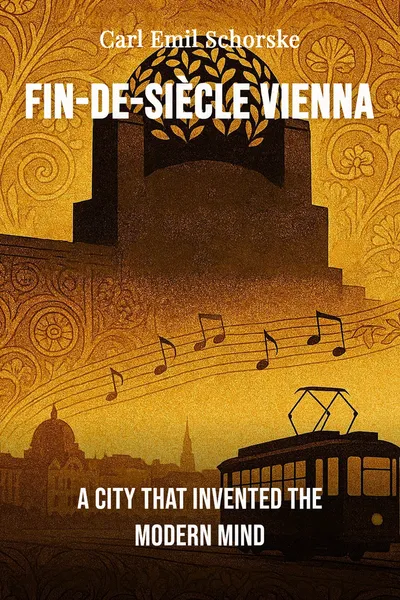
Fin-de-Siècle Vienna
A city that invented the modern mind
Description
In the last decades before 1900, Vienna was the capital of an empire that no longer quite worked. The Habsburg monarchy stretched across a dozen nationalities held together by a dynasty, an army, and a bureaucracy, and its liberal middle class had spent a generation building the Ringstrasse — the grand boulevard of parliaments, museums and opera houses that ringed the old city and announced, in stone, that reason and progress had won. Carl Schorske, an American historian, spent much of his life looking at that city and asking a strange question: why did so many of the ideas that made us modern — psychoanalysis, abstract painting, atonal music, a new architecture — all appear there, at the same time, in the same narrow social world.
His answer, gathered in the 1979 book that shares this city's name, is not the flattering one. Vienna did not invent the modern mind because it was confident and rich and cultured. It invented the modern mind because its confident, rich, cultured liberal class was losing its grip on power, and its sons — the generation of Freud, of Klimt, of Hofmannsthal — turned inward when the public world stopped answering to them. The Ringstrasse was still going up while the politics it celebrated was already crumbling underneath.
What makes Schorske's account unusual is that he refuses to treat culture and politics as separate rooms. The painter, the analyst and the party organizer are, in his telling, breathing the same air, reacting to the same defeat, each in their own medium. Read together, they tell one story rather than several — the story of a class that lost the city and found the psyche.
The question we’re asking : Why did psychoanalysis, modern painting and a new kind of mass politics all emerge from one small Viennese world at the same moment?What we’ll see : How a liberal generation's political defeat pushed its most gifted sons out of the public square and into the interior it would spend the next century mapping.
Table of contents
01Chapter 1 — The liberals who ran out of room
The story starts with a victory that curdled. In the 1860s the Austrian liberals finally got much of what they had wanted: a constitution, parliamentary government, a free press, careers open to talent. This was largely a bourgeois achievement, and its monument was the Ringstrasse, laid out on the ground where the old city walls had stood. Schorske reads that boulevard closely — each building a costume, the parliament dressed as a Greek temple, the city hall as Gothic, the university as Renaissance. The liberals were borrowing the wardrobe of every past age to dress a present they believed was rational and permanent.
The permanence did not last a generation. Liberal government rested on a narrow franchise, and once the vote widened, the liberals were outnumbered by the very forces their rationalism had dismissed — Catholic conservatives, German nationalists, the new anti-Semitic populism of Karl Lueger, and a growing socialist movement. By the 1890s the party of reason was a shrinking faction watching louder, angrier movements take the streets and eventually city hall. Lueger became mayor of Vienna in the mid-1890s over the emperor's own reluctance, on a platform the liberal fathers found unthinkable.

02Chapter 2 — Freud reads his own defeat
Sigmund Freud was a liberal's son to the core. He trained as a neurologist, believed in science, and dreamed of the kind of public career the liberal order had promised ambitious, talented men — including ambitious, talented Jewish men, whom liberalism had briefly welcomed. The rise of Lueger's political anti-Semitism made that career harder and colder. Schorske follows this frustration into the most private text Freud ever wrote: the dreams he analyzed in "The Interpretation of Dreams," published, tellingly, in 1900.
Read as Schorske reads them, several of Freud's own dreams are soaked in politics. They circle around blocked professional advancement, around ministers and appointments withheld, around the humiliation of a Jewish man in a city turning against him. Freud's genius, on this account, was to take that public wound and reframe it as a private, universal drama — the son against the father, desire against authority — and then to declare politics itself a surface phenomenon, a projection of forces buried in the individual psyche.
03Chapter 3 — Klimt paints the exit
Gustav Klimt made the same retreat visible on canvas. He began as a successful decorative painter, the kind of artist the Ringstrasse commissioned to celebrate its own values on ceilings and staircases. Then, in the late 1890s, he broke with the official art establishment and helped found the Vienna Secession, whose motto — roughly, to every age its art, to art its freedom — was already a declaration that the shared public language had failed.
The break turned into scandal with the faculty paintings Klimt was commissioned to make for the University of Vienna's great hall. The university expected images of triumphant reason: Philosophy, Medicine and Jurisprudence rendered as the light of progress. Klimt gave them something else entirely — swirling, erotic, tormented allegories in which knowledge dissolves into a churn of bodies, sex and death, and reason looks less like a torch than a mood. The professors were horrified. After a long fight, Klimt returned the state's money and kept the paintings.
04Chapter 4 — The whole city speaks at once
Step back from the individual figures and Schorske's larger claim comes into focus: fin-de-siècle Vienna is a case study in how a whole culture reorganizes itself around a political failure. The pieces are not separate innovations that happened to share a postal code. They are variations on one theme, played across disciplines by men who mostly did not coordinate and often did not even like one another.
The same shift runs through fields Schorske only touches here — the architect Otto Wagner stripping the historical costume off buildings and letting function show; the writer Hugo von Hofmannsthal losing faith that words can hold experience together; and, just past the edge of the book, Arnold Schoenberg letting go of the tonal center the way Klimt let go of the civic ceiling. In each case, an inherited public order dissolves and something more private, more formal, more inward takes its place. That convergence is the phenomenon Schorske set out to explain, and it is why he insists on reading Vienna as a single milieu rather than a list of geniuses.
05Conclusion
The Ringstrasse still stands, and tourists still walk it as a monument to nineteenth-century confidence. Schorske's book teaches us to read it against the grain — to see, behind the temple facades, a class that was already slipping when the stone went up, and to hear, in Freud's dreams and Klimt's gold, the sound of that class turning away from a public world it could no longer command. The buildings celebrate an order; the art records its quiet collapse.
Related books