
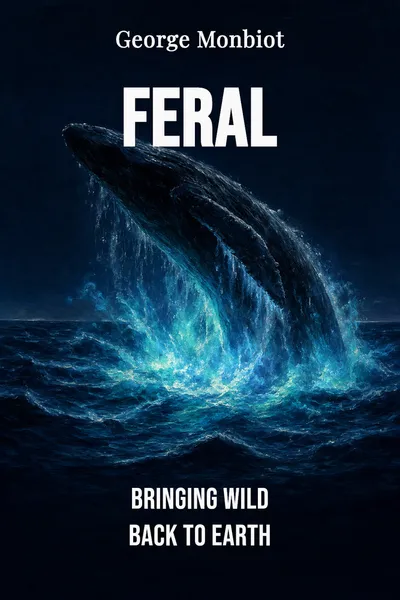
Feral
Bringing wild back to earth
Description
In his early forties, living comfortably in Wales, George Monbiot found himself gripped by a feeling he struggled to name. He had a family, a career as one of Britain's better-known environmental writers, a landscape of green hills at his door. And he was, by his own admission, dying of boredom. Not the ordinary kind — something more physical, an ache for danger, weather, teeth, the sense of being a mammal among other mammals. He called it "ecological boredom," the flatness of a life lived inside a nature that had been mowed, fenced, and pacified until nothing wild could surprise him anymore.
His diagnosis was uncomfortable, because it turned the usual story inside out. Most environmentalism, Monbiot came to feel, was defensive: hold the line, prevent losses, keep things as they are. Manage the damage. But what if the countryside people fight to protect is itself the wound? What if those beloved bare green hills are, ecologically speaking, closer to a desert than to a forest — and the emptiness we call "scenery" is the absence of nearly everything that should be there? Out of that discomfort came Feral, published in 2013, part memoir and part manifesto for an idea with a strange, feral name.
That idea is rewilding — not restoring nature to some fixed postcard of the past, but stepping back and letting ecological processes run loose again, wolves and whales and forests included. It is an environmentalism of addition rather than subtraction, of hope rather than grief. Monbiot roams the Welsh hills, kayaks among dolphins, and tracks the people trying to bring the missing pieces home.
The question we’re asking : What if the nature we fight to protect is actually the damage — and letting go, rather than managing harder, is the way back to abundance?What we’ll see : A restless writer, his boredom, and the wild he chases across land and sea in search of a noisier, fuller kind of world.
Table of contents
01Chapter 1 — The man who was bored by his own life
Monbiot doesn't open Feral with statistics. He opens with a confession about his own body — the way it felt slack and underused, the way an ordinary week left him restless in a manner he couldn't argue away. He'd catch himself picking fights he didn't need, taking small physical risks for no reason, longing for the moment a storm might roll in. The problem, he decided, wasn't psychological in the usual sense. It was ecological. He was a creature built for a wilder environment, marooned in one that offered nothing to test him.
There's a scene that carries the whole idea: Monbiot out at sea in a kayak off the Welsh coast, mackerel fishing, when the water around him erupts with life — dolphins, seabirds diving, fish boiling at the surface. For a few minutes he feels fully awake, fully present, in a way the green fields never manage. That contrast becomes his method. Everywhere he goes, he asks the same quiet question: is this place alive, or is it merely tidy?

02Chapter 2 — Trees walk, whales fertilize, wolves move rivers
The intellectual heart of Feral is a set of findings that genuinely surprised Monbiot, and are meant to surprise us. The one he returns to most is the story of Yellowstone. Wolves were exterminated there in the 1920s and reintroduced in 1995. What followed wasn't just fewer deer. The elk, no longer able to graze the riverbanks at leisure, moved differently. Willows and aspen recovered along the water. Beavers returned to the willows. Songbirds and fish followed. The riverbanks, now held by roots, stopped eroding — the courses of the rivers themselves grew more stable. A single predator, added back, had rippled all the way down to the shape of the land.
This is what ecologists call a trophic cascade, and Monbiot collects them like a man who has found treasure. Certain species, he shows, are not just residents of an ecosystem but its engineers. Whales, once thought to deplete fish stocks, turn out to fertilize the seas: by feeding at depth and defecating near the surface, they pump nutrients upward, feeding the plankton that feed everything else. Fewer whales, fewer fish. The intuition had it exactly backwards.
03Chapter 3 — The sheep on the hill and the empty sea
If cascades show what nature can do, the British uplands show what happens when we stop it. Here Monbiot names his least popular target: sheep. The bare, beloved hills of Wales and the north are bare because sheep eat every tree seedling before it can rise. What looks like timeless wilderness is an intensively grazed monoculture, kept treeless by animals and by the subsidies that pay farmers to keep them there. He calls the effect "sheepwrecked" — a landscape hollowed out and then admired for its emptiness.
The economics sting more than the ecology. Much upland farming, he shows, barely functions without public money, producing little food while suppressing the forests that would store carbon, shelter wildlife, and soak up the rainfall that otherwise floods the towns below. We are, in effect, paying to keep the hills dead. And we defend the arrangement fiercely, because we have mistaken a recent, artificial landscape for the natural order of things — a case of shifting baselines, where each generation takes the depleted world it inherits as the normal one.
04Chapter 4 — A wilder world means a wilder us
Step back from the wolves and the whales, and Feral is really an argument about hope, and about what environmentalism is for. Monbiot is impatient with a movement that has become, in his view, a chronicle of decline — a list of things to mourn and losses to slow. Rewilding flips the emotional register. It offers something to want, not just something to prevent. A raucous summer, in his phrase, instead of a silent spring: ecosystems getting louder and fuller rather than quieter and emptier. That shift from grief to desire, he thinks, is the missing ingredient in decades of well-meaning defeat.
It is also an argument against a certain human vanity — the belief that nature is a garden and we are its gardeners, responsible for arranging every hedge and culling every surplus. Rewilding requires a harder discipline: restraint. It means accepting that a healthy wild will do things we didn't choose and can't fully control, that a returned predator or a self-seeding forest answers to its own logic. Monbiot frames this not as loss of control but as a kind of maturity, letting the world be more than a reflection of our management.
05Conclusion
The book ends more or less where it began, with a man in a kayak, alive to the sea. But the boredom that opened Feral has been transformed into a program. Monbiot has taken a private restlessness and turned it outward into a public proposition: that the emptiness so many of us half-consciously feel in nature is real, measurable, and reversible. The wolf can come back. The forest can climb the hill again. The sea can fill. None of it requires us to build anything — only to loosen our grip and let ancient processes resume the work they were doing before we interrupted them.