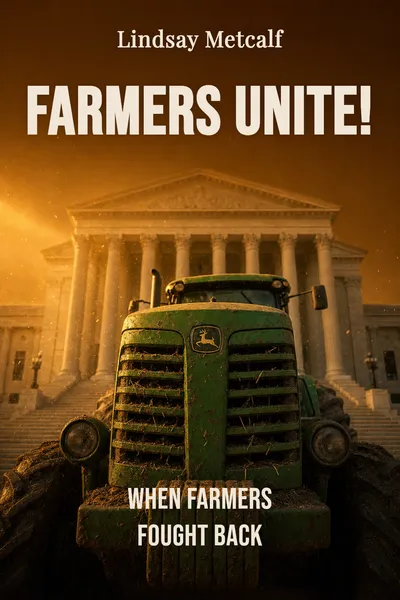
Farmers Unite!
When farmers fought back
Description
A farmer grows the wheat that becomes the bread on a supermarket shelf, and somewhere between the field and the checkout, most of the money disappears into hands that never touched a plow. That gap — between what it costs to grow food and what a grower actually gets paid — is the oldest ache in agriculture. Lindsay Metcalf builds a whole book around it, aimed at younger readers but honest enough for anyone. "Farmers Unite!" is a history of the people who decided the ache was not simply the weather of life, but something that could be pushed back against.
The story she tells is not about a single hero or a single year. It stretches across generations of growers in the United States who noticed the same thing, again and again: alone, a farmer has almost no bargaining power. The buyer sets the price. The railroad sets the freight. The bank sets the loan. One family with a barn full of grain and a mortgage due cannot argue with any of them. But a thousand families, moving at the same time, refusing the same bad deal, suddenly have a voice loud enough to reach a state capitol.
Metcalf writes it as protest history for people who may never have set foot on a farm, and that is part of the point. The tools these growers reached for — organizing, marching, withholding, showing up in numbers — belong to anyone who has ever felt too small to matter against a bigger force. We're following how food gets its price, and what happens when the people who grow it stop accepting the answer they're handed.
The question we’re asking : How did scattered, isolated farmers turn economic hardship into a movement powerful enough to be heard?What we’ll see : How growers discovered that fairness was something they had to organize for, not wait for — and what their history still teaches about standing together.
Table of contents
01Chapter 1 — The math that never adds up
Metcalf starts where farming actually starts: with numbers that refuse to cooperate. A grower spends money before earning any. Seed, fuel, equipment, land, labor — all of it goes out in the spring, months before a single crop can be sold. Then comes harvest, and with it the moment of truth, when the farmer finds out what buyers are willing to pay. Often it is less than what the growing cost. The book lays this out plainly, because it is the engine of everything that follows: a person can work sunup to sundown, do everything right, and still end the year deeper in debt.
The reason, as the book explains for its young audience, is that farmers rarely set their own prices. Somebody else does. The grain elevator, the meatpacker, the buyer at the far end of the line decides what a bushel or a pound is worth, and a single farmer with perishable goods and bills to pay is in no position to haggle. Hold out for a better price and the crop rots, or the animals keep eating feed the farmer can't afford. The pressure to sell, now, at whatever is offered, is built into the work itself.

02Chapter 2 — Learning to move together
Organizing did not come naturally, and Metcalf doesn't pretend it did. Farmers are, by the nature of the job, spread out and independent. They live miles apart. They trust their own judgment. Asking such people to coordinate — to agree on a demand, to act in unison, to trust that their neighbors will hold the line too — was its own kind of harvest, slow and uncertain. The book traces how growers built the habits of acting together, meeting by meeting, season by season.
The early forms were social as much as political. Farmers gathered in granges and local chapters, places where they could compare notes and discover that their struggles were shared rather than personal failures. That discovery mattered. A farmer who believes their debt is their own fault stays quiet. A farmer who learns that the family down the road, and the one past that, are all squeezed by the same freight rates and the same low prices starts to see a pattern — and a pattern can be organized against.
03Chapter 3 — The tractor as a megaphone
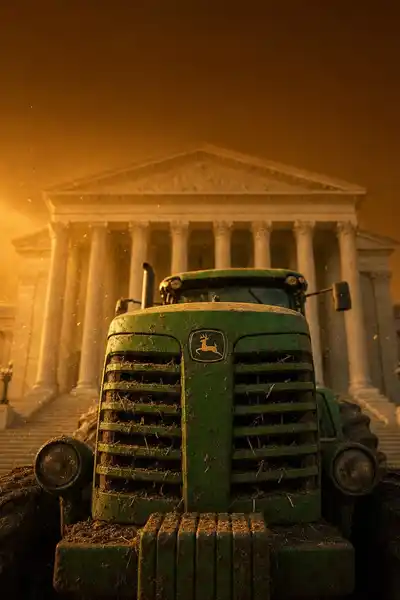
When organizing turned into action, it took on a shape unlike other protests, and this is where Metcalf's book comes alive for younger readers. Farmers protest with what they have, and what they have is farming. They brought tractors. They drove them slowly through towns and toward capitals, turning the tools of their trade into a rolling, unmissable statement. A single tractor is a machine. A line of them stretching down a highway is an argument that no politician can drive past without noticing.
The book shows how growers used their crops as leverage too. If low prices were the problem, then withholding what they grew was an answer — refusing to send milk to market, holding back grain, letting the people who set the prices feel what happens when the supply stops. These were hard choices, because a withheld crop is also an unpaid bill, and Metcalf doesn't soften that. Standing together meant sharing risk, and sometimes sharing loss, in the hope that the pressure would move something bigger than any one farm.
04Chapter 4 — A quiet trade that keeps its edge
Step back from the individual protests and the book reveals something steadier underneath. What Metcalf is really documenting is how people with almost no institutional power learn to manufacture some — and how slow, undramatic that manufacturing is. Farmers had no seat at the tables where their prices were set. They couldn't buy influence. What they had was numbers and the willingness to coordinate them, and the history she tells is essentially the long education of turning that raw fact into leverage.
This is why the story reaches beyond agriculture, even as it stays rooted in it. The farmers' basic move — recognizing that isolation is weakness and that acting together converts many small, ignorable voices into one that has to be answered — is the same move behind every kind of collective bargaining. Metcalf writes it through tractors and grain, but the underlying lesson is portable: fairness is rarely handed down to the people who need it most. It gets organized for, demanded, and held onto against pressure to give it back.
05Conclusion
The book closes where it opened, with a farmer and a price that doesn't cover the work. Metcalf never pretends the growers solved that problem for good. Prices still swing, buyers still hold the middle, and the arithmetic that squeezes a single family is as sharp now as it was for the ones who first drove their tractors toward the capital. What changed was not the math but the response to it — the discovery that the answer to being small is not to accept it.
Related books