

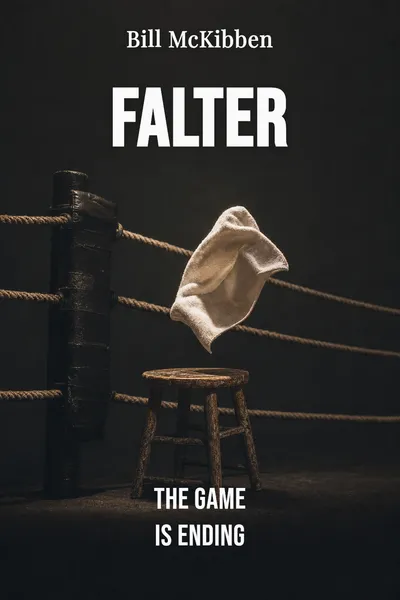
Falter
The game is ending
Description
In 1989, a young writer named Bill McKibben published a slim book called The End of Nature. It was the first book written for a general audience about what was then still called the greenhouse effect, and its argument was quieter than the title suggested. Nature, McKibben wrote, had always meant the part of the world that ran without us. By pumping enough carbon into the atmosphere to change the weather everywhere at once, we had ended that separation. There was no longer a rainstorm, a heat wave, or a coastline that human industry had not touched. The idea landed hard, was translated into dozens of languages, and became a classic of environmental writing. Thirty years later, McKibben came back with a bleaker follow-up.
Falter, published in 2019, does not read like a sequel. It reads like a man who has spent three decades watching a warning go unheeded and has decided the warning was too small. The problem, McKibben now argues, is not only that we are heating the planet. It is that the whole human project — the improvised, several-thousand-year experiment we might call the human game — has started to wobble. Climate change is squeezing the physical space where a civilization can survive. And at the same time, a cluster of new technologies is threatening to hollow out what it means to be human inside that shrinking space.
That is the pairing that makes the book unusual. McKibben is not content to write another climate book, and he is not writing a technology-panic book either. He is trying to hold two very different threats in one frame, and to explain why we keep our hands off the wheel while both accelerate. The title is a word from boxing and from walking — to falter is to stumble, to lose the thread of a motion you were sure of. The question is whether we recover our footing in time.
The question we’re asking : What does McKibben mean when he says the human game has begun to play itself out — and what, if anything, is left to do about it?What we’ll see : How two very different threats converge, why an ideology keeps us from acting, and where a lifelong organizer thinks the last real leverage sits.
Table of contents
01Chapter 1 — The size of the board is shrinking
McKibben opens where his career began, with the physics, because the physics is the part that does not negotiate. Human civilization grew up during a freakishly stable stretch of climate — the roughly ten thousand years since the last ice age, a window mild enough to invent agriculture, cities, and everything that followed. That window is now closing. We have raised the average temperature by about one degree Celsius, and the effects are not abstract. They arrive as fire seasons that no longer end, as coastlines that flood on clear days, as heat that makes outdoor work lethal.
His framing is spatial rather than merely warmer-or-cooler. The planet, he argues, is getting smaller — not physically, but in terms of where a modern society can comfortably exist. Bands of the tropics are edging toward temperatures the human body cannot survive for long. Cities built on the assumption of a stable shoreline are learning they were built on a bet. The habitable board on which the human game is played is contracting, and it is contracting faster than the institutions meant to protect us can adapt.

02Chapter 2 — The fervor that keeps our hands off the wheel
The delay, McKibben argues, was not an accident of human nature. It was engineered. He walks through the now-documented history of the fossil-fuel industry's own scientists, at companies like Exxon, who understood by the late 1970s and early 1980s that burning their product would warm the planet dangerously. Rather than warn the public, the industry spent decades funding doubt — think tanks, front groups, advertorials designed to make a settled question look like an open debate. The strategy was borrowed, almost line for line, from the tobacco companies. It worked.
But McKibben pushes past the villain story, because a conspiracy of oil executives cannot fully explain a civilization that would not turn. Underneath the lobbying, he sees an ideology doing the deeper work — a strain of libertarian thought that treats any collective restraint as a kind of tyranny. He traces its intellectual lineage, dwelling at length on Ayn Rand, whose novels recast selfishness as a virtue and government as the enemy of the heroic individual. That philosophy, absorbed by generations of business and political elites, made the one tool we needed — coordinated public action — feel morally suspect.
03Chapter 3 — The engineers who want to edit the player
Here Falter takes its strangest turn, the one that separates it from every other climate book. Even if we somehow stabilized the atmosphere, McKibben argues, a second threat is gathering — not to the board this time, but to the player. He means the accelerating projects of Silicon Valley: artificial intelligence, robotics, and above all human genetic engineering. The same Randian confidence that resisted climate action, he notes, now flourishes among the engineers who believe technology can simply transcend our old human limits.
The chapter he lingers on longest is germline engineering — editing the DNA of embryos so that changes pass to every future generation. Some of its boosters, he reports, dream of designing children for intelligence, athletic ability, even mood. McKibben's objection is not that it is unnatural in some vague sense; it is that it would end something he treasures. The variety and unpredictability of human beings — the fact that no parent knows who their child will become — is, to him, the texture of the game itself. Engineer it away and you have not improved the player, you have canceled the match.
04Chapter 4 — Solar panels and nonviolence
Having built a case this dark, McKibben refuses to end there, and the refusal is the most personal part of the book. He helped found 350.org, one of the first genuinely global grassroots movements against climate change, and he writes from the inside of organizing rather than the outside of commentary. His claim is that the human game is not over — it is faltering, and a stumble is not a fall. What he offers is not a technological rescue but a wager on two tools we already hold.
The first is the solar panel. McKibben is almost tender about it, because it is the rare technology that does the opposite of what the others in his book do. It makes power without a fuel, without a smokestack, without an owner who can meter the sun. Its price has collapsed faster than almost anyone predicted, and it decentralizes energy rather than concentrating it. In a book suspicious of technology's promises, the panel stands out as a machine that expands the game instead of narrowing it — spreading capability outward to villages and rooftops rather than upward to a few labs and boardrooms.
05Conclusion
McKibben ends more or less where his life's work began, on the observation that we have long known enough to act. The difference between The End of Nature and Falter is thirty years of that knowledge going unused, and a second front — the redesign of the human being — opening while we argued about the first. His verdict is neither denial nor despair. It is that the game has faltered, that a stumble is survivable, and that recovery depends on whether we can still act together at the scale the moment demands.