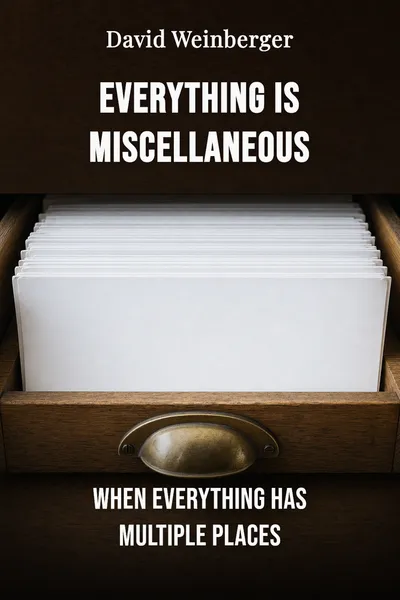
Everything Is Miscellaneous
When everything has multiple places
Description
In a shoe store, the manager faces a small daily problem that turns out to be a large one. Should the running shoes go with the athletic gear, or near the men's section, or in the display by the door catching the eye of whoever walks in? Whatever the manager decides, the shoe lands in one spot. It can be near the socks or near the sneakers, but not both. Physical space is jealous that way. A thing occupies a place, and that place is the only place it occupies. For most of human history, this was so obvious it wasn't worth saying. Objects sit somewhere, books sit on shelves, files sit in drawers, and whoever chose the arrangement — the librarian, the store planner, the archivist — held a quiet kind of power.
David Weinberger's argument, laid out in his 2007 book Everything Is Miscellaneous, is that this constraint was never really about knowledge. It was about atoms. We built elaborate systems of categories not because reality comes pre-sorted, but because a physical object can only be in one place, so we had to pick. The Dewey Decimal system, the alphabetized card catalog, the org chart, the paper map — all of them are compromises with the stubbornness of matter. And now, for the first time, that constraint is lifting. Digital information doesn't have to sit anywhere in particular. A song can belong to forty playlists at once. A photo can carry a hundred tags and answer to any of them.
Which means the deep assumption underneath centuries of organizing — that everything has its place — is quietly dissolving. In its place comes something messier and, Weinberger argues, far more powerful: everything has its places, plural. The pile beats the tree. The tag beats the folder. What looks at first like chaos turns out to be a new kind of order, one that changes how businesses sell, how science publishes, and who gets to say what is true.
The question we’re asking : What happens to knowledge when a thing no longer has to live in one place?What we’ll see : How the move from atoms to bits dismantles the old order — and hands the power of arranging the world to a much larger crowd.
Table of contents
01 Chapter 1 — The tyranny of the single shelf
Consider the Dewey Decimal system, which Melvil Dewey devised in 1876 and which still runs most public libraries. It is a marvel of nineteenth-century order: every book gets a number, and the number tells you exactly where it sits. But a number is also a verdict. Dewey had to decide that religion occupies the 200s, and within that range Christianity got the lion's share while the religions of most of the world's population were crammed into a handful of leftover slots. The system doesn't just locate books. It bakes in a whole worldview, and once the shelves are built, that worldview is very hard to argue with.
This is the hidden cost of physical organization. Because a book can sit in only one place, the classifier has to guess how you will come looking for it. A cookbook of Italian regional food — is it filed under cooking, under Italy, under travel? Pick one, and everyone who would have found it under the others is out of luck. Weinberger calls this the problem of the single spine: an object has one location, so it can express only one relationship, when in truth it belongs to dozens.

02 Chapter 2 — The three orders of order
Weinberger's cleanest idea is a simple ladder with three rungs. The first order of order is the arrangement of things themselves: books on a shelf, spices in a rack, photos in an album. You organize the objects directly, and because they are physical, you can put each one in exactly one spot. This is the order we have lived in forever, and its limits are the limits of matter.
The second order is the arrangement of information about the things. The library card catalog is the classic case. Instead of walking the stacks, you flip through cards, and here something loosens: the same book can appear on several cards at once — one by author, one by title, one by subject. The metadata escapes the single-spine problem even though the book cannot. The catalog is a map of the territory that can be richer than the territory allows, and for centuries it was the best workaround we had.
03 Chapter 3 — Trees fall, piles rise
The old order was a tree. Every category branched into sub-categories, each item hung from exactly one twig, and to find anything you climbed down from the trunk making one choice at a time. Biology, then mammals, then primates, then humans. The tree is elegant and it is tyrannical, because it forces every question through a single path and every object into a single home. The animal that doesn't fit the branch simply has nowhere to go.
The digital pile works the other way around. It refuses to decide in advance. A recipe blog doesn't file its posts under one heading; it tags each one with vegetarian, quick, spicy, dinner, and lets readers assemble their own path through the mess. Weinberger's point is that the mess isn't a failure of organization — it is organization that has been handed to the user, to be performed fresh each time a question is asked, rather than fixed once by an authority.
04 Chapter 4 — Knowledge stops being a thing you own
Underneath the shelves and the maps, Weinberger is really talking about knowledge itself. In the world of atoms, knowing had a shape borrowed from the book: it was orderly, settled, filtered, and owned by whoever had the credentials to publish it. An encyclopedia was authoritative precisely because a small group decided what went in and what stayed out. Knowledge was a stock — a finished thing you could keep on a shelf — and its trustworthiness came from the exclusion at the gate.
The miscellaneous dissolves that shape. When everything can be included and filtered afterward, the value shifts from what gets left out to what gets connected. Wikipedia is the standing example: it has no editorial gate, it is never finished, it contradicts itself, and it is nonetheless one of the most consulted references ever built. Its authority comes not from a curator's judgment but from being open to argument — the disputes are visible, the history is public, the entry is a conversation rather than a verdict.
05 Conclusion
Return to the shoe store. The manager still has to put the running shoe somewhere, because a shoe is made of atoms and atoms are jealous. But the catalog that sells that shoe online has already moved on: there the same shoe sits under running, under men's, under sale, under whatever a shopper types into the search box, occupying every place at once. The physical world still forces the single choice. The digital one quietly refuses it, and that refusal is spreading outward from music and maps into how we work, learn, and decide what is real.
Related books