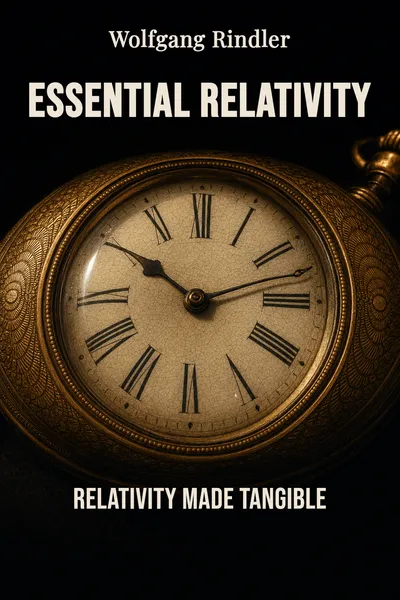
Essential Relativity
Relativity made tangible
Description
In 1905, a clerk at the Swiss patent office in Bern published four papers in a single year, one of which quietly dismantled the idea that time was the same everywhere. Albert Einstein was twenty-six, working outside the academic system, and the notion he proposed was almost insultingly simple: the speed of light is the same for everyone, no matter how fast they are moving. From that one stubborn fact, everything we thought we knew about clocks, rulers, and the shape of space began to bend. The trouble is that relativity has spent the following century being explained badly — as a fog of paradoxes, twins who age differently, and equations that seem to punish anyone who asks what they actually mean.
Wolfgang Rindler spent his career refusing that fog. A physicist who taught the subject for decades and coined the term "event horizon," he wrote Essential Relativity for a specific kind of reader: someone comfortable with mathematics but not yet a specialist, someone who wants the picture behind the symbols rather than a set of tricks to memorize. The book has a reputation, earned across its editions, for one quality above all — it makes relativity tangible. Not simpler than it is, but graspable. The formulas stay, but they stop being the point.
That distinction is the whole game. Relativity is not hard because the algebra is fierce; the algebra is often gentle. It is hard because it asks us to give up intuitions we did not know we were holding — that time flows evenly, that space is a stage, that gravity is a pull. Rindler's project is to hand back a new set of intuitions, ones that actually fit the universe we live in.
The question we’re asking : How does relativity become something we can picture, rather than a set of paradoxes we memorize?What we’ll see : How a single fact about light forces us to rebuild time, gravity, and eventually the whole cosmos into shapes the mind can actually hold.
Table of contents
01Chapter 1 — The awkward peace between light and motion
The starting point is a clash that physics could not ignore by the end of the nineteenth century. On one side sat the old principle of relativity, going back to Galileo: the laws of mechanics look the same whether you are standing still or gliding smoothly on a ship. There is no experiment you can do below deck to tell whether the ship is moving. On the other side sat the new physics of light, which said that light travels at a fixed speed through space. These two ideas could not both be right in the old framework, because if light has one fixed speed, then surely someone chasing it should measure it going slower. Common sense demands it.
Common sense turned out to be wrong, and Rindler is careful to show why the error is so natural. We assume that speeds simply add up. Throw a ball forward on a moving train and its speed relative to the ground is the ball's speed plus the train's. For everyday objects this works beautifully. The whole trouble is that we quietly extend it to light, expecting the same arithmetic, and light refuses to cooperate. Every observer, whatever their motion, measures the same speed for a light beam. The 1887 Michelson-Morley experiment, hunting for the Earth's motion through the supposed ether, found nothing precisely because there was nothing to find.

02Chapter 2 — Time stops being a clock and becomes a coordinate
Once light's speed is fixed for everyone, time can no longer be universal, and this is where most explanations of relativity lose people. The famous consequences arrive in a rush — moving clocks run slow, moving rulers shrink, events that are simultaneous for one observer are not simultaneous for another. Presented as a list of paradoxes, they sound like magic tricks. Rindler's approach is to derive them from the single fact already established, so that each one feels less like a surprise and more like a bill that has come due.
Consider simultaneity, which he treats as the deepest of the shifts. Two flashes of lightning strike the ends of a train. Standing on the platform, you might see them arrive at the same instant and call them simultaneous. A passenger moving with the train, rushing toward one flash and away from the other, will not agree. There is no referee, no master clock in the sky, to settle who is right. Both are right within their own frame, and the disagreement is not about perception but about the structure of time itself. Once simultaneity is relative, the slowing of moving clocks and the shrinking of moving lengths follow almost inevitably.
03Chapter 3 — Gravity is not a force, it's the shape of things
The first half of relativity leaves gravity untouched, and Einstein knew it was unfinished. Special relativity described a flat, empty spacetime with no room for the falling apple. It took him another decade, until 1915, to close the gap, and the closing began with what he later called the happiest thought of his life: a person falling freely feels no gravity at all. Inside a falling elevator, you float. Weight simply vanishes. Rindler builds the whole of general relativity outward from this ordinary, almost banal observation.
The idea is the equivalence principle: being in a gravitational field is locally indistinguishable from being accelerated. Stand in a windowless rocket accelerating through empty space, and you would feel pressed to the floor exactly as you do on Earth. Drop a ball and it falls just the same. If gravity and acceleration cannot be told apart by any local experiment, then gravity is not a force acting across space in the ordinary sense. It is something about the framework in which motion happens. And the framework, as special relativity had already shown, is spacetime.
04Chapter 4 — The universe as a single object
Step back from the equations and a larger ambition comes into view, one that runs through Rindler's whole treatment. If gravity is the geometry of spacetime, and spacetime is the arena for everything, then relativity is not merely a theory about fast-moving particles or heavy stars. It is a theory whose subject can be the entire universe treated as one object, with its own shape, its own history, and possibly its own edges. This is where the tangible picture Rindler has been building pays its largest dividend — it scales all the way up.
Apply the curvature of spacetime not to a single star but to all the matter there is, spread roughly evenly, and the geometry describes a cosmos that cannot sit still. It must expand or contract. Einstein himself flinched from this and inserted a term to hold the universe steady, later calling it his great mistake when Edwin Hubble showed in 1929 that the galaxies really are flying apart. The expanding universe, the notion of a beginning, the very question of whether space is finite or infinite — all of these become legitimate, calculable questions rather than philosophy. Rindler was among those who took cosmology seriously as physics rather than speculation.
05Conclusion
It began with a patent clerk refusing to explain away an inconvenient fact: light travels at the same speed for everyone. From that single refusal, the whole edifice unfolds — time becomes a coordinate, gravity becomes curvature, and the universe becomes an object with a shape and a history. Rindler's achievement in Essential Relativity is to walk that path without letting go of the reader's hand, keeping the physical meaning in view at every step so that each consequence arrives as something earned rather than decreed.
Related books