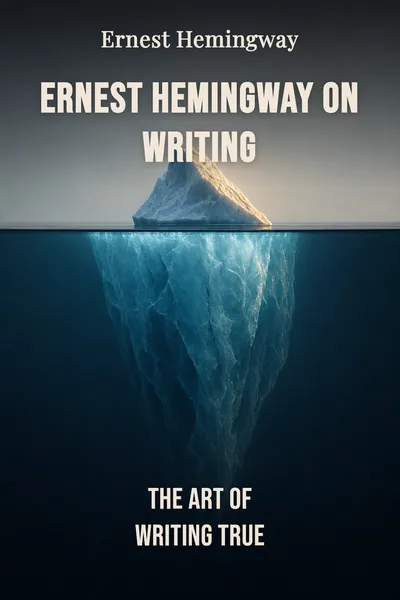
Ernest Hemingway on Writing
The art of writing true
Description
Ernest Hemingway never sat down to write a book about writing. He said, more than once, that talking about it was bad luck — that the surest way to ruin a thing was to explain it before it was done. And yet across a lifetime of letters, essays, interviews and the occasional aside buried in a story, he kept returning to the subject he claimed to avoid. Decades after his death in 1961, the critic Larry W. Phillips gathered those scattered remarks into a single volume, "Ernest Hemingway on Writing," published in 1984. It is not a manual. It is a mosaic, assembled from a man who spent his working hours trying to get sentences right and his off hours insisting the effort couldn't be taught.
What emerges from those fragments is stranger and sharper than any how-to guide. Hemingway didn't offer techniques so much as a code — a set of near-superstitious rules about honesty, omission, and knowing when to stop. Write one true sentence, he said. Leave out the things you know. Never empty the well completely. The advice sounds simple, almost blunt, until we notice how much of it runs against the instinct of anyone who has ever tried to fill a blank page.
He was, by the time these notes were collected, one of the most imitated prose stylists of the twentieth century, a Nobel laureate whose clipped declarative rhythm had reshaped how American writers heard their own sentences. But the man in these pages is not performing mastery. He is anxious, exacting, often afraid of losing whatever it was that let him do the work at all.
The question we’re asking : What did the most influential American prose stylist of his century actually believe about the act of writing?What we’ll see : A writer's private code — honesty, omission, discipline, and the cost of getting it right — assembled from the notes of a man who swore it couldn't be taught.
Table of contents
01Chapter 1 — The one true sentence
The most quoted line in the whole collection comes from "A Moveable Feast," Hemingway's memoir of Paris in the 1920s. When he found himself stuck, he wrote, he would tell himself: "All you have to do is write one true sentence. Write the truest sentence that you know." Not a good sentence, not a beautiful one — a true one. The distinction is the whole method in miniature. He wasn't chasing decoration or cleverness. He was trying to set down something he actually knew to be so, stripped of everything he had merely heard, assumed, or been taught to feel.
The enemy, as he described it, was ornamentation. Whenever he caught himself "writing elaborately," or laying in "scrollwork or ornament," he learned to cut it out and begin again with that single honest sentence he had already put down. The trick was to distrust the parts that came easy and pleased him too much. Fine writing, in his vocabulary, was almost an insult. The suspicion ran deep: if a passage sounded impressive, it was probably hiding the fact that he didn't yet know what he meant.

02Chapter 2 — The iceberg under the water
If the true sentence was the foundation, the iceberg was the architecture. Hemingway's most famous idea about prose is that the strength of a piece comes from what is left out. "If a writer of prose knows enough about what he is writing about," he explained, "he may omit things that he knows and the reader, if the writer is writing truly enough, will have a feeling of those things as strongly as though the writer had stated them." A story, in this image, is like an iceberg: seven-eighths of it sits underwater, unseen, and the mass beneath is exactly what gives the visible tip its weight.
The crucial condition is the knowing. Omission only works if the writer genuinely understands the material he is withholding. Leaving something out because you never grasped it, Hemingway warned, produces a "hollow place" in the writing — the reader senses the gap and feels cheated. But leaving something out because you know it so well you trust the reader to feel its pressure without being told: that is the difference between economy and evasion. The discipline is in doing the full work and then having the nerve to show almost none of it.
03Chapter 3 — Stop while you still know what happens next
Alongside the grand ideas about truth and omission, the collection is full of hard, practical rules — the kind a working writer keeps taped above the desk. The most useful, and most counterintuitive, is about when to quit for the day. "The best way," Hemingway advised, "is always to stop when you are going good and when you know what will happen next." Never write yourself dry. Never grind to a halt because you've run out of things to say. Stop while the road ahead is still clear.
The logic is about the next morning. If you stop at a natural exhaustion point, you begin the following day facing a wall, with nothing in the tank and no idea where to go. But if you break off mid-momentum, knowing the very next move, you can start again cleanly and be running before the doubt has a chance to catch you. Then, he said, you don't think about the work at all until you sit down again — you let the subconscious keep turning it over while you fish, or read, or do anything but worry the sentences.
04Chapter 4 — The wound and the work
Step back from the individual rules and a portrait of the writer's condition comes into focus — one far less confident than the legend suggests. For all his public swagger, the Hemingway of these notes is a man under constant threat, guarding a talent he does not fully understand and fears he might lose. Writing, he insisted, was solitary work that no one else could do for you and no organization could improve. "Writing, at its best, is a lonely life," he told the Swedish Academy when he won the Nobel Prize in 1954. It grew a man's loneliness, he said, but it was the work itself that mattered, done alone, and each day starting over from nothing.
There is a recurring, almost defensive quality to how he talks about the source of the work. He distrusted analysis; he worried that talking too much about a story before it was finished, or dissecting how he did it, would break the mechanism. This is why he claimed writing couldn't really be taught — not out of arrogance, but because he suspected the ability was fragile and partly unconscious, something that could be protected but not fully commanded. The rules he lived by were, in part, superstitions built to keep the well from going dry for good.
05Conclusion
Hemingway never wrote the book that Larry Phillips eventually assembled, and it is worth remembering why. He thought explaining the work was a way of losing it. What we have instead is a writer talking to himself over forty years — in letters to friends, in advice to younger writers he mostly told to stop asking, in the rare moment when his guard slipped. The consistency across those fragments is the surprise. The man who claimed writing couldn't be taught turns out to have carried a remarkably firm code: one true sentence, the iceberg beneath, the well left half full.
Related books