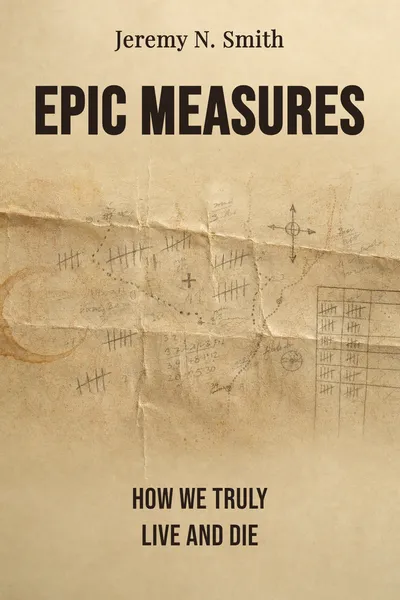
Epic Measures
How we truly live and die
Description
In the early 1990s, a young American physician named Christopher Murray sat down with a Harvard economist and a deceptively simple problem: nobody actually knew what was killing people around the world. Not roughly, not by guess, but with anything like the precision a hospital brings to a single patient. Governments reported what they wanted to report. International agencies leaned on numbers that had been copied, padded, and recopied so many times that some disease tolls added up to more than the population that could possibly have suffered from them. Murray, who had spent part of his childhood running a clinic in the Sahara with his family, found this intolerable. If medicine was going to help humanity, it first had to know, honestly, how humanity lived and died.
That refusal to accept fuzzy numbers became the seed of one of the strangest and most ambitious scientific projects of the era. Murray wanted to measure everything — every disease, every injury, every risk factor, in every country, across every age and both sexes — and fold it all into one comparable ledger. Not a snapshot of the rich world, not a wish list from ministries, but a single global accounting of human health that told the truth even when the truth was unwelcome. It sounded impossible, and for years plenty of very serious people told him so.
Jeremy N. Smith's Epic Measures follows Murray and the enterprise he built, from a contested set of tables in the 1990s to an institute in Seattle churning through data on billions of lives. It is a book about disease, but really it is about the audacity of counting — and about a man who decided that the most important number in the world was the one nobody had bothered to calculate.
The question we’re asking : What does it take to build one honest measure of how the whole of humanity actually lives and dies?What we’ll see : A quest that turns medicine into something closer to Moneyball, and the friction that follows when the numbers refuse to flatter anyone.
Table of contents
01Chapter 1 — A doctor who refused the small question
Christopher Murray's childhood was not ordinary. His father was a cardiologist, his mother a microbiologist, and in the 1970s the family relocated to run a rural health project in the Nigerien desert. Young Chris weighed babies, dispensed medicine, and watched people die of things that were cheap to prevent. The experience left him with a conviction that hardened over time: the gap between what medicine could do and what it actually did was enormous, and much of that gap was invisible because no one was keeping honest score.
He trained as a physician, but the clinic frustrated him. Treating one patient at a time felt like bailing an ocean with a spoon. What pulled at him was the population — the aggregate, the whole. He took a detour into economics at Oxford, drawn to the idea that health could be studied with the rigor economists brought to money. That combination, medicine plus economics, would define everything that followed. He wanted to think about human suffering the way an actuary thinks about risk: comprehensively, comparably, without sentiment.

02Chapter 2 — The Global Burden of Disease
The idea that made it work was a new unit of measurement. Counting deaths alone missed most of human suffering — a life spent blind or paralyzed or in chronic pain barely registered if it did not end early. So Murray and his collaborator Alan Lopez built a metric that combined the two: years of life lost to premature death, plus years lived with disability, added into a single figure. They called it the disability-adjusted life year, the DALY. One DALY was, in effect, one healthy year of human life gone. For the first time, dying young and living sick could be placed on the same scale.
This is where the Moneyball comparison earns its keep. Just as baseball's statistical rebels replaced folklore about players with numbers that actually predicted performance, Murray replaced the received wisdom of global health with a hard accounting of where healthy years were being lost. And the DALY produced surprises that overturned settled priorities. Mental illness, long treated as a soft concern, turned out to be one of the largest sources of lost healthy life on earth. Depression ranked among the leading causes of disability worldwide. Road injuries and self-harm loomed far larger than the funding maps suggested.
03Chapter 3 — The war over the numbers
A project that reranks the world's diseases is a project that reranks the world's power. Murray discovered this the hard way. The moment the Global Burden figures began to circulate, they collided with institutions, advocacy groups, and national governments who had a stake in the older, friendlier numbers. If a country's true child-mortality rate was worse than its official one, that was an accusation as much as a statistic. If a beloved disease campaign turned out to address a smaller burden than assumed, its funding was suddenly in question.
Murray's personality did not smooth the friction. He was brilliant, relentless, and impatient with the diplomatic pace of international bureaucracy. He rose fast at the World Health Organization, close to its reformist director-general, and pushed for rankings of health-system performance that graded countries against one another. The rankings caused an uproar. Nations that scored poorly protested loudly; the methodology was picked apart line by line. When the political winds at the WHO shifted, Murray's uncompromising style left him exposed, and he eventually left the organization that had once championed his work.
04Chapter 4 — Counting as an act of conscience
Step back from the DALYs and the disputes, and Epic Measures is really about a moral proposition disguised as an accounting exercise. To insist on measuring everyone, everywhere, with the same instrument is to make a quiet but radical claim: that a year of healthy life is worth the same whether it is lived in Seattle or in the Sahel, and that no life gets to disappear simply because no one wrote it down. Murray's ledger is a machine for refusing to look away.
This is why the project provoked such heat. A map of human suffering is never neutral — it directs money, attention, and blame. For most of history, that map was drawn by whoever held the pen: rich countries counted themselves carefully and the rest of the world barely at all. By demanding that the invisible be estimated rather than ignored, Murray was not just doing statistics. He was redistributing visibility, and visibility, in global health, is the first step toward resources.
05Conclusion
The arc of Epic Measures runs from a boy weighing babies in a desert clinic to a founder presiding over one of the largest data operations in the history of public health. Along the way, Christopher Murray refused every version of the small question. He would not settle for the numbers he was handed, would not treat one disease as the whole story, and would not accept that the poorest, sickest corners of the world should remain statistically dark. The disability-adjusted life year was his lever, and the Global Burden of Disease was the vast structure he built with it.
Related books