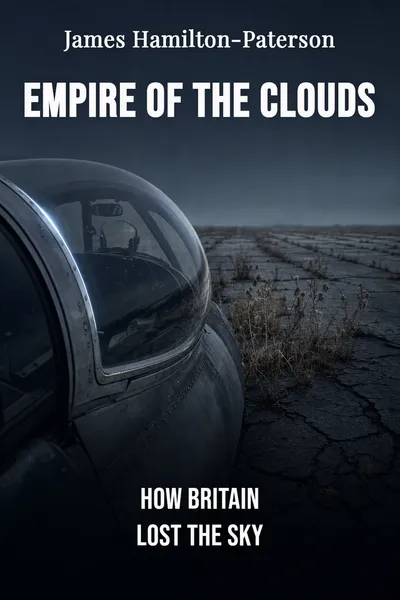
Empire of the Clouds
How Britain lost the sky
Description
On a September afternoon at the Farnborough air show in 1952, a de Havilland test pilot named John Derry took a swept-wing jet called the DH.110 into a fast run over the crowd, and the aircraft came apart in the air. The engines tore loose and fell into the spectators; Derry, his observer, and twenty-eight people on the ground were killed. And then something happened that tells you almost everything about the moment. The show went on. Another pilot, Neville Duke, took off in a Hawker Hunter within the hour and put it through the sound barrier, and the surviving crowd cheered. Nobody went home. This was a country that had decided flight was worth dying for, and worth watching people die for, because the sky felt like the place where its future was being decided.
James Hamilton-Paterson grew up in that Britain, a boy who cut pictures of prototypes out of magazines and knew the names of aircraft the way other children knew footballers. In Empire of the Clouds he goes back to those years — roughly 1945 to the early 1960s — when Britain built more types of experimental jet than anyone on earth, when a small island coming off the back of a ruinous war was, for a brief window, the leading designer and builder of jet aircraft in the world. That last claim is not nostalgia. It was, for a while, simply true.
And then it wasn't. Today there is no British aircraft manufacturer of any real significance — no Sopwith, no Hawker, no de Havilland turning out complete aeroplanes under its own name. Something that was genuinely world-class was allowed to dissolve, not in a single defeat but in a long series of small surrenders. Hamilton-Paterson wants to understand how that happened, and what it felt like to be alive while it was still happening.
The question we’re asking : How did a country that led the world in jet aviation in 1945 end up, within a generation, with no aircraft industry to speak of?What we’ll see : The euphoria of the post-war workshops, the pilots who paid for it in blood, and the slow institutional unravelling that followed.
Table of contents
01 Chapter 1 — The morning Britain owned the sky
The lead was real, and it started with the engine. Frank Whittle, an RAF officer, had patented the turbojet in 1930 and flown a prototype during the war while the Air Ministry alternately backed him and starved him of money. By 1945 Britain had jet fighters in service, the design talent to build more, and — crucially — a head start the Americans openly envied. In one of the more astonishing decisions of the period, the post-war government simply gave Rolls-Royce's advanced Nene engine to the Soviet Union as a goodwill gesture. The Soviets reverse-engineered it and put a version in the MiG-15, the fighter that would shoot down British and American pilots over Korea a few years later.
For a while, though, the sheer productivity was intoxicating. Hamilton-Paterson describes a landscape of small, fiercely independent firms — de Havilland, Hawker, Gloster, Vickers, Avro, Supermarine — each with its own chief designer, its own house style, its own prototypes screaming across test airfields. Britain produced an extraordinary number of experimental aircraft types in these years, far more than a country its size had any business building. The Comet, which entered service in 1952, was the world's first jet airliner, and for a moment it looked as though Britain would own commercial aviation the way it had once owned the seas.

02 Chapter 2 — The test pilots who died to prove it
Somebody had to fly these things, and in the late 1940s and 1950s a remarkable number of them did not come back. The test pilot occupies the emotional centre of Empire of the Clouds. These were mostly ex-wartime fliers, young men who had survived combat and then volunteered to push untried airframes past speeds nobody understood, into aerodynamic territory — compressibility, transonic buffet, control reversal — that the theory hadn't yet caught up with. The margin for error was catastrophic and the instrumentation was crude.
The casualty figures are sobering. In the worst stretch of these years, Britain was losing test pilots and prototype aircraft at a rate that would be unthinkable now, several killed in a single bad season. Hamilton-Paterson knew some of them, or knew of them, and he writes about men like John Derry and later Bill Waterton with a mixture of hero-worship and grief that never tips into sentimentality. Waterton, who tested the Gloster Javelin, survived a crash by seconds and spent his energy afterwards warning that the machines were being rushed into the air before they were safe.
03 Chapter 3 — A committee for every triumph
If the pilots are the heroes, the villain — Hamilton-Paterson is not shy about this — is a system. The British aircraft industry of the 1950s was too fragmented and too politically managed to convert its brilliance into staying power. There were far too many firms chasing too few contracts, each unwilling to merge, each with a proud chief designer who would rather build a whole aeroplane than a wing for someone else's. The Air Ministry and its successors issued specifications that were often muddled, changed their minds, and let projects run on political rather than engineering logic.
The Comet became the emblem of the whole predicament. After two catastrophic mid-air breakups in 1954, investigators traced the cause to metal fatigue around the square window openings — a failure mode barely understood at the time. Britain had built the first jet airliner and then, through a genuinely novel engineering problem, handed the lesson to Boeing, whose 707 went on to dominate the market Britain had opened. The pioneer paid the tuition; the follower collected the degree.
04 Chapter 4 — What a country forgets when it stops building
Step back from the crashes and the cancelled contracts and Empire of the Clouds is really about how confidence dies inside a nation that is still, technically, winning. Britain in 1945 had the engines, the designers, the pilots and the momentum. What it lacked, or lost, was the collective nerve to back its own excellence over the long run. Hamilton-Paterson's argument is that industrial leadership is not just a matter of having the best machines. It is a matter of believing you deserve to keep them, and organising yourself to do so — and that belief turned out to be more fragile than the airframes.
The decline reads, in his telling, less like a defeat than like a series of reasonable-sounding retreats. Merge these firms to save money. Buy the American aircraft because it's cheaper this year. Cancel the ambitious project because the budget is tight this quarter. Trust the White Paper that says the future needs no pilots. No single choice looks fatal. The pattern is. A country can dismantle a world-class capability without ever deciding to, simply by never quite deciding to defend it.
05 Conclusion
That afternoon at Farnborough, when the crowd stayed to watch Neville Duke fly after the wreckage had fallen among them, marks the high emotional water of the whole story. It was a country that could look death in the face and still believe the sky belonged to it. Within fifteen years the belief was gone, and within a generation the firms whose names those boys had cut from magazines — de Havilland, Hawker, Gloster — had been merged, renamed and finally erased. The talent didn't vanish overnight. It was spent, absorbed, and let go, decision by cautious decision.
Related books