Doughnut Economics
An economy inside two boundaries
Description
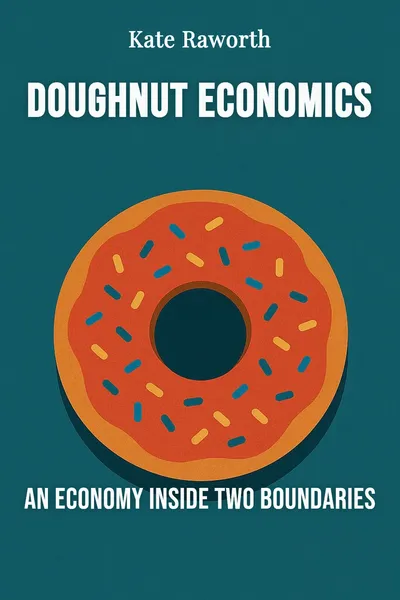
In 2011, an economist named Kate Raworth, then working with Oxfam, sketched a diagram that looked like a doughnut. She was trying to put a single image on a problem that kept coming up in her development work: how do you meet everyone's basic needs without wrecking the planet that supplies them? The picture had two concentric rings. The inner ring marked a floor below which people fall into deprivation — no food, no schooling, no clean water. The outer ring marked a ceiling beyond which we tear holes in the living systems we depend on — a stable climate, healthy soils, a working ozone layer. Between the two, a green band. That band was the doughnut, and it was where a good economy was supposed to live.
The sketch was meant as a quick visual for a report. Instead it travelled. It turned up in UN discussions, in lecture halls, eventually in city halls — Amsterdam adopted it as a planning tool in 2020. Raworth expanded the idea into a 2017 book, Doughnut Economics, and the argument underneath the drawing turned out to be bigger than the drawing. Her real target was not a policy but a habit of mind: the reflex, drilled into a century of students, that a healthy economy is one that grows, and that growth is the goal against which everything else gets measured.
That reflex, Raworth argues, is carried less by arguments than by pictures — the curves and diagrams economics students absorb before they can question them. Her wager is that if we want to think differently about the economy, we have to redraw the images we think with. The doughnut is the first of those images. It is also a provocation aimed straight at the discipline that trained her.
The question we’re asking : If an economy shouldn't be measured by how much it grows, what should it be measured by — and can a doughnut really answer that?What we’ll see : How a drawing became a diagnosis of growth-first economics, and the shift in thinking it asks us to make.
Table of contents
01Chapter 1 — The diagram that started with a shape
Raworth's route into economics was unusual, and it matters for the book. She studied the subject at Oxford in the late 1980s, found it strangely disconnected from the human problems she cared about, and left the discipline for years to work on the ground — on microfinance in Zanzibar, on human development reports at the UN, on Oxfam's research. When she came back to economic ideas, she came back as someone who had watched the standard models fail to describe what she'd actually seen. That distance is the source of the book's confidence.
The doughnut emerged from a specific frustration. In 2009, scientists led by Johan Rockström had published the idea of planetary boundaries — nine biophysical limits, from climate change to freshwater use to biodiversity loss, that humanity crosses at its peril. It was a compelling ceiling. But Raworth noticed it said nothing about a floor. You could stay inside every planetary boundary and still leave millions in hunger. So she drew a second ring inside the first, made of social foundations rather than ecological ones, and the space between them became the goal.

02Chapter 2 — Two rings, one safe space
The strength of the doughnut is that both its rings are furnished with real content, not gestures. The outer ring, the ecological ceiling, borrows the nine planetary boundaries directly. The inner ring, the social foundation, Raworth assembles from the priorities the world's governments themselves signed up to in the Sustainable Development Goals: food, health, education, income and work, water, energy, housing, gender equality, political voice, and more. So the doughnut isn't one person's utopia. It's stitched together from commitments that already exist on paper.
Plotting the world against it produces an uncomfortable image. Humanity is overshooting the ecological ceiling on several fronts — climate, nitrogen and phosphorus loading, biodiversity — while still falling short of the social floor for billions of people. We are, in the diagram's terms, simultaneously outside the doughnut on top and inside the hole at the bottom. The green band, the place we're supposedly aiming for, is where almost no one currently lives. That single picture does more argumentative work than pages of statistics.
03Chapter 3 — Why the graph in the textbook lies
To explain how the growth reflex got so deep, Raworth goes after a specific culprit: the diagrams in the introductory textbooks. Her claim is that economics teaches its worldview visually, and that students absorb the pictures long before they're equipped to interrogate the assumptions baked into them. Redrawing those pictures, she argues, is not decoration — it's how you change what the next generation takes for granted.
Her prime exhibit is the humble supply-and-demand cross and, alongside it, the model of the economy as a self-contained circular flow of money between households and firms. That flow diagram, she notes, floats in a void. It shows no energy coming in from the sun, no materials drawn from the earth, no waste going out. The economy appears as a perpetual-motion machine with no dependence on the living world at all. Generations of students learned to picture the economy exactly this way, and then wondered why the discipline was slow to take ecological limits seriously.
04Chapter 4 — Seven ways to think like a twenty-first-century economist
Step back from the doughnut and the book's real ambition comes into view: it is less a policy proposal than an argument about mental pictures. Raworth's contention is that economics governs us through the images it plants — the flow diagram, the growth curve, rational economic man — and that whoever controls the pictures controls what feels possible. So she organizes the whole book as seven shifts in thinking, seven old images swapped for new ones, and the doughnut is only the first.
The seven run roughly like this. Change the goal, from endless GDP growth to the doughnut's safe and just space. See the big picture, by embedding the economy inside society and the living world instead of floating it in a void. Nurture human nature, by retiring rational economic man for a portrait of people as social and adaptable. Get savvy with systems, trading the tidy supply-demand cross for the messy feedback loops of complex systems, where booms and busts are features, not glitches. And so on toward distribution and regeneration.
05Conclusion
The doughnut began as a sketch for a report and ended as a framework that cities and institutions now use to plan. That journey tells you something about what Raworth was really offering. Not a finished economic system, and not a set of predictions, but a picture clear enough to hold in your head — a floor no one should fall below, a ceiling we can't push past, and the space between them where a good life for everyone becomes possible without costing the earth.
Related books