
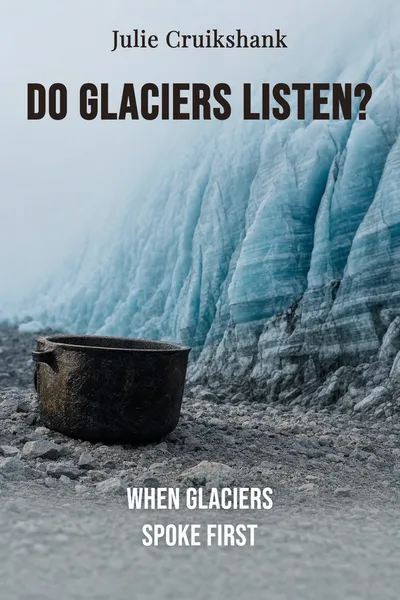
Do Glaciers Listen?
When glaciers spoke first
Description
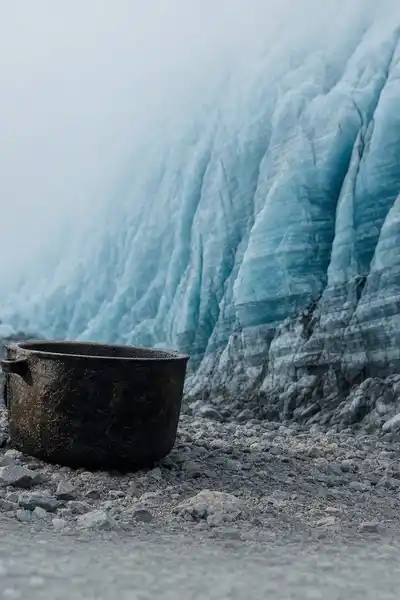
Somewhere in the St. Elias Mountains, along the border between Alaska, the Yukon and British Columbia, ice sits over one of the most seismically restless corners of the continent. For the Athapaskan and Tlingit peoples who have lived in its shadow for generations, this ice is not scenery and not a backdrop. In their oral traditions, glaciers listen. They take offense at boasting, they respond to the smell of cooking grease, they surge and retreat in reaction to how humans behave in their presence. Cook meat carelessly near the ice, the stories warn, and a glacier may answer.
When European explorers and naturalists reached the same valleys in the eighteenth and nineteenth centuries, they saw something else entirely: a natural laboratory. To them the glaciers were objects to be measured, mapped, dated, slotted into a planetary story about climate. Two peoples stood before the same walls of ice and recorded them in two archives that barely acknowledge each other — one written in field notes and survey lines, the other carried in narratives passed between grandmothers and grandchildren. The anthropologist Julie Cruikshank spent decades listening to the second archive, and her book asks what happens when we set it beside the first.
The temptation is to treat the Indigenous accounts as charming metaphor and the scientific ones as literal truth. Cruikshank refuses the shortcut. Both, she argues, are ways of thinking with a landscape that will not hold still, and both were forged in the same volatile centuries when the ice was on the move.
The question we’re asking : What does it mean to say a glacier listens, and what changes when that claim is taken seriously alongside the science of ice?What we’ll see : How two profoundly different traditions came to know the same mountains of ice, and why the encounter between them still matters.
Table of contents
01Chapter 1 — The ice that watches back
In the oral traditions Cruikshank gathered from elders in the southern Yukon and coastal Alaska, glaciers are not inert. They are agents. They watch, they hear, they respond, and they hold grudges. A recurring rule runs through the stories: certain human acts near the ice are dangerous, above all cooking with grease or fat, whose smell provokes the glacier to react. Boasting, arrogance, disrespect toward the land — these too can draw a response, a sudden surge, a splitting sound, a wall of ice advancing where none had been.
This is not a vague animism. The accounts are precise and practical. They encode routes across dangerous terrain, warnings about where ice moves fast, memories of specific events tied to named places and named people. When an elder like Kitty Smith or Angela Sidney told a glacier story, she was doing several things at once: recounting family history, teaching how to travel safely, and asserting a moral relationship between people and a powerful, unpredictable neighbor. The narrative form carried the knowledge that a survey map could not.

02Chapter 2 — Where two archives meet
The European record of these same glaciers begins in the late eighteenth century and accelerates through the nineteenth. Explorers, fur traders, gold seekers and, later, professional naturalists passed through the region, and they wrote things down. Their notebooks describe the ice as spectacle and as data: its extent, its color, its rate of retreat, its place in the emerging science of glaciation. This was the era when European thinkers were assembling the very idea of an ice age, and the St. Elias mountains offered a living specimen.
Cruikshank's move is to read these two bodies of knowledge as neighbors rather than as truth and superstition. The explorers' journals, she shows, are not pure observation. They are shaped by the anxieties, ambitions and blind spots of the men who wrote them, by imperial projects and by the reputations riding on each expedition. And the Indigenous narratives are not pure imagination. They contain detailed, testable information about how the ice actually behaved. The clean opposition between objective science and subjective story dissolves once both are read closely.
03Chapter 3 — When the Little Ice Age arrived
Behind both archives lies a shared physical event. Between roughly the sixteenth and the mid-nineteenth centuries, much of the Northern Hemisphere cooled during the stretch climatologists call the Little Ice Age. In the St. Elias region, glaciers grew and surged, sometimes dramatically, blocking rivers, drowning valleys, and forcing people to change how and where they lived. The generations who produced the oral traditions Cruikshank recorded were living through, or remembering, a landscape of genuinely advancing ice.
This reframes the stories entirely. When a narrative describes a glacier surging across a travel route, or ice damming a river until the lake behind it burst catastrophically, it may be recording an actual event with startling accuracy. Outburst floods from ice-dammed lakes are well documented in the region; the oral accounts of sudden, destructive walls of water track closely with what glaciology now understands about how such floods occur. The stories were reporting the world, not decorating it.
04Chapter 4 — The politics of a listening landscape
Step back from the glaciers, and Cruikshank's book becomes an argument about how knowledge gets sorted into categories of real and unreal. For a long time, the colonial habit was to file Indigenous accounts under myth, folklore, belief — anything but knowledge — while reserving the word knowledge for the written, the measured, the scientific. That sorting was never neutral. It travelled with the survey lines and the treaties, and it helped decide whose claim to the land counted and whose could be set aside as picturesque.
The claim that glaciers listen sits at the center of this, because it is exactly the kind of statement the colonial frame is quickest to dismiss. Cruikshank neither ridicules it nor sentimentalizes it into a wisdom the modern world has lost. She takes it as a serious proposition about the relationship between human conduct and a responsive environment, and she asks what it would mean to hold it alongside glaciology without forcing either to surrender. The two do not merge into a single richer truth. They stay in tension, and the tension is where the honesty lives.
05Conclusion
Return to the rule that opens so many of the stories: do not cook grease near the ice, do not boast, do not treat the glacier as if it cannot hear you. Read as folklore, it is a quaint prohibition. Read as Cruikshank reads it — against the explorers' journals, against the record of the Little Ice Age, against the seismic violence of the St. Elias ranges — it becomes something else: a distilled instruction for living beside a neighbor that is powerful, unpredictable, and paying attention. The stories were never only about the past. They were about how to act.