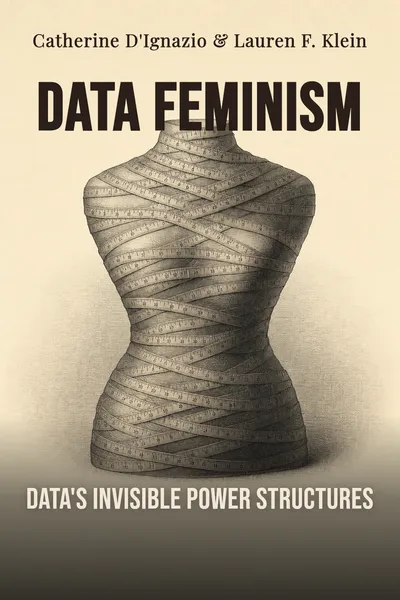
Data Feminism
Data's invisible power structures
Description
In 2016, two researchers — Catherine D'Ignazio, who works at the intersection of data and design, and Lauren Klein, a scholar of digital humanities — started writing a book together. It came out in 2020 from MIT Press under a title that reads almost like a provocation: Data Feminism. The pairing sounds odd at first. Data science is supposed to be the cool, rational corner of the modern world — spreadsheets, models, dashboards, the stuff that settles arguments. Feminism is supposed to be about politics and power. Putting the two words side by side is the whole argument in miniature. It says: the numbers were political all along.
Their starting point is a claim that sounds abstract but lands hard once you sit with it. Data is never raw. Somebody decides what gets counted and what doesn't, which categories exist and which are left off the form, whose experience becomes a data point and whose stays invisible. Those decisions are made by particular people, in particular institutions, carrying particular assumptions. And because the people building the big datasets and the big models have, historically, skewed toward one narrow slice of humanity, the tools that claim to describe everyone quietly encode the worldview of a few.
D'Ignazio and Klein don't want to burn data science down. They want to reclaim it. The book takes the intellectual toolkit of feminist thought — especially the idea that knowledge always comes from a particular position — and turns it into a practical set of principles for anyone who collects, cleans, analyzes, or visualizes numbers. It's a book about power written for people who make charts.
The question we’re asking : If data always carries the fingerprints of the people who made it, whose interests does it usually serve, and can it be built to serve anyone else?What we’ll see : How two researchers borrow feminist thinking to expose the power buried inside data science — and rebuild it as something more accountable.
Table of contents
01 Chapter 1 — The numbers were never neutral
The founding move of Data Feminism is to reject a story that data science tells about itself: that numbers are objective, that models are neutral, that a well-built algorithm simply reports the world as it is. D'Ignazio and Klein call this the myth of the view from nowhere — the fantasy that data can be produced without a point of view. Every dataset, they argue, comes from somewhere. It reflects who had the resources to collect it, what they thought worth measuring, and what they never thought to ask.
The examples they gather make the point concrete. Crash-test dummies were, for decades, modeled on the average male body, so cars were engineered to protect men — and women turned out to be significantly more likely to be seriously injured in comparable collisions. Medical research long treated the male body as the default, leaving whole categories of symptoms understudied. These aren't glitches in otherwise fair systems. They're the predictable result of who was in the room when the questions got framed.

02 Chapter 2 — Who counts, and who does the counting
Once you accept that data carries a point of view, a harder question follows: who gets to be counted at all? The book keeps returning to what it calls missing data — the gaps where a phenomenon exists but no one has bothered, or dared, to measure it. These absences aren't random. Things go uncounted when the people they affect have little power, or when counting them would embarrass someone who does.
One of the book's recurring examples is femicide — the killing of women because they are women. For years, many governments simply did not track it as a distinct category, which meant that, statistically, the problem barely existed. D'Ignazio and Klein highlight the Mexican activist and geographer María Salguero, who built a painstaking map of femicides across Mexico largely by hand, scraping news reports the state had never bothered to compile. Where the official record was silent, she manufactured the data herself — an act the authors read as counter-data, information gathered by the affected against the institutions that ignored them.
03 Chapter 3 — The body that data forgot
A striking thread in the book is its insistence that data work has a body and a feeling, even though the field pretends it doesn't. The reigning ideal of the dispassionate analyst — cool, detached, above the fray — is, they argue, another version of the view from nowhere, just applied to the person instead of the dataset. Emotion gets coded as bias, something to be scrubbed out. But that scrubbing is itself a choice about whose experience counts as legitimate knowledge.
They make the case most vividly around data visualization. The convention is that a good chart is clean, minimal, stripped of anything that might sway the reader — as if a bar chart of eviction rates or overdose deaths were the same kind of object as a chart of quarterly widget sales. D'Ignazio and Klein argue that this false neutrality can flatten human suffering into a tidy grid, and that reintroducing context, texture, and even emotion can make a visualization more truthful, not less. A chart that helps you feel the weight of what it shows may be doing better science than one that hides it.
04 Chapter 4 — When data pushes back
Step back from the individual cases and a larger ambition comes into view. Data Feminism is not, in the end, a takedown of data science. It's an attempt to reimagine what the field could be if it started from a different question. Instead of asking is this model accurate, the book asks who has power here, and does this shift it or entrench it. That single reframing changes everything downstream — what you collect, how you label it, who you build it with, and who gets to say when it's wrong.
The hopeful half of the argument is that the same tools used to sort, score, and surveil can be turned around. The femicide maps, the community-gathered environmental data, the projects where affected people help design the categories that describe them — these are examples of data serving the people it usually measures rather than the institutions measuring them. The authors call for building with, not for: co-creating datasets and analyses alongside the communities involved, treating them as experts on their own lives rather than as raw material.
05 Conclusion
D'Ignazio and Klein set out to put two words next to each other that most people would keep apart, and the book is really an extended defense of why they belong
Related books