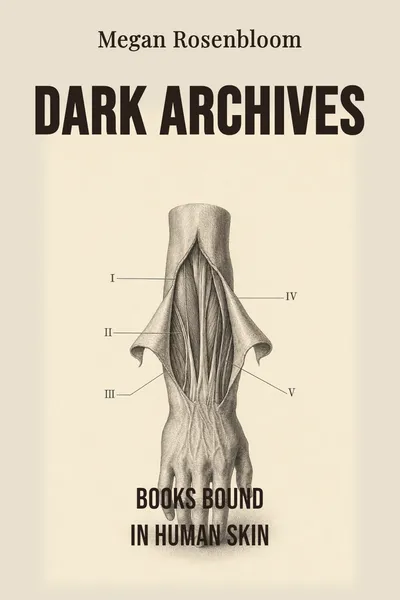
Dark Archives
Books bound in human skin
Description
Somewhere in a rare-book room, a librarian pulls on a pair of gloves and lifts a small nineteenth-century volume from a padded tray. The binding is soft, slightly waxy, the color of old parchment gone amber. A note tucked inside, or an inscription on the flyleaf, makes a claim that most people would rather not read twice: this book is bound in human skin. For centuries these objects have drifted through collections with a whisper attached, half legend, half warning. Curators knew about them, sometimes hid them, sometimes bragged quietly. Almost no one had ever checked whether the whisper was true.
Megan Rosenbloom is a medical librarian, and she spent years chasing exactly these volumes. The practice even has a name — anthropodermic bibliopegy, the binding of a book in human skin — and it turns out to sit at a strange intersection of medicine, craftsmanship, and death. Most of the supposed examples in the world are rumors. Some are hoaxes, some are pigskin, some are the invention of a bookseller who wanted a better story. But a stubborn handful, once tested, come back genuine. And the ones that are real were, more often than not, made by respectable physicians using the bodies of their own patients.
That fact reframes the whole subject. These are not trophies from a horror film. They were produced inside the ordinary machinery of medicine, at a time when a doctor's access to a corpse came with almost no strings attached. Rosenbloom's investigation is partly forensic and partly historical, and it keeps circling back to a discomfort that has nothing to do with ghost stories.
The question we’re asking : When a book is bound in a person's skin, whose skin was it — and did anyone ever ask?What we’ll see : How a medical librarian tracked these volumes down, tested them, and traced them back to the world that made them ordinary.
Table of contents
01Chapter 1 — The librarian and the rumor
Rosenbloom did not go looking for a career in the macabre. She came to it sideways, as a medical librarian drawn to the odder corners of medical history, and fell in with a loose group of like-minded people who collected and studied the material culture of death — anatomists, conservators, a pathologist or two. What united them was a refusal to flinch. Where most institutions treated a skin-bound book as an embarrassment to be locked away, this circle treated it as evidence worth examining.
The problem was that the field had no facts, only stories. A library would hold a volume with a confident label, and the label rested on nothing more than an old inscription or a dealer's word. Some of the most famous claimed examples were tied to lurid tales: a book supposedly bound in the skin of an executed murderer, a confession said to be wrapped in the confessor's own hide. These narratives were repeated for so long that they hardened into fact, even though no one had lifted a finger to confirm them.

02Chapter 2 — A test that ends the guessing
The breakthrough came from chemistry rather than history. A technique called peptide mass fingerprinting — borrowed from the tools conservators use to identify parchment — can read the protein signature of a tiny sample and say what animal it came from. Cow, sheep, goat, pig all leave distinct traces. And so does a human. Crucially, the test needs only a speck of material scraped from an unobtrusive edge, which makes it viable on a precious binding that no institution wants to damage.
Rosenbloom and her collaborators began working through the claimed examples one by one, and the results reorganized the entire field. A large share of the alleged human-skin books turned out to be leather from familiar farm animals. The dramatic provenance evaporated on contact with the data. It was the kind of finding that a purist might find deflating, but it did something valuable: it cleared away the noise and left a small, verified set of objects that could finally be discussed honestly.
03Chapter 3 — Made in the doctor's office
The confirmed books share a striking common thread: most of them were made by physicians, in the nineteenth century, often from the bodies of patients who had died in their care. This is the detail that unsettles more than any executioner's tale. The people binding books in human skin were not deranged outsiders. They were educated men of medicine, and they were doing it more or less openly, as a curiosity a colleague might admire.
The setting explains a great deal. In that era, a doctor's access to the dead was nearly total, and the poor who died in hospitals or almshouses had no advocate to object to what was done with their remains. Dissection, display, and keepsakes existed on a continuum, and a strip of skin turned into a book cover was, to that mindset, simply an extension of the anatomist's ordinary work. One famous confirmed example is a treatise on the female body — a physician bound it in the skin of a woman who had died in his hospital, an irony the maker seems not to have registered.
04Chapter 4 — The body as property
Strip away the shock, and the skin-bound book poses a question medicine has never comfortably answered: who owns a body once its owner is gone, and who gets to decide what is done with it. The physicians who made these volumes assumed the answer was obvious — the body belonged to whoever held it. That assumption did not vanish with the nineteenth century. It merely became less visible, folded into the routines of hospitals, teaching schools, and research.
Rosenbloom is careful not to treat this as a settled scandal of the past. The history of medicine is full of bodies used without consent, from anatomy specimens to tissue samples that ended up fueling entire industries. The skin-bound book is an unusually literal version of a pattern that runs quietly through the whole enterprise: the assumption that the dead, especially the poor and the marginalized dead, are available. What makes these objects useful is precisely that they make the pattern impossible to overlook. We cannot rationalize a book cover the way we can rationalize a specimen jar.
05Conclusion
The librarian who lifted that small amber volume from its tray was doing something the practice's makers never imagined: asking whose skin it was, and whether that person had any say. For most of these books' lives, the question had no way of being answered, so it was not asked. The rumor was enough — thrilling for the collector, convenient for the institution that preferred not to know. Rosenbloom's work replaced the whisper with a fact, and a fact turns out to be much harder to shelve.
Related books