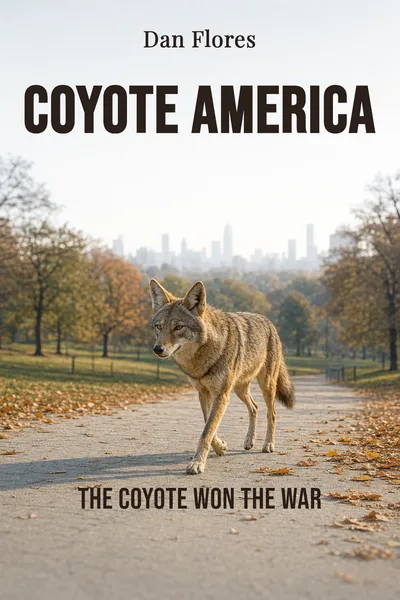
Coyote America
The coyote won the war
Description
For most of the twentieth century, the United States government ran what may be the longest sustained extermination campaign ever aimed at a single wild animal. Not the wolf, which was gone from most of the country by the 1930s. Not the grizzly, which retreated into a few mountain pockets and stayed there. The target was the coyote, and the war on it involved strychnine, cyanide guns, aerial gunning from light planes, government trappers on federal payroll, and at one point a deliberate attempt to spread mange through captured animals released back into the wild. By the most sober estimates, tens of millions of coyotes were killed over the century.
And the coyote answered by spreading. In 1900 it was an animal of the western plains and deserts, a creature most Americans east of the Mississippi had never seen. Today coyotes live in every state but Hawaii, in the swamps of Louisiana and the suburbs of Chicago, in Central Park and on the beaches of Cape Cod. The harder we hunted them, the wider they ranged. Something in the biology of the animal turned persecution into fuel, and the more we tried to erase it, the more of the continent it took. This is the story Dan Flores tells in Coyote America.
It is a strange kind of history — part natural science, part cultural reckoning, part the biography of a creature that has been on this continent far longer than we have. The coyote outlasted mammoths and dire wolves. It shrugged off a federal budget line dedicated to its death. And it did so while we told ourselves stories about it, from Old Man Coyote of the plains tribes to the cartoon that never catches the roadrunner. The animal and the story have never quite matched.
The question we’re asking : How did the most relentlessly hunted animal in American history end up winning the continent?What we’ll see : A five-million-year life of an animal we tried to erase, and what the trying reveals about us.
Table of contents
01Chapter 1 — A war declared on a single species
The campaign was not metaphorical. In 1931 Congress passed the Animal Damage Control Act, formalizing a federal program whose explicit purpose was the eradication of predators from American rangeland, and the coyote sat at the top of the target list. The agency that ran it went through several names over the decades, but the mission held steady: paid government hunters, bounties, and above all poison, distributed across the West on a scale that is hard to picture now. The tool of choice for much of the century was strychnine, later joined by thallium and the compound known as 1080, sodium fluoroacetate, which one wildlife biologist called the most lethal poison ever deployed against wildlife.
The methods escalated as the animal refused to cooperate. When ground poisoning plateaued, hunters took to the air, gunning coyotes from low-flying planes across the open country of Wyoming and Nevada. The government experimented with the coyote-getter, a spring-loaded device that fired cyanide into the mouth of any animal that tugged at a scented bait. Flores describes attempts, some of them serious, to introduce disease into wild populations deliberately — to weaponize sarcoptic mange and turn the animal's own body against it. The numbers killed ran into the millions per decade at the program's height.

02Chapter 2 — The oldest American, older than the wolf
The coyote is a genuinely North American animal in a way almost nothing else on the continent is. Its lineage, Flores explains, traces back roughly five million years to a small canid the fossil record calls Eucyon, which gave rise to the dogs of the New World while its relatives crossed into Asia and became the ancestors of wolves and, eventually, our domestic dogs. When those larger canids came back across the land bridge, they returned as competitors. The coyote had never left. It had been here the whole time, evolving in place, watching the megafauna come and go.
And go they did. The end of the last ice age wiped out the dire wolf, the American cheetah, the giant short-faced bear, an entire cast of Pleistocene predators the coyote had lived alongside. The coyote survived them all, and Flores argues this was not luck but design. It is a middle-sized generalist, able to hunt alone or in a pack, to eat rodents or fruit or carrion or grasshoppers, to live in a desert or a forest or, as we now know, a golf course. Specialists die when the world changes. The coyote is built for a changing world.
03Chapter 3 — The strychnine years and what they got wrong
The deepest irony of the extermination campaign is that it helped clear the way for the very expansion it was meant to prevent. The animal that had kept the coyote in check across most of the continent was the wolf, a larger canid that killed coyotes and dominated the same ground. When the federal predator programs succeeded in wiping out the wolf — and they did succeed, comprehensively, by the 1930s — they removed the coyote's only serious rival. Into the empty space, the coyote poured. The war on predators killed the one predator that had been holding coyotes back.
Then there was the biology of the killing itself. Coyotes have an unusual reproductive response to pressure on their numbers, a mechanism Flores describes with some wonder. In a stable, unhunted population, social structure suppresses breeding; only the dominant pair reproduces, and litters stay modest. But when a population is heavily culled, the survivors respond by breeding earlier, producing larger litters, and more females conceive. The pups survive at higher rates because there is less competition for food. Kill a lot of coyotes and the population, within a couple of seasons, rebounds past where it started. The poison campaign was, in effect, a fertility program.
04Chapter 4 — The animal that fission taught us nothing about ourselves
Step back from the coyote and the war on it starts to look less like a story about an animal and more like a story about a habit of mind. The predator programs rested on a simple sorting: some creatures are useful and some are vermin, some belong and some must be removed, and a rational nation manages the land by clearing out the second category to make room for the first. The coyote was filed under vermin and sentenced accordingly. What Flores traces is how badly that entire way of thinking mapped onto reality — how the sorting itself, not the animal, was the thing that failed.
The failure was expensive and it was long. Generations of Americans grew up believing the coyote was a problem being solved, when in fact it was thriving on the solution. The gap between the story we told — of vermin in retreat, of a managed and orderly landscape — and the animal actually spreading beneath that story is the real subject of the book. We narrated a victory while losing, and the coyote never once read the script we wrote for it, from Old Man Coyote to Wile E. Coyote, the cartoon eternally outsmarted by his prey. The joke, it turns out, was on the hunter.
05Conclusion
The bait stations are mostly gone now, the aerial gunning curtailed, the bounties a memory in most states. What remains is the animal, in more places than it has occupied at any point in its five-million-year existence. The coyote that Americans in 1900 could only find on the western plains now trots through Manhattan and dens under suburban decks in forty-nine states. It absorbed strychnine, cyanide, aircraft, and engineered disease, and it answered every campaign by breeding faster and ranging farther. In the war between humans and coyotes, there is no honest way to score it except as a rout, with the coyote on top.
Related books