Computer Lib
Why computers need no gatekeepers
Description
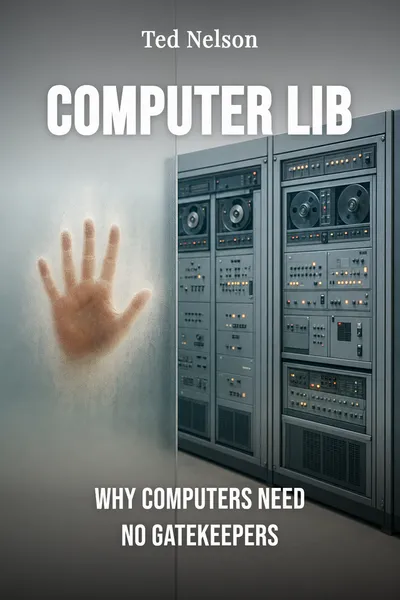
In 1974, a self-published paperback appeared with an oversized format, hand-drawn diagrams, blocks of text set at odd angles, and a raised fist on the cover. The author was Ted Nelson, a man who had coined the word "hypertext" a decade earlier and had never held a conventional programming job. The book had no publisher behind it — Nelson printed it himself, at his own expense, because the publishing world had no shelf for what he was doing. It was, on the surface, a book about computers. Underneath, it was a book against the people who owned them.
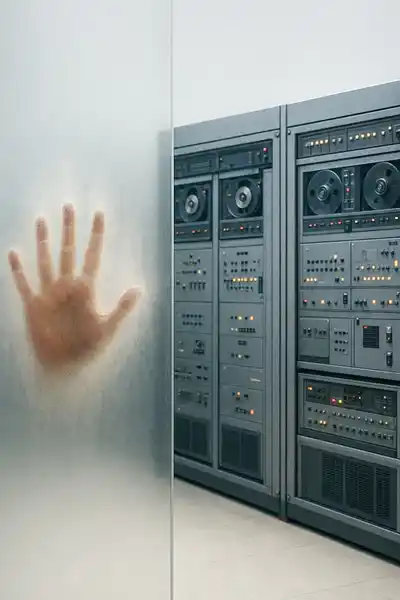
At the time, a computer was a room. It belonged to a corporation, a university, or a government, and access to it ran through a priesthood of specialists who spoke a language ordinary people were told they could not learn. IBM was the giant in that room, and "the computer" in most minds meant something vast, expensive, humming behind glass, tended by men in white coats. Nelson looked at all of this and decided the mystique was a con. Not an accident of complexity — a con, maintained on purpose, and worth taking apart page by page.
He gave the con a name and declared war on it. He wrote that anyone could grasp what these machines actually did, that the difficulty was manufactured, and that the machine most people had never touched was about to become the most personal thing they owned. He was writing before the personal computer existed. That is the strange position the book occupies — a manifesto for a world that hadn't shown up yet.
The question we’re asking : What was Ted Nelson actually rebelling against when he told ordinary people they could — and must — understand computers?What we’ll see : A homemade manifesto, the lies it set out to demolish, and the medium it saw coming before anyone had one on a desk.
Table of contents
01Chapter 1 — A double book, printed back to back
The physical object was as unruly as its argument. Computer Lib was really two books bound together, printed so that one ran from the front and the other, flipped upside down, ran from the back. Reach the middle of one and you hit the inverted last page of the other. The front half carried the title Computer Lib. The back half was called Dream Machines. Nelson meant the two as halves of a single idea: the first about liberation, the second about what liberation was for.
There was no house style holding it together, because there was no house. Nelson laid it out himself in an era before desktop publishing, cutting and pasting text, scrawling cartoons in the margins, running headlines in whatever direction the page seemed to want. The effect was closer to an underground newspaper than a computing text, and that was the point. A tidy book from a real publisher would have carried the very authority Nelson was trying to strip away. The mess was a statement: this knowledge does not belong to institutions, so it need not look like it came from one.

02Chapter 2 — Down with cybercrud
The rallying cry of the book was a word Nelson invented for the occasion: cybercrud. He defined it, roughly, as putting people down with computers — the whole apparatus of intimidation, jargon, and quiet dishonesty that kept non-specialists from understanding what was actually going on. "Down with cybercrud" ran through the pages like a chant. It was not aimed at the machines. It was aimed at the people standing between the machines and everybody else.
What made the charge sharp was that Nelson thought the fog was deliberate. He was not simply saying computers were hard and people were lazy. He argued that computer people told untruths to non-computer people, on purpose, because mystery was profitable and power. If you could convince a manager, a customer, or a citizen that only a trained caste could comprehend the machine, you controlled access to it — and you could hide behind "the computer won't let us do that" whenever it suited you. The phrase, still with us, was cybercrud in its purest form.
03Chapter 3 — You can and must understand computers
The famous line on the cover was blunt: "You can and must understand computers now." The "can" was the encouragement. The "must" was the argument. Nelson believed that as these machines spread, understanding them would stop being a hobbyist's luxury and become a condition of being a full participant in the world — and that leaving the understanding to specialists was a way of handing them your affairs.
But he was careful about what he meant by understanding, and here he broke with what was being sold as computer literacy. To Nelson, learning which buttons to press on a particular machine, or memorizing the quirks of one program, was a shallow familiarity that left you dependent — the moment the hardware changed, your competence evaporated, and you were back to asking permission. Real understanding meant grasping the underlying ideas: how information could be represented, stored, and manipulated, what a program actually was, why the machine did what it did rather than merely how to make it do it. That kind of knowledge transferred. It couldn't be taken away by a software update.
04Chapter 4 — Dream Machines and the medium that hadn't arrived yet
Flip the book over and the second half, Dream Machines, answered a question the first half had only implied: liberation for what? Nelson's answer was that the computer was not, at heart, a calculator. It was a medium — as expressive and as personal as paper, film, or the written word, and far more flexible than any of them. That framing was startling in 1974, when nearly everyone, including most of the professionals, still saw the machine as a device for crunching numbers and processing business records.
What Nelson described was a screen you could write on, draw with, and read through — where text need not sit in fixed lines on a fixed page but could branch, link, and rearrange itself at the reader's command. This was the hypertext he had been imagining since the 1960s, the idea that documents could connect to one another so that reading became a path you chose rather than a track you were placed on. He sketched interactive media, responsive images, writing that behaved less like ink and more like something alive. He was describing, in outline, experiences that would not become ordinary for another twenty years.
05Conclusion
Nelson never got the exact world he drew. His own grand project, Xanadu — a universal, linked library of everything ever written — spent decades unfinished and was overtaken by cruder systems he found disappointing. The web that arrived borrowed his word, hypertext, and little of his precision. The personal computer he predicted came, but wrapped in new corporations and new priesthoods, new versions of the very cybercrud he had named. In that sense the fist on the cover is still raised, because the fight it declared never fully ended.
Related books