Changes in the Land
How colonists remade New England
Description
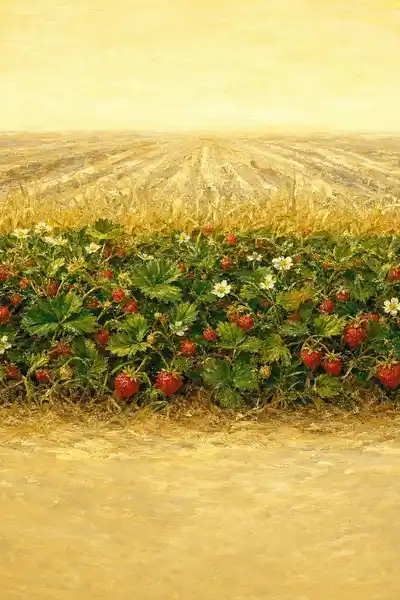
In the summer of 1633, a colonist named William Wood walked the coast of Massachusetts and wrote down what he saw. The woods were open enough to ride a horse through at a gallop. Wild strawberries reddened whole meadows. The rivers ran thick with salmon, sturgeon and alewives, the flocks of passenger pigeons darkened the sky for hours. Wood described a country of astonishing abundance, and he meant it as an advertisement — proof that New England was a land where an Englishman could grow rich. What he did not know was that much of what he admired was not wilderness at all. It was a landscape that people had been shaping, deliberately, for thousands of years.
A little over a century later, that country looked different. The forests had thinned and retreated, the soil in many places had worn out, the beaver were gone from whole watersheds, and the deer, turkey and salmon Wood had counted on were becoming scarce. The change was fast, and it was not an accident of weather or disease alone. Something in the way the newcomers held the land — the way they fenced it, bought it, sold it, grazed it and cut it — had reorganized the living system itself. New England's ecology had been rewritten to match a new idea of what land was for.
William Cronon set out to explain that rewriting. His book treats the forest, the soil and the animals not as a backdrop to colonial history but as its evidence, and it asks a question historians rarely put so plainly: what happens to an ecosystem when one culture's sense of property replaces another's?
The question we’re asking : Why did New England's landscape change so drastically in the first century of English settlement, and what does that change reveal about the two peoples who lived on it?What we’ll see : How a settled way of reading the land as a tradeable good remade the forests, soils and animals of a whole region — and left a bill nobody had thought to add up.
Table of contents
01Chapter 1 — Two ways to hold a forest
Cronon's starting move is to refuse the tidy story the colonists told about themselves — that they had arrived in an empty, untouched wilderness and made it productive. The land was neither empty nor untouched. It carried a resident population that had lived on it for millennia, and it carried the marks of their living. But the deeper point is that the two peoples who met in New England did not simply want different things from the land. They held it in fundamentally different ways, and those ways were rooted in two different economies.
The native peoples of southern New England were mobile within a territory. They moved with the seasons — to the coast for fish and shellfish in spring, inland for planting in summer, to the uplands for hunting in fall and winter. What they owned was not the ground itself but the right to use it in a particular way at a particular time: the right to plant this field, to set weirs in that river, to hunt in this stretch of woods. Rights overlapped, shifted, and were tied to use. Leave a place, and your claim to it faded.

02Chapter 2 — The Indians who managed the woods
The open forests William Wood galloped through were not a gift of nature. They were, in large part, a human artifact. The native peoples burned the underbrush regularly, once or twice a year, clearing the forest floor to make travel easy, to improve hunting sightlines, and to encourage the grasses and berries that drew deer and other game. The burning kept the woods park-like and the edges rich. What the colonists read as the bounty of an untamed Eden was, Cronon shows, the product of careful management by people who understood their ecosystem intimately.
That management was tuned to a way of life that took what it needed and moved on. Because native communities shifted with the seasons, no single place was pressed too hard for too long. Fields were planted, exhausted, and abandoned to grow back into forest. Villages relocated. The demands on any one patch of ground stayed within what that ground could regenerate. This was not conservation in the modern sense — it was not a philosophy of restraint — but the effect was a landscape that could renew itself indefinitely.
03Chapter 3 — When land became a commodity
The decisive change, in Cronon's account, was the arrival of an economy in which land and its products could be turned into money. The English did not just want food and shelter from New England; they wanted goods they could sell into a transatlantic market. And once a forest, a beaver pond or a stretch of pasture could be converted into cash, the logic that had held native harvesting in check simply dissolved. There was now a reason to take everything.
The beaver went first. Native trappers, drawn into the fur trade, hunted the animal far beyond what their own needs would ever have required, because European traders offered goods in exchange for as many pelts as could be gathered. Within decades the beaver were trapped out across much of the region. Their disappearance was not trivial: beaver dams had created wetlands, ponds and meadows across the whole landscape. When the beaver vanished, the dams failed, the ponds drained, and the hydrology of entire watersheds shifted.
04Chapter 4 — The ledger nobody was keeping
What makes Cronon's book more than a catalogue of ecological damage is the method behind it. He reads the changed landscape as a document — a physical record of the economic assumptions the colonists carried in their heads. The thinned forests, the drained beaver meadows, the eroded hillsides are not just consequences of settlement; they are the settlers' worldview made visible in the soil. To understand why the land changed, we have to understand what the people who changed it believed land was.
This is the quiet radicalism of the argument. Environmental history is usually told as nature acting on people — droughts, storms, epidemics. Cronon insists the traffic runs both ways, and that the more powerful current, in this case, ran from culture into ecology. A market economy is not only a way of organizing exchange between people. It is a way of organizing the relationship between people and the natural world, and it leaves marks that outlast any deed or ledger.
05Conclusion
William Wood's country of open woods and darkened skies did not vanish because the newcomers hated it. It vanished because they held it differently — as a thing to be owned, improved and sold — and a landscape held that way behaves accordingly. The salmon, the beaver, the deep soil and the standing forests were spent within a few generations, converted into farms, cargoes and money that traveled back across the Atlantic. The abundance Wood advertised had been a relationship between a people and a place, and when the people changed, the relationship broke.
Related books